Last week I was doing research to prep for a call with a lead, and their company page on LinkedIn was boring AF. Perfectly written posts, branded images, content with all the warmth of a tax form.
Then I looked at a post from one of their business developers. A few hundred followers, crappy writing, no image. It pulled more engagement than the last ten posts on the company page combined.
That gap, between what the logo gets and what a person gets, is the entire business case for employee advocacy. And the fact that most companies respond to it by turning their people into extra logos is the entire reason their programs fail.
In this article
- What is employee advocacy, in simple words
- Why companies suddenly care
- Why most advocacy programs fail anyway
- What real advocacy looks like: the VIBE framework
- Employee advocacy vs employer branding
- Employee advocacy vs influencer marketing
- What counts as employee advocacy content
- If your program already failed once
- Questions I get about employee advocacy
What is employee advocacy, in simple words
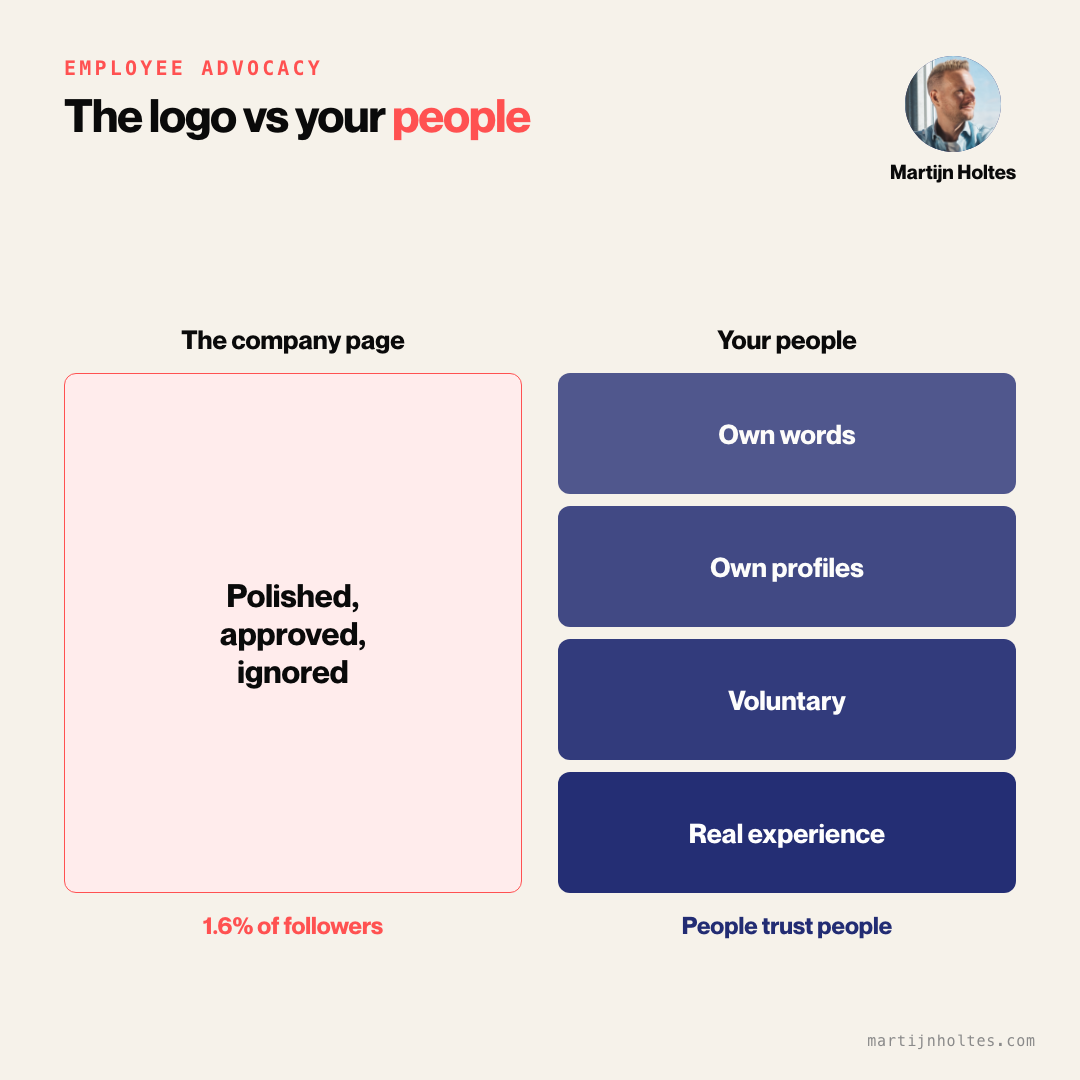
Employee advocacy is your people sharing what they know and do, on their own profiles, in their own words, voluntarily.
That’s it.
A consultant posting what she learned on a project.
A developer commenting on an industry discussion.
A sales lead sharing his take on where the market is going.
The company becomes visible through its people instead of through the logo, and because people trust people, that visibility works.
Every word in the definition is important.
Their own words, because a reposted press release isn’t advocacy, it’s distribution.
Voluntarily, because the moment sharing becomes an obligation, the audience can tell, and the whole effect dies. Their own profiles, because the trust that makes this work belongs to the person, not the brand, and it only transfers while the person stays credible.
You’ll meet the same idea under different names, depending on who’s talking.
HR says employee advocacy and means proud employees strengthening the employer brand.
Marketing says it and means reach and pipeline.
Why companies started to care
Because the alternative collapsed. Ordinal’s tracking now puts page posts at 1.6% of followers, down from around 7% in 2021. If your company page has 10,000 followers, your average post reaches a decent wedding reception.
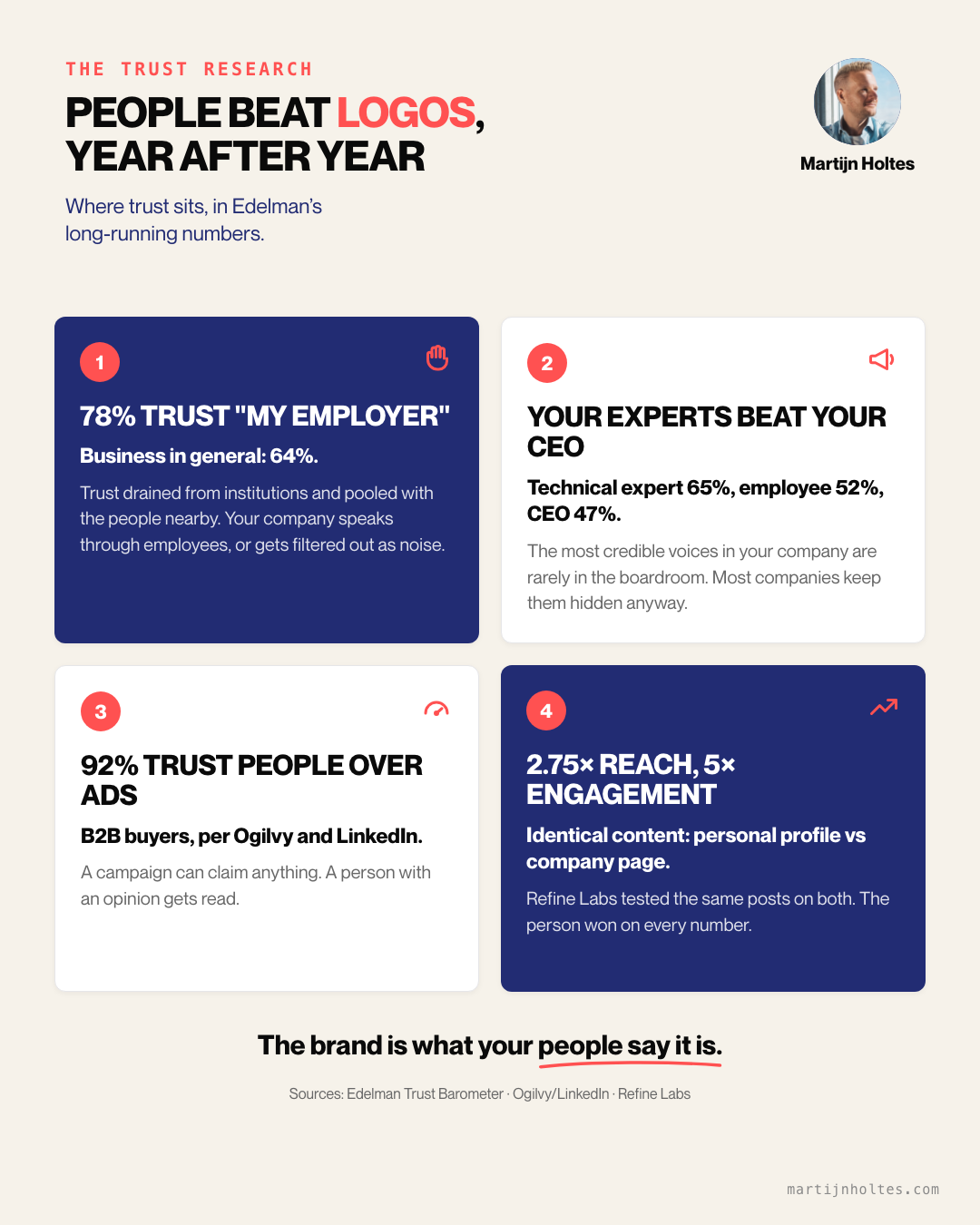
People are a different story. Refine Labs tested identical content and found personal profiles pull 2.75x the impressions and five times the engagement of company pages.
Other research puts employee posts at roughly eight times the engagement of the same message on a corporate channel, and your employees together have a network roughly ten times the size of your company account.
Even your company page itself depends on them. The Algorithm Report 2026 by Richard van der Blom found 42% of all engagement on company pages comes from employees.
And then there is trust, which is moving away from institutions and toward the people nearby.
The Edelman Trust Barometer sees Business in general at 64%, government lower, media lower still, and “my employer” on top at 78%.
Ask people which spokespersons they believe, and the pattern is the same. A technical expert scores around 65%, a regular employee 52%, a CEO 47%. Ogilvy and LinkedIn put 92% of B2B buyers on the side of people over ads.
For completeness: salespeople score 9%. (Sorry, sales friends.)
Your clients, your applicants, your leads, they don’t care about your legal-approved, polished content.
They scroll straight past the corporate stuff. What they want to know is whether the people building this company actually stand for anything.
The brand isn’t what the company says it is. It’s what your people say it is.
And audiences will hear it from your people or not at all.
Why most advocacy programs fail anyway
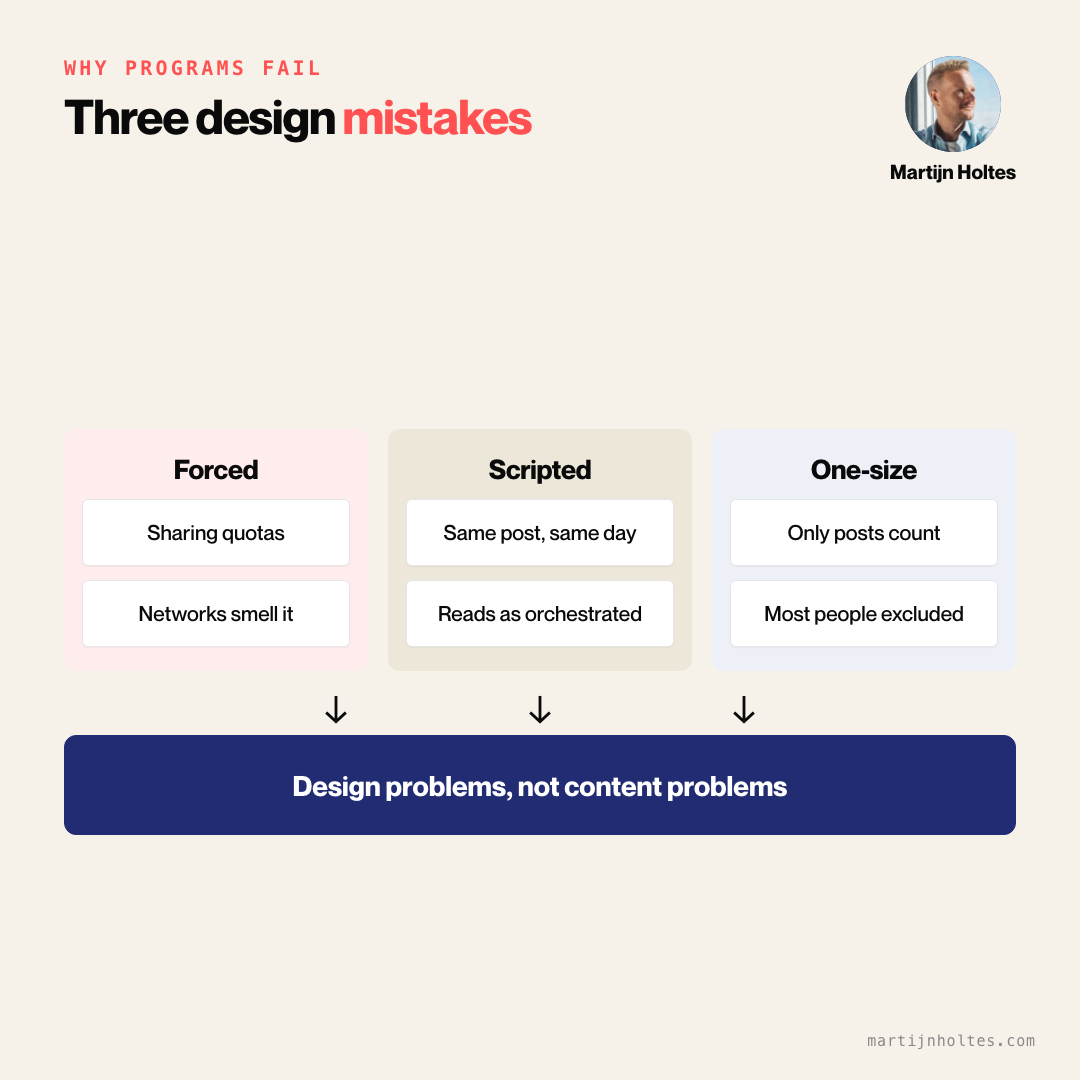
With numbers like that, advocacy should be unmissable. And still, most programs work like this: the company writes the post, the employee clicks share, nobody engages. After 16 years around these programs, the same three design mistakes keep coming up.
They force participation. Sharing quotas, mandatory posts, participation linked to performance reviews. People share to tick the box, but the reader can smell a corporate-approved post from a mile away, and forced advocacy does more damage than posting nothing at all. Now the market can see your people don’t mean it.
They hand out scripts. Thirty people posting the same approved text on the same day doesn’t say “great culture.” It says “orchestrated,” because it is. The whole point of advocacy is that the person in finance and the person in sales see the world differently. A script deletes the only thing that made it worth doing.
They treat everyone the same. Most programs count exactly one behaviour as participation: publishing posts. So the two extroverts who love writing get celebrated, while the colleagues who comment, share and open doors, the people responsible for most of the reach, are told their contribution doesn’t count.
Then someone has to explain to the board why “employees don’t participate.” They participated but they did not act.
The brand is what your people say it is.
I help companies build advocacy people join voluntarily, with VIBE as the backbone. 950+ companies and 250,000+ professionals since 2011.
See how I build programsLast year I had a call with a lead that had a full program.
Executive backing, real budget, a library of 200 pre-approved posts, an analytics dashboard, a leaderboard handing out quarterly prizes.
Six months later, participation sat at 4%.
Everything was in place except a reason for employees to believe this was for them.
When people don’t believe posting helps their own careers, no amount of infrastructure changes their behaviour.
They look at the content library and see corporate messaging dressed up as personal posts, and they’re right.
It all comes down to control. I understand where it comes from: there’s a real fear that someone will post something wrong, and in regulated industries that fear has legal teeth.
So companies build guardrails, and the guardrails become scripts, and the scripts become approval workflows, and somewhere in that chain the “advocate” becomes a puppet.
The more you control what people say, the less anyone trusts what they’re saying.
You end up telling people to be authentic on LinkedIn and, in the same breath, to run every post past their manager before it goes out.
What true advocacy looks like
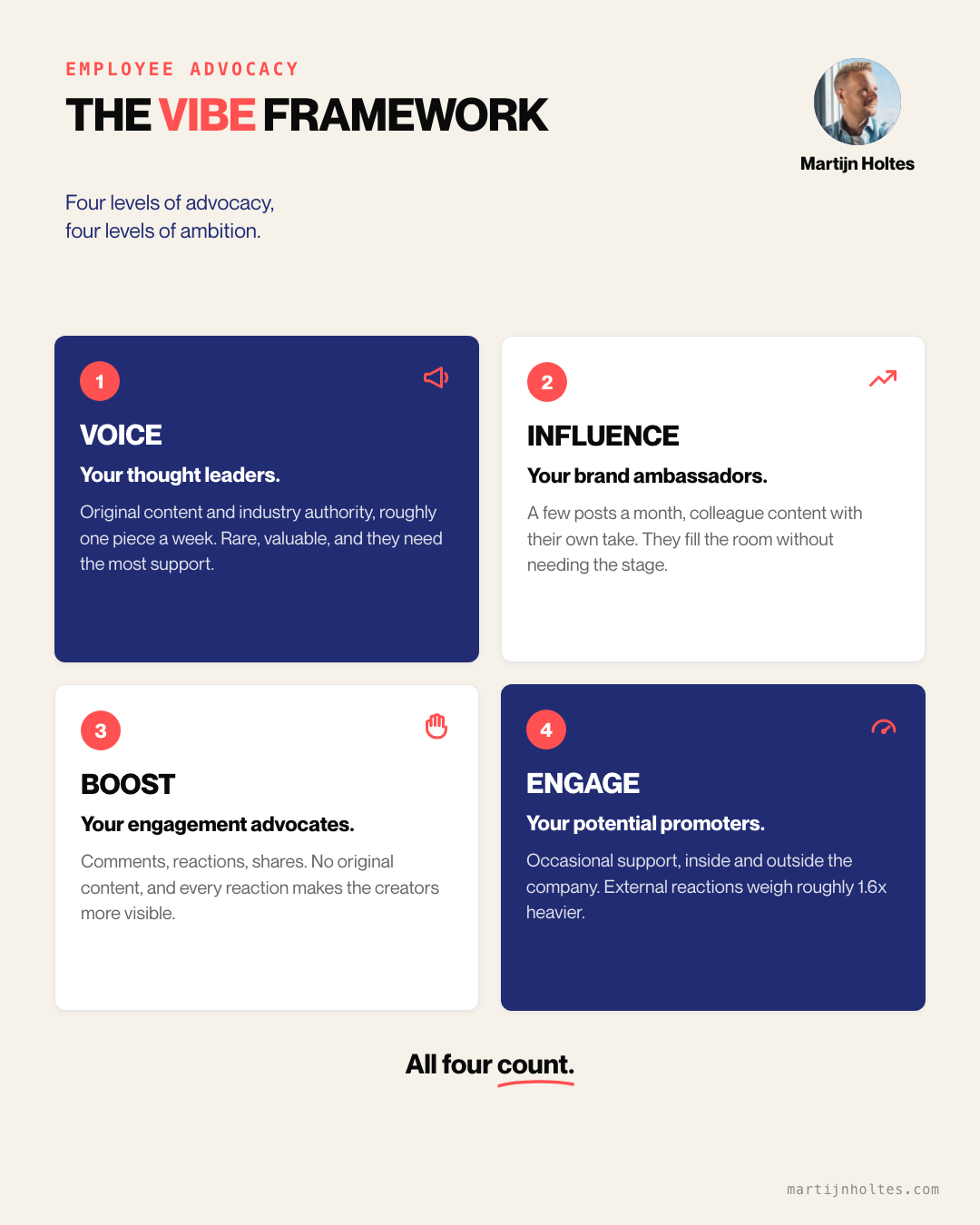
The fix starts with accepting that people participate differently, which is why I built the VIBE framework.
Four levels of advocacy, so every employee can contribute in a way that matches what they want and can do.
Voice people create original content and build industry authority. They have opinions, they like writing or speaking, and they’re comfortable being visible. They’re your most visible advocates and they need the most support: positioning, coaching, feedback. They’re also not automatically your executives, some of your best Voices are three levels down the org chart, sitting on expertise nobody asked them about.
Influence people amplify with their own take. A few original posts a month, colleague content shared with commentary, presence in industry conversations. They won’t stand up front, but they show up in everyone else’s comments.
Boost people engage: comments, reactions, shares, no original content. Underrated, because every reaction extends the reach of the people who do create, and a thoughtful comment from a Boost person can be worth more than a forced post from someone who never wanted to write. Motivation is their only entry requirement.
Engage people maintain a solid professional presence and join in occasionally, and this level extends outside the company: partners, clients and collaborators who engage with your content. Their reactions carry extra weight. Engagement from outside your organisation counts roughly 1.6x heavier on LinkedIn than colleague applause, but they’re partners, not channels, and the moment it feels transactional the credibility is gone.
Underneath VIBE sits employeeship, borrowed from the Scandinavian idea of medarbetarskap: leaders trust people, people take ownership. The chain runs trust, then less control, then ownership, then initiative. You can’t order someone to be a trusted advocate. You can only build the conditions where it happens on its own.
In practice that means one page of clear limits, real training, no approval chain on every word, and a program people can leave without consequences. That last one sounds like a weakness and is the whole strength: voluntary is the only thing the audience believes.
You know it’s working when it stops looking like a program, when someone adds their own take to a colleague’s post because they wanted to, not because a leaderboard told them to. No email reminded them. That’s advocacy: people choosing to be visible because the culture makes it worth doing.
Employee advocacy vs employer branding
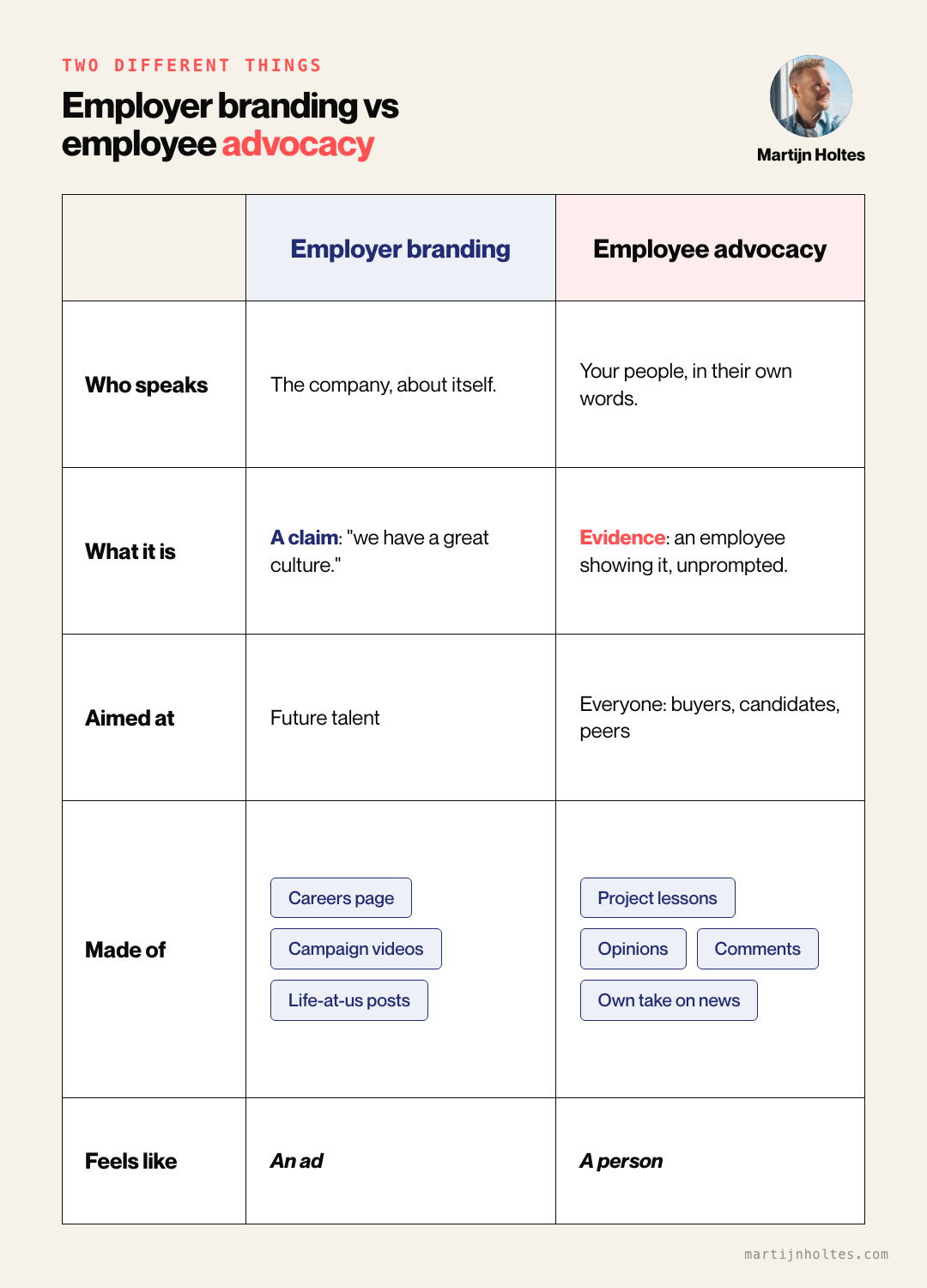
These get mixed up constantly. Employer branding is the company telling its own story, careers page, campaign videos, “life at us” posts, aimed at future talent. Employee advocacy is your people telling their stories, in their own words, to their own networks.
The two feed each other, but only one direction builds proof. A careers page says “we have a great culture.” An employee posting freely about her work shows it, and the audience knows the difference between a claim and evidence.
Candidates read the campaign and then go check what actual employees sound like; if the employees sound like nothing, the campaign was expensive wallpaper. The strongest employer brand I know of is a company whose people post without being asked.
Employee advocacy vs influencer marketing
Worth separating too, because budget holders keep comparing them. An influencer rents you their audience: you pay, they mention, the audience knows the deal, and the trust involved is thin and priced accordingly. An advocate lends you their credibility: unpaid, voluntary, speaking about work they do all day, to a network that knows them personally. Smaller reach per person, radically higher trust per impression, and it compounds, because the advocate’s reputation grows with every useful post, while the influencer’s mention is spent the moment it’s posted.
What counts as employee advocacy content
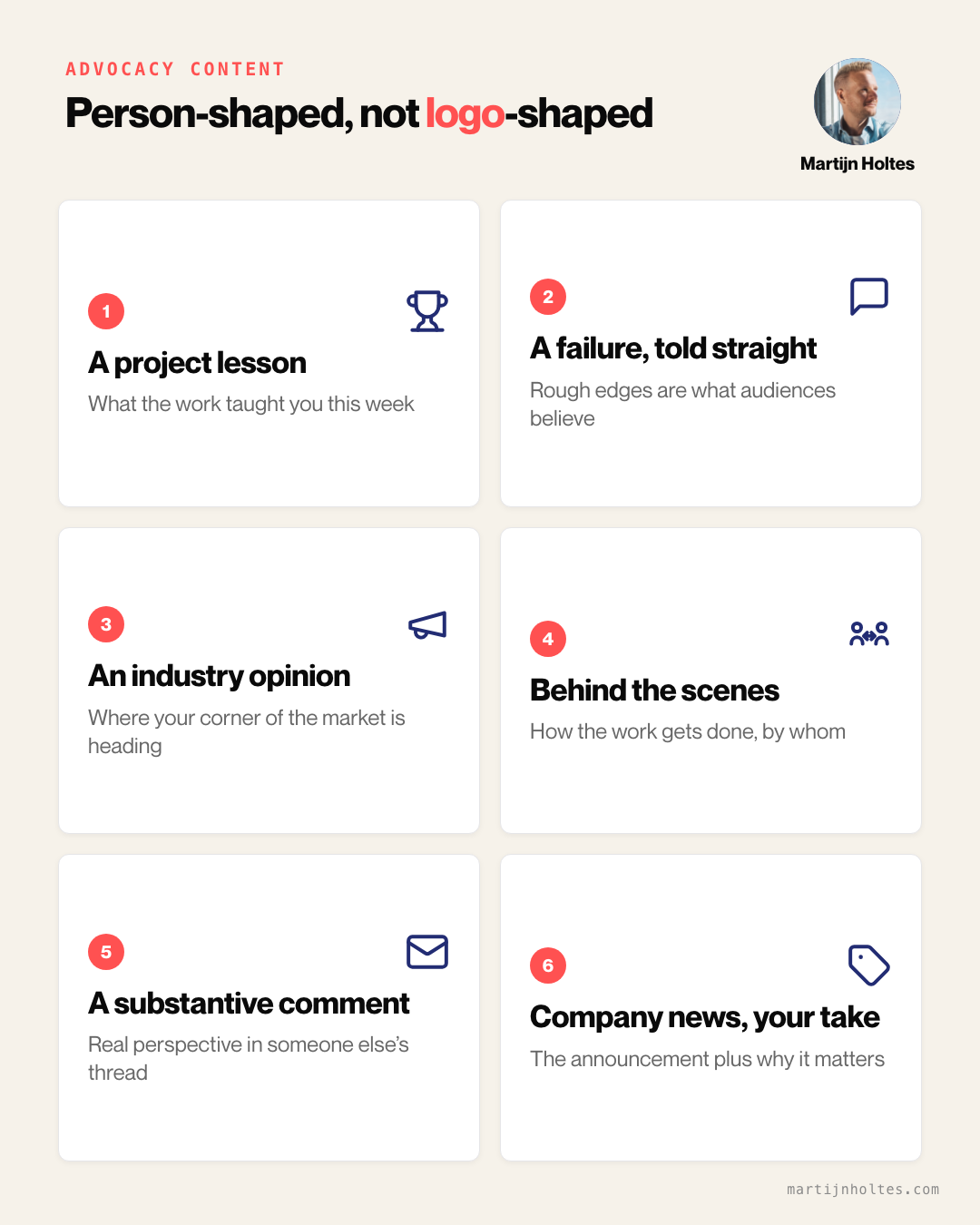
The person-shaped stuff, not the logo-shaped stuff. It’s what someone learned on a project, a lesson pulled from a failure, a view on where the industry is heading, a behind-the-scenes look at how the work actually gets done, or a comment that adds real perspective to someone else’s discussion.
Written the way that person talks, rough edges included, because the rough edges are what make the audience believe a human wrote it.
The company announcement can come along for the ride now and then, ideally with the employee’s own take on why it matters. As a guideline I give programs a 70-20-10 split: 70% insights the audience finds useful, 20% company perspective, 10% promotional. But if your “advocacy content” is a library of pre-written posts about your product, you’ve built corporate broadcasting with a human face on it, and your employees’ networks will treat it accordingly.
If your program already failed?
Most people reading this aren’t starting clean, they’re staring at a stalled program.
The good news: you don’t need to start from scratch. The foundation needs changing, not the ambition.
Talk to the people who stopped participating, in person, not through a survey; the answers will be blunter and more useful than anything in your analytics.
Kill the content library as the centrepiece and teach people to make their own material from their own week instead. Remove the pressure: quotas, leaderboards and mandates all tell people this is a performance metric, and people game performance metrics.
And widen what counts as participation, because the colleagues who comment and share were contributing all along; your measurement was too narrow to see them.
That rebuilt program I mentioned, the one that launched with everything and landed on 4%? After we scrapped the scripts and started trusting people, participation hit 23% in three months. The infrastructure barely changed. The relationship did.
So, one homework assignment. Go look at your own company page. Then look at a post from someone on your team who likes their work.
Which one would you believe?
Ready to move past the definition?
Start with an intake call. Tell me where your people are stuck, and I’ll tell you straight if I can help, and how.
Schedule your intake callQuestions I get about employee advocacy
What is employee advocacy in simple words?
Employees sharing their knowledge, experiences and opinions about their work on their own social profiles, voluntarily and in their own words. The company becomes visible through people instead of the logo, which works because audiences trust people far more than brands.
What does employee advocacy mean in HR?
The same behaviour seen from the talent side: visible, proud employees who share what it’s like to work somewhere. For HR it’s employer-brand proof and professional development in one, real people beat any careers page, and the skills and reputation employees build belong to their careers.
What is the difference between employee advocacy and employer branding?
Employer branding is the company telling its own story to attract talent. Employee advocacy is employees telling their own stories to their networks. One is a claim, the other is evidence, and audiences can tell them apart instantly.
What is the difference between employee advocacy and influencer marketing?
An influencer rents you their audience for a fee, and everyone knows it. An advocate voluntarily lends you credibility built on doing the actual work, inside a network that knows them. Less reach per person, far more trust per impression, and it compounds instead of expiring.
What is employee advocacy content?
Content shaped like a person, not a logo: project lessons, professional opinions, experiences, a personal take on company news, substantive comments in industry discussions. Written by the employee in their own words. Pre-written posts shared word-for-word are distribution, not advocacy, and they perform like it.
What is an example of employee advocacy?
A business developer posting his own view on a market shift and outperforming the company page’s last ten posts combined, which I watched happen while researching a lead. Or juniors joining a senior colleague’s discussion because they had something to add. Small, human, unscripted, and worth more than any campaign.
Why do employee advocacy programs fail?
Three design mistakes: forced participation, scripts instead of boundaries, and counting only published posts as participation. Underneath all three: the company built the system before it built the trust. Programs work when they’re voluntary, personal and open to every level of contribution, which is what the VIBE framework structures.
Is employee advocacy the same as posting company content?
No, and the confusion kills programs. Resharing approved company posts is distribution; audiences scroll past it. Advocacy is the employee’s own perspective in the employee’s own words, within clear boundaries. The company provides support and safety, never the sentences.