Last year, in a workshop at a large insurance company, a participant raised her hand and said something I’ve never forgotten: “You want me to be authentic on LinkedIn, but my manager has to approve every word before I post it.”
She’d put her finger on the exact reason most employee advocacy programs die.
Companies say they want authentic employee voices, then build a system designed to prevent them. And the budget owner ends up in a board meeting explaining why the platform license, the content library and the kick-off event produced three months of silence.
Almost every company is trying this.
DSMN8’s research puts it at 90% of brands running or planning an advocacy program, while only 17% have a formalised one, and the satisfaction numbers aren’t much better.
Roughly 70% of those companies aren’t completely satisfied with the results.
So before you spend a euro, understand what the unhappy 70% did, because they mostly did the same thing.
This article is the build guide I wish more companies read before they kick-off.
In this article
- Why the math is on your side (and the execution isn’t)
- Why most programs die (and it’s not the content)
- Before you build anything: three decisions
- The four-step build
- How to measure employee advocacy
- “Which platform or tool is best?”
- What is the role of HR (and marketing, and comms)?
- What this looks like when it works
- If you’re about to spend the budget
- Questions buyers ask me about advocacy programs
Why the math is on your side (and the execution isn’t)
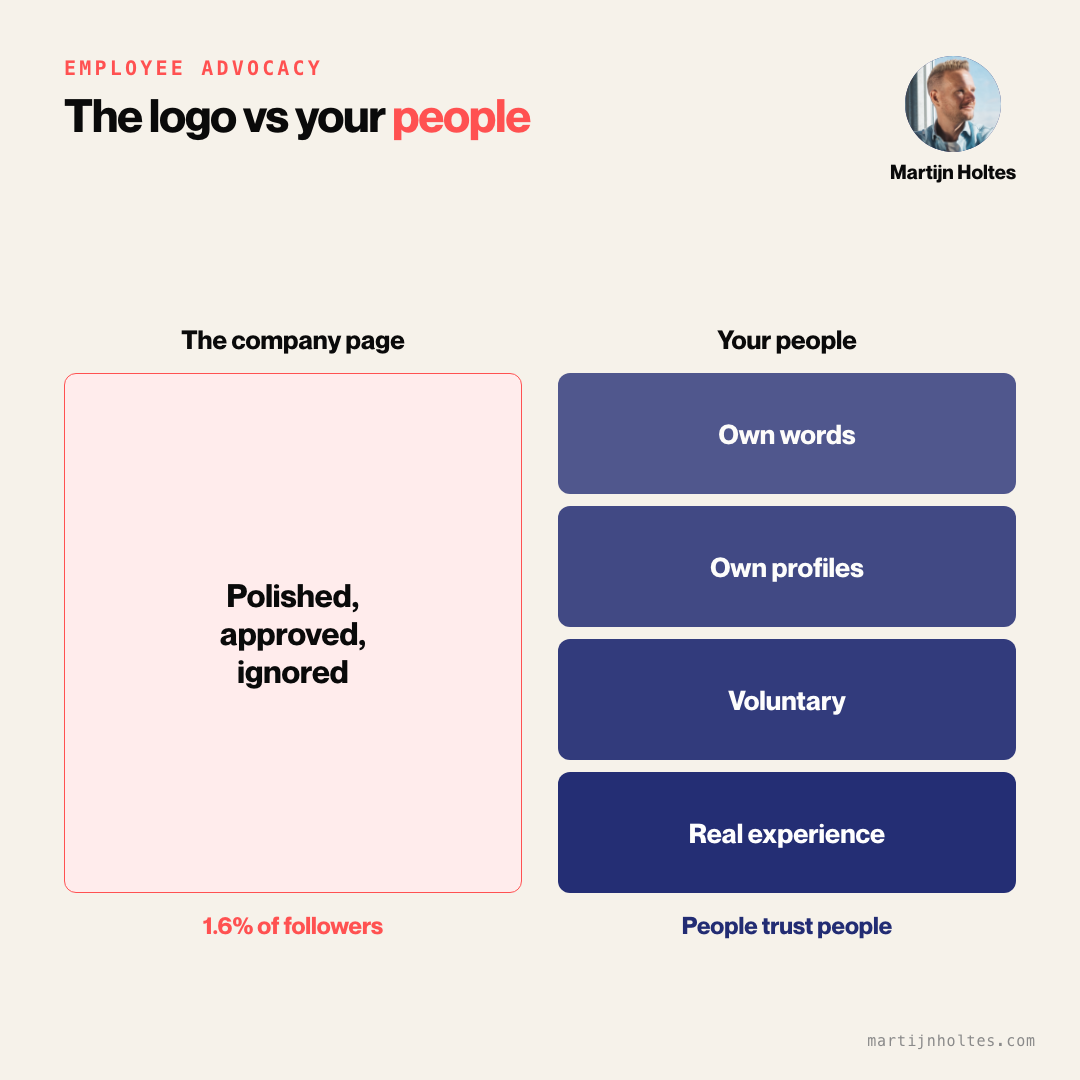
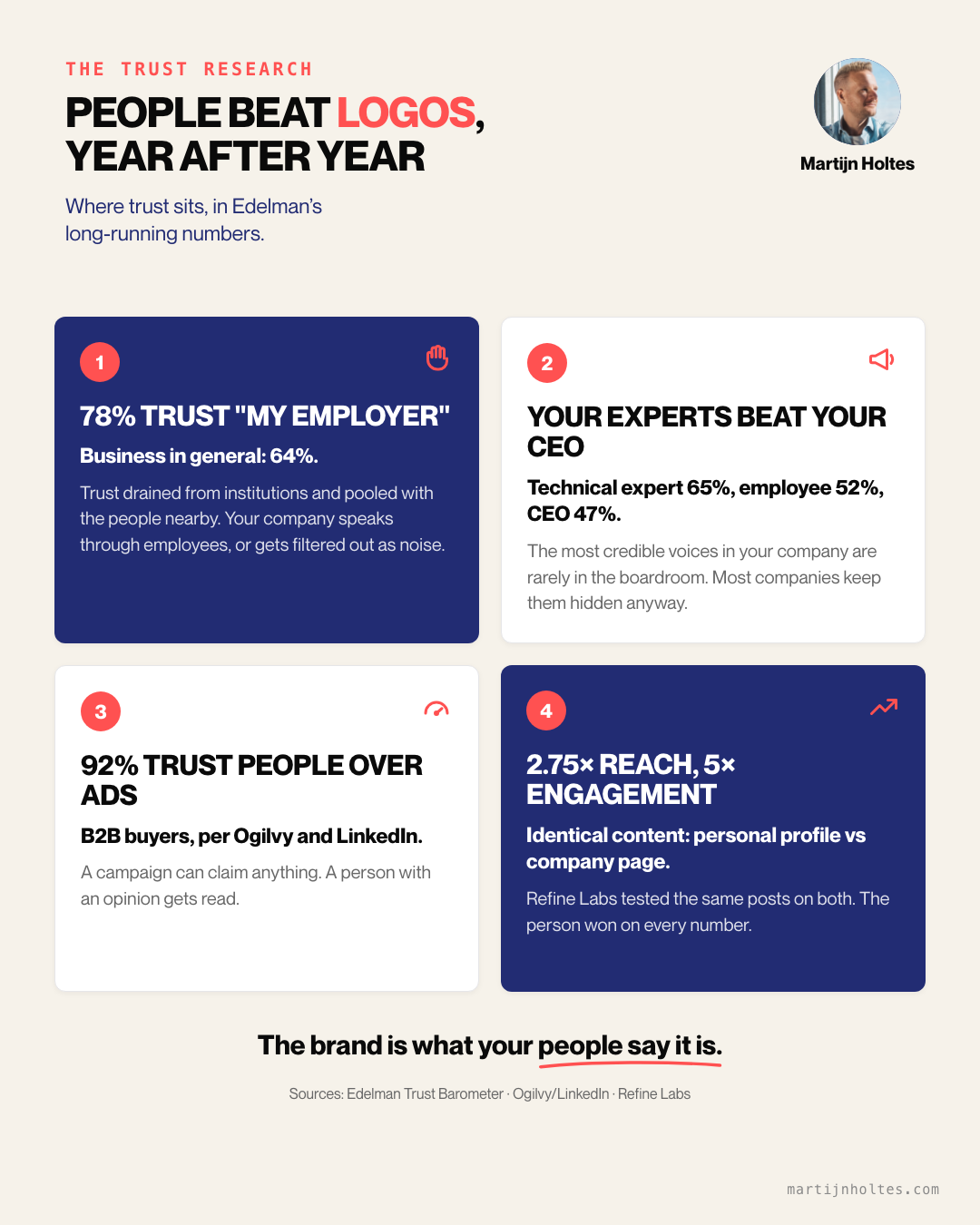
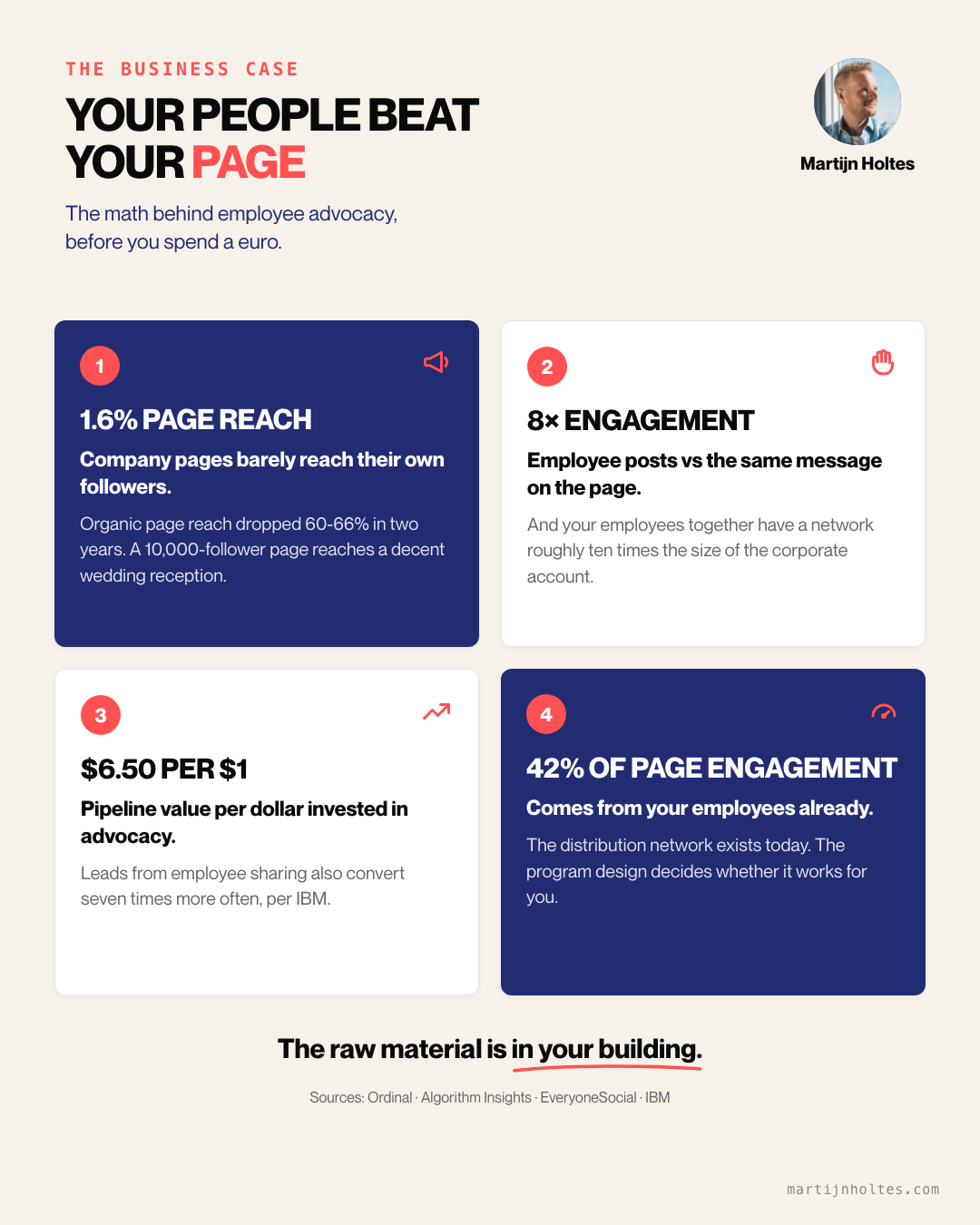
Your LinkedIn company page reaches almost nobody anymore. Ordinal’s tracking now puts LinkedIn page posts at 1.6% of followers organically.
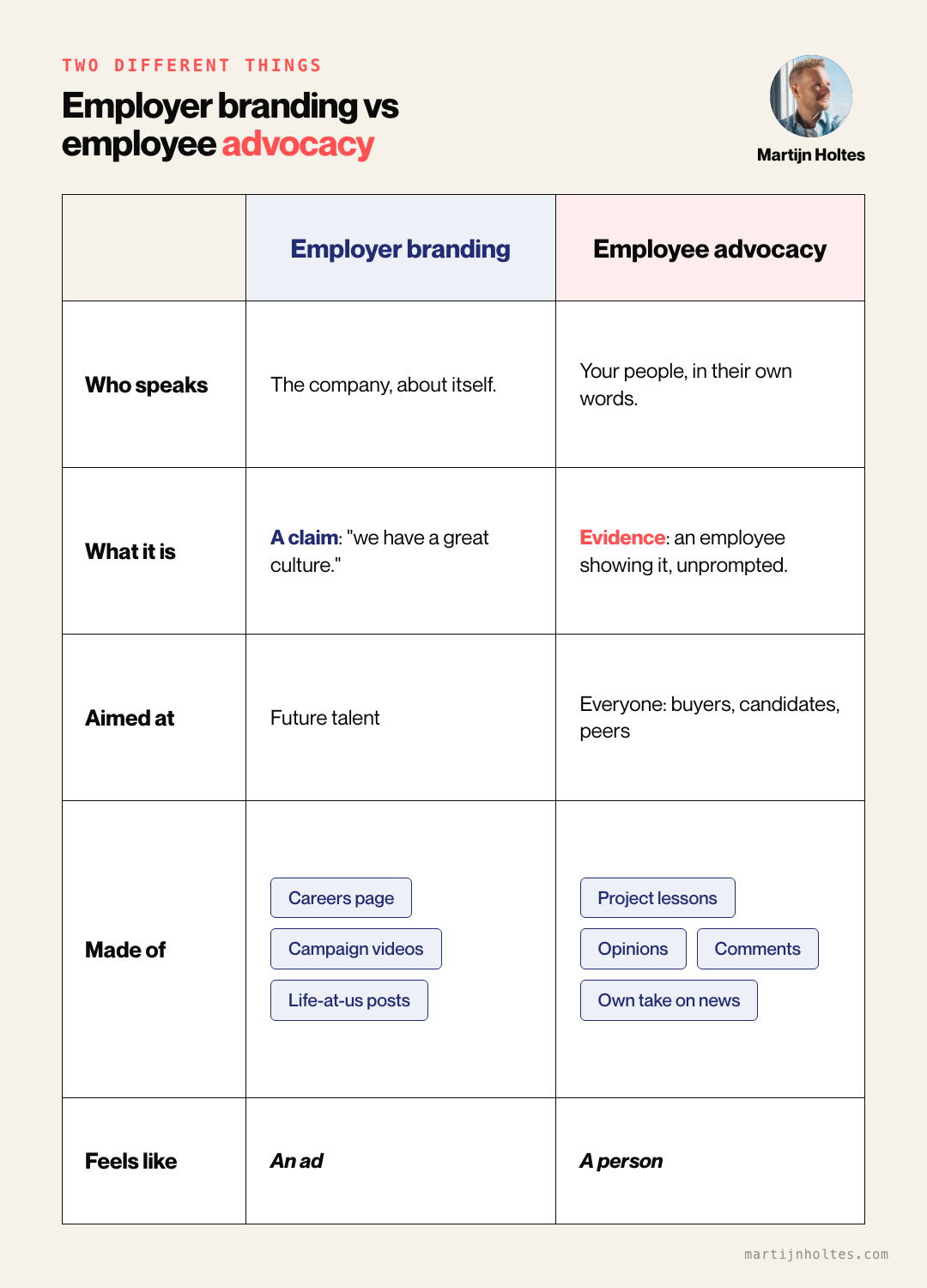
Your employees, partners and stakeholders reach people your company page never will. Employees together have a social presence roughly ten times larger than the corporate account, their posts pull about eight times the engagement of the same message on a company channel, and the Algorithm Report 2026 found that 42% of all engagement on company pages already comes from employees.
On top of that you have the problem of declining trust in institutions and companies
Edelman has “my employer” at 78% trust while business in general scores 64%, and Ogilvy and LinkedIn put 92% of B2B buyers on the side of people over ads.
The ROI research points the same direction:
EveryoneSocial calculates $6.50 of pipeline per dollar invested in advocacy, and IBM found that leads from employee sharing convert seven times more often than other leads.
So the opportunities are there. The reason most programs still fail is that the build treats people as distribution channels, and people notice.
Why most programs die (and it’s not the content)
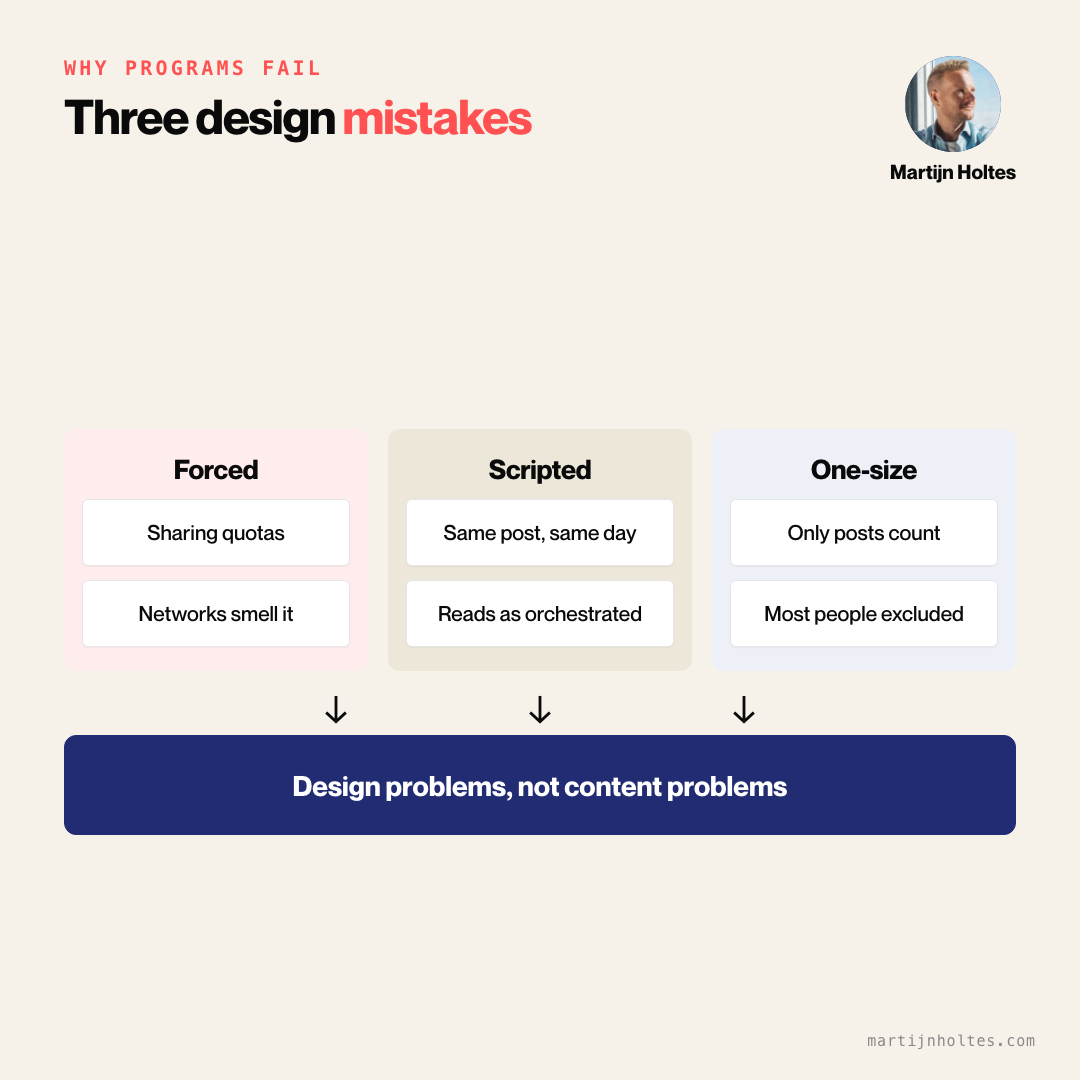
The failed programs all made the same handful of mistakes.
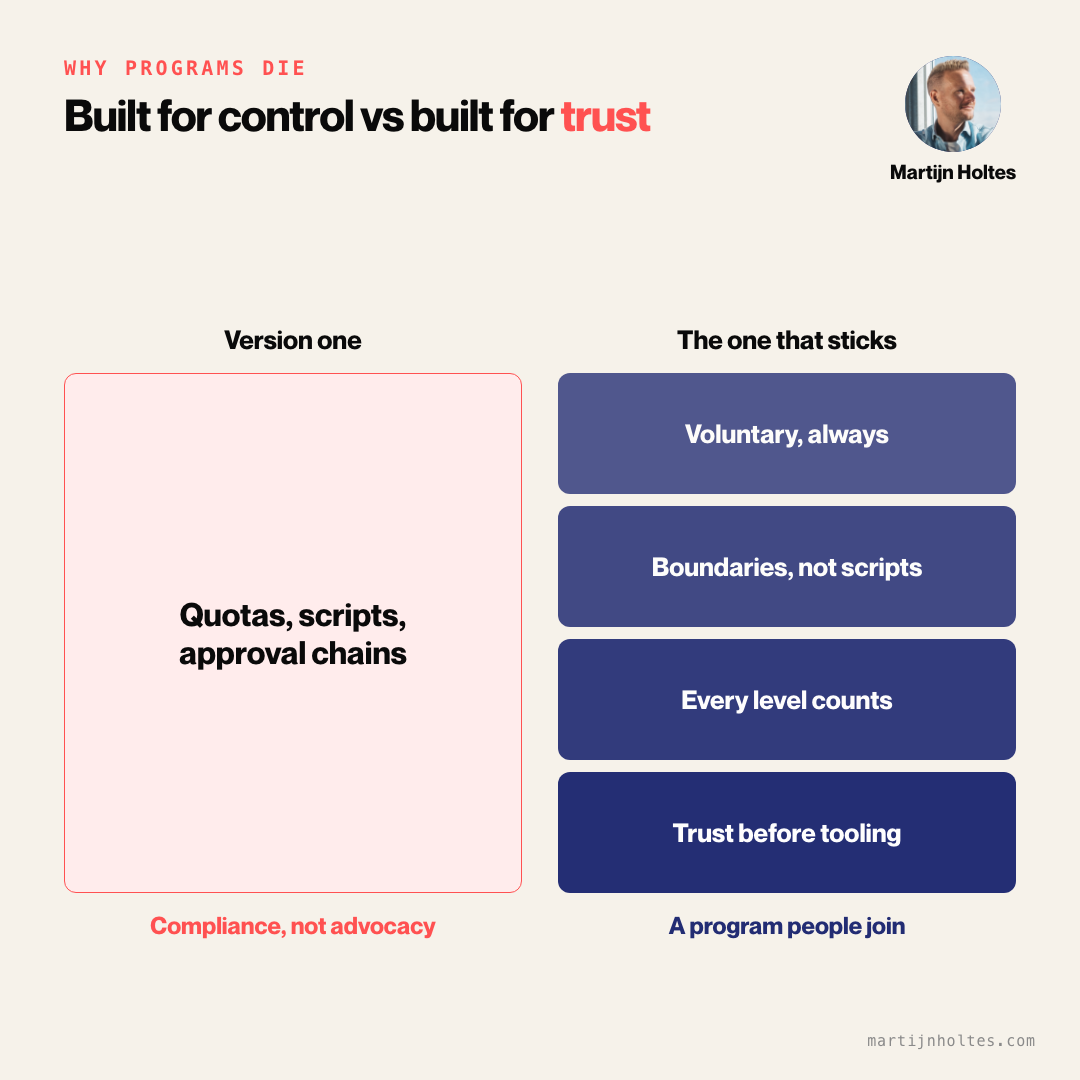
Companies made participation mandatory, so people shared to tick the box and their networks smelled the corporate-approved post from a mile away.
They handed everyone a script, so thirty people posted the same message on the same day and the audience concluded, correctly, that it was orchestrated. And they treated every employee the same, so anyone who didn’t want to write posts was counted as a non-participant and checked out.
None of these are content problems. They’re design problems. Version one was built for control, not for advocacy, and you can’t fix that with a better content calendar.
There’s another version of the same mistake, building the system before building the trust. One program launched with executive sponsorship, dedicated budget, a 200-post content library, an analytics platform and a leaderboard with quarterly prizes.
Six months in, participation sat at 4%.
Everything was in place except a reason for employees to believe the program was for them. When people don’t believe posting helps their own careers and aspirations, no amount of infrastructure changes their behaviour.
About to spend the advocacy budget?
You get one cheap attempt at this. My Strategy work starts with a VIBE survey across your people, then an audit and a plan for the first ninety days. 950+ companies since 2011.
See how I build programsThey see corporate messaging dressed up as personal posts, and a leaderboard that rewards copy-paste over thinking.
Before you build anything: three decisions
Decide what the program is for.
More pipeline, easier recruitment, a visible leadership team, a stronger position in one market. Pick one primary goal and write it down, because “more visibility” is not a goal, it’s a wish, and you can’t report a wish to a board.
“Our people should become more active” is not a goal either, which is exactly why so many programs with that objective end up measuring activity and proving nothing.
The goal also decides who your first ambassadors should be: pipeline points at sales and consultants, recruitment points at the teams you’re hiring for.
Start with the willing.
You don’t need everyone, and you shouldn’t want everyone.
You need the 10 to 20% who are already motivated to build their professional presence.
Support them properly and the results pull in the next group, because colleagues trust colleagues who got something out of it. That ripple effect is the only scaling mechanism that works. Every program that launches company-wide on day one trades it for a compliance exercise.
The best programs I’ve worked on spent their first three months looking like nothing more than a handful of people learning to post.
Give boundaries, not scripts.
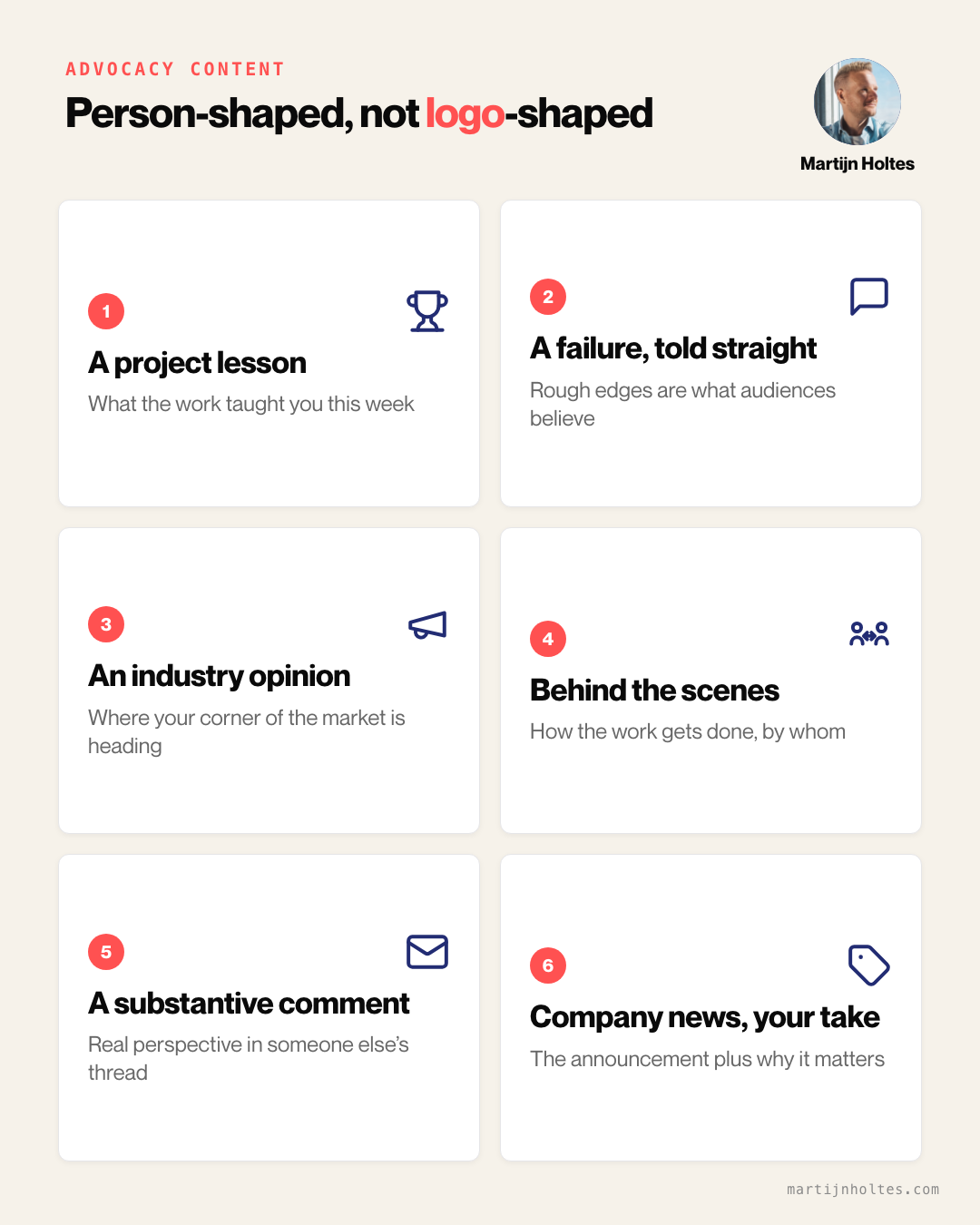
Write down what’s off-limits: confidential client information, legal claims, speaking for the company on sensitive matters. Keep it on one page. Inside those lines, people write in their own words, without an approval workflow.
A script deletes the only thing that made advocacy worth doing, which is that Karen from finance and Dave from sales see the world differently.
And for the compliance officer reading along, across the 950+ companies I’ve worked with, problematic posts happen in about 0.3% of cases, and trained ambassadors cause fewer incidents than untrained employees, not more.
The risk you’re pricing in is mostly already there, on the profiles of people you never trained.
A program with clear boundaries reduces it.
The four-step build
This is the sequence I run with clients. The order matters, because each step makes the next one cheaper.
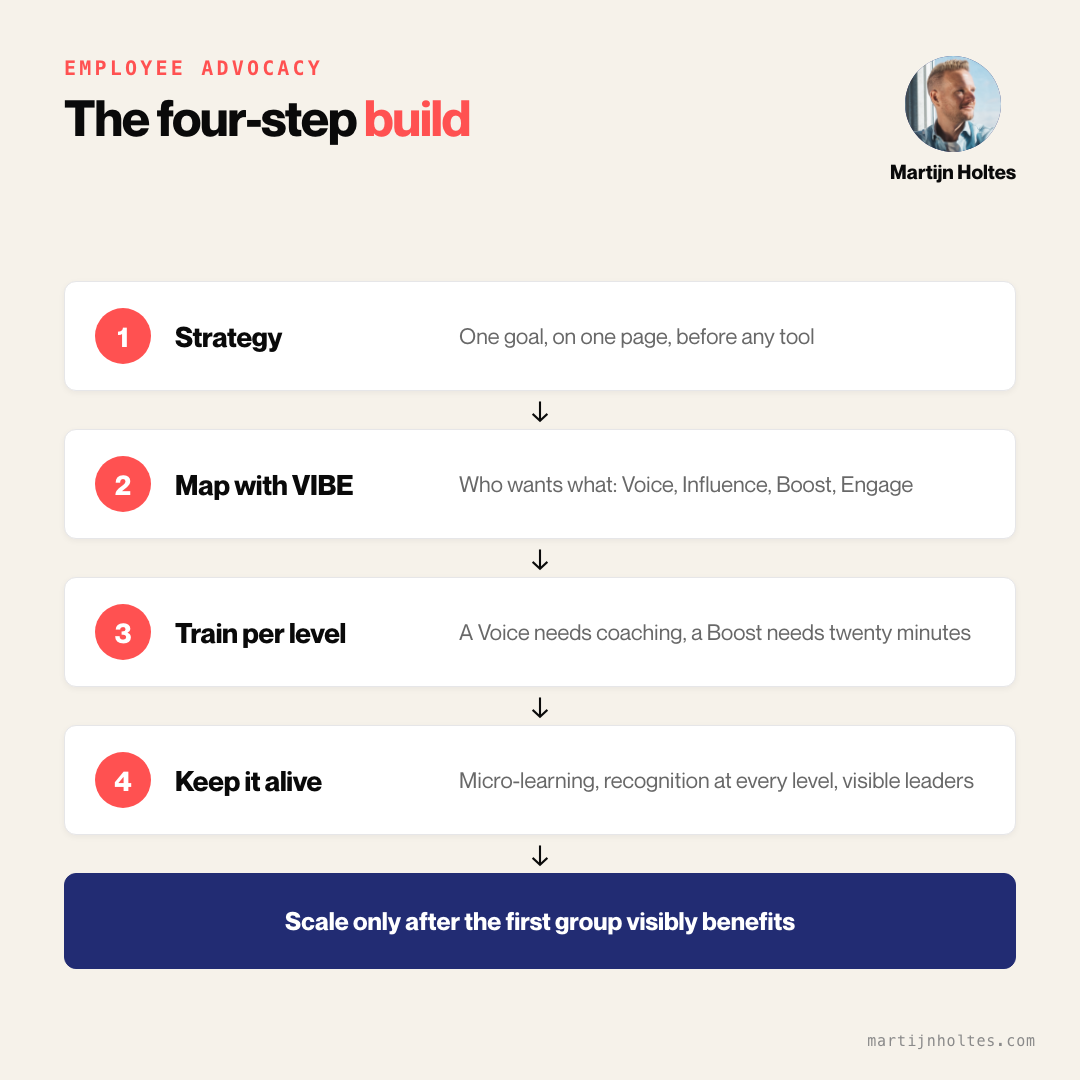
Step 1: strategy before tooling
Turn the goal into real choices: who you want to reach, what your people can credibly talk about, what’s in it for them, and how this fits what marketing and sales already do.
One workshop, one page of decisions. Skipping it is how companies end up with a platform subscription and no answer to “why would anyone open this.”
Step 2: map your people with VIBE
Not everyone wants to create content, and not everyone should.
That’s why I built VIBE around ambition levels instead of job titles.
Four levels of advocacy, four levels of ambition.
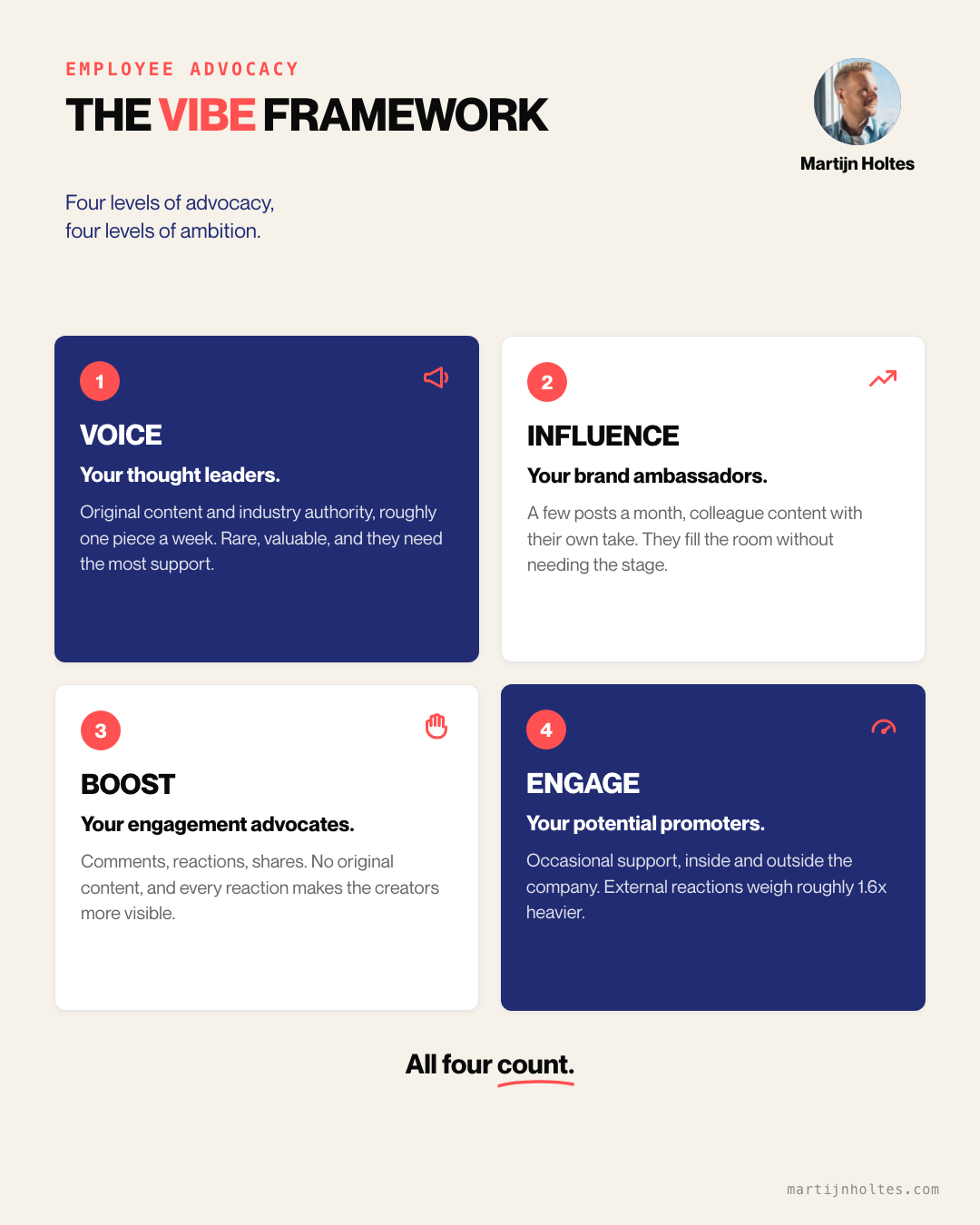
- Voice, your thought leaders. They create original content on a strategic level and build industry authority: roughly one original piece a week plus daily engagement. Rare and valuable, and not necessarily your executives, expertise lives at every level of the org chart.
- Influence, your brand ambassadors. Two to four original posts a month, sharing colleague content with their own take, engaging in industry conversations. They don’t want to be the star. They’re the ones who get everyone else’s posts seen.
- Boost, your engagement advocates. No original content. They comment, react and share, a few meaningful interactions a week, and every one of them increases visibility for the people who do create. Motivation is the only entry requirement.
- Engage, your potential promoters. Occasional engagement and campaign support, a few times a month.
Two things most programs miss about this map.
First, the Engage level has an external track: partners, clients and collaborators who engage with your content, and their reactions carry extra weight.
LinkedIn especially values engagement from outside your organisation at roughly 1.6x the weight of colleague applause. Treat those people as partners, not channels; the moment it feels transactional, the credibility is gone.
Second, level placement isn’t a management decision.
Map people through a short assessment of role, capability and motivation, let them place themselves, and review it quarterly, because people grow into higher levels when the program works.
Step 3: train per level, not per department
A Voice needs help finding the point of view worth being known for.
A Boost person needs twenty minutes on what a substantive comment looks like.
Give them the same training and you bore one while terrifying the other. In practice: live training and individual coaching for your Voices, structured group training for Influence people, light instruction for Boost, and a clear invitation for Engage.
This is also where the personal benefit has to become real.
The programs that last are the ones where employees see their own career move: a promotion, a speaking gig, an inbound job offer, a network that answers when they need it.
Frame advocacy as professional development, employee goals first and company goals second, and you’ll never have to “motivate” anyone again. People don’t need motivation to build their own reputation. They need permission and a bit of skill.
Step 4: keep it alive
These programs die in week six, not week one.
The kick-off is easy, the routine is the program.
What works: short monthly micro-learnings instead of annual training marathons, a monthly report that shows people their own progress, fresh conversation starters (suggestions, never scripts), and public recognition across all four VIBE levels, not a leaderboard for the two extroverts who’d be posting anyway.
Recognition tells everyone what counts; make sure it counts comments and shares, or you’ve told most of your ambassadors their contribution doesn’t matter.
One more thing that decides week six: leadership. If the leadership team asks employees to be visible while staying invisible themselves, everyone reads the real message. The board doesn’t need to post daily. One leader sharing openly once in a while gives everyone below cover to do the same.
How to measure employee advocacy
At the start only two kinds of numbers matter.
Adoption.
Enrolment rate: how many people joined voluntarily.
Distribution across VIBE levels: are all four levels alive, or is this five writers and silence. Trend: is participation growing quarter over quarter.
Count comments, shares and profile updates as participation, not only posts, because measuring only post count excludes the majority of your ambassadors from day one.
Business value.
Translate employee reach into money with earned media value. Two calculations do it.
Impressions times what those impressions would cost you as LinkedIn ads (EMV-Reach), and clicks times the going cost per click (EMV-Action).
Crude, but it’s a language a CFO accepts, and it turns “our people posted a lot” into a number you can put next to the program’s cost.
Behind it, watch the metrics your goal cares about: pipeline conversations started, candidates referencing employee posts, event invitations.
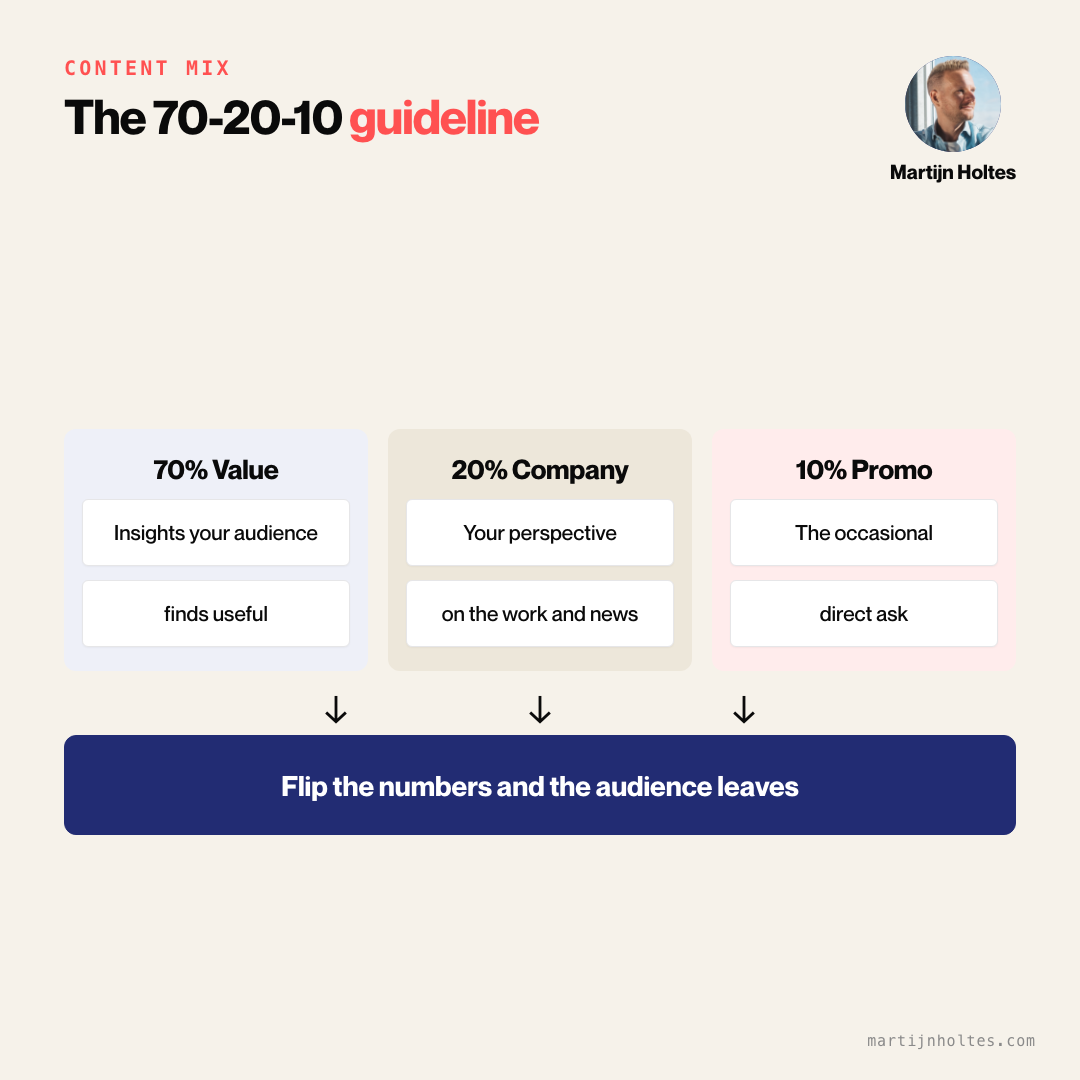
For the content itself, I give my clients a 70-20-10 guideline:
✅ 70% insights your audience finds useful
✅ 20% company perspective
✅ 10% promotional
The moment those numbers flip, your program becomes a megaphone for the marketing calendar, and the audience leaves.
What I’d ignore are the vanity dashboards of total likes, and any metric that ranks colleagues against each other. Both optimise for the wrong behaviour, and the second one poisons the culture the program depends on.
“Which platform or tool is best?”
The question everyone asks first, and it’s the wrong first question.
An advocacy tool without a strategy and an adoption plan is just another license fee. Companies spend serious budget on a platform whose main function turns out to be reminding people about a program they’d already abandoned.
The answer: for B2B, the platform that matters is LinkedIn, because that’s where your audience is. A dedicated advocacy tool becomes useful at scale, when you need to organise content suggestions, coordinate campaigns and report across hundreds of people.
Buy it after the first group works, not before.
A tool can amplify a culture you’ve already built. It can’t build you one.
What is the role of HR (and marketing, and comms)?
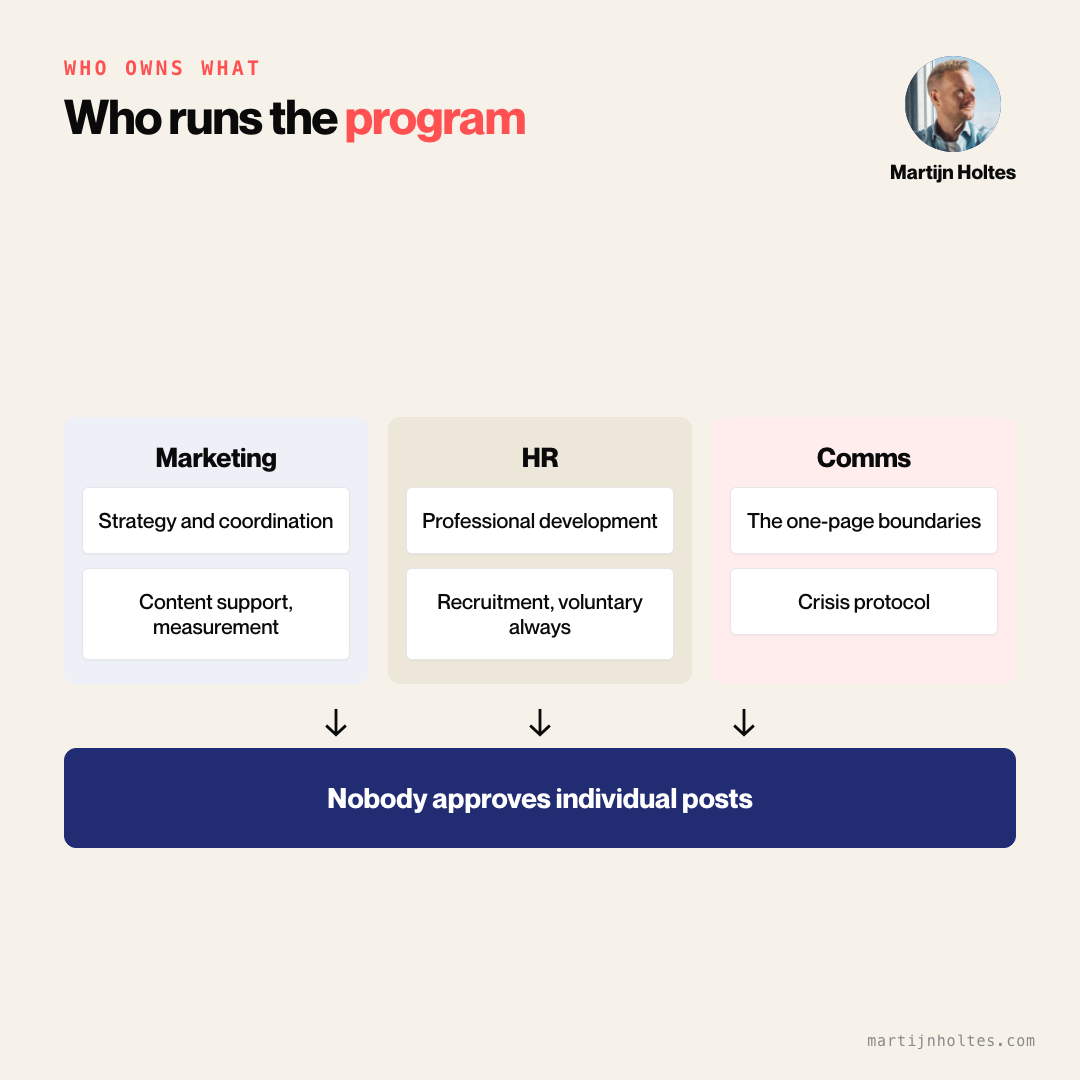
Advocacy programs sit awkwardly on the org chart because they belong to three departments and the split looks like this.
- Marketing usually runs the program: strategy, coordination, content support, measurement.
- HR co-owns it, for two reasons. Done right, advocacy is professional development, people building skills and reputation that serve their careers, and that’s HR territory. And the same visible employees who bring in pipeline bring in candidates: applicants trust the posts of real employees over any careers page, so recruitment gets a distribution network it never had.
- Communications guards the boundaries: the one-page policy, the crisis protocol, the answer to “can I say something about this news.”
The thing none of the three should do is approve individual posts.
Approve every post and you kill the one thing that made it work. Leave them free inside clear boundaries, and you get what you trained them for.
A trained, visible workforce also protects you. When something goes wrong publicly, companies with credible human voices weather it better than companies where only the logo speaks.
What this looks like when it works
That company I mentioned, the one with everything going for it and 4% participation? We rebuilt it on this sequence.
Scrapped the pre-written posts, replaced the leaderboard with monthly recognition across all four VIBE levels, and ran small workshops where people worked out what they wanted to be known for.
Participation went from 4% to 23% in three months.
Same company, same employees, same budget.
The only thing we changed was who the program trusted.
Six months in, the director told me something I wrote down: “It’s working better because it doesn’t feel like a program anymore. It just feels like how we work.”
That’s the goal. When it stops feeling like a program and becomes how you work.
At another client, a program director overheard two employees discussing a senior consultant’s post about a shared project, and one said,
*”I didn’t know she thought about it that way.”*
Nobody prompted that. That’s advocacy actually working: people talking about each other’s ideas because they want to.
If you’re about to spend the budget
The mistake isn’t buying the wrong tool. It’s launching a control system with the word “advocacy” on it, burning your employees’ goodwill, and then having to relaunch later against the memory of round one.
You get one cheap attempt at this.
The second one costs double, because this time people remember.
So run the first ninety days small and low-key: one goal on paper, ten willing people mapped across VIBE, one page of boundaries, real training, and a report at the end that counts every form of participation.
If that works, only then start to scale it.
If you want a second pair of eyes before you commit: my Strategy work starts with a VIBE survey, a short questionnaire across your people that shows who sits where, followed by an audit and a plan for those first ninety days.
Want a second pair of eyes before you commit?
Start with an intake call. No form, no gatekeeper. Tell me where the program is stuck, and I’ll tell you straight if I can help, and how.
Schedule your intake callQuestions buyers ask me about advocacy programs
How do I create an employee advocacy program?
In sequence: set one primary goal, recruit the 10 to 20% who volunteer, and write one page of boundaries instead of scripts. Map people across the four VIBE levels (Voice, Influence, Boost, Engage), train each level differently, keep it alive with micro-learning and recognition across all levels, and measure adoption plus earned media value. Scale only after the first group visibly benefits.
How do I measure employee advocacy?
Adoption first: voluntary enrolment, distribution across VIBE levels, and growth over time, counting comments and shares as participation. Then business value via earned media value: impressions priced at ad-equivalent CPM, clicks at cost per click. Benchmarks for the board: $6.50 pipeline per $1 invested (EveryoneSocial) and 7x lead conversion from employee sharing (IBM).
What is the best employee advocacy platform?
The one your people would open voluntarily, which is a strategy question, not a software question. For B2B the arena is LinkedIn. A dedicated tool earns its fee at scale, for organising suggestions and reporting across hundreds of employees. Buy it after your pilot group works, never as step one.
What is the role of HR in employee advocacy?
HR co-owns the program with marketing, because advocacy done right is professional development and an employer-brand engine: candidates trust visible employees more than any careers page. HR keeps the program voluntary and career-focused; marketing runs strategy and support; communications guards the one-page boundaries. Nobody approves individual posts.
How many employees do I need to start?
Five to ten volunteers is enough, and it’s the strongest way to start. A small group that visibly wins pulls in the second wave through the ripple effect. A company-wide launch on day one usually buys compliance instead of advocacy, and compliance is what your audience can smell.
What does a good employee advocacy program look like in practice?
A volunteer group trained per VIBE level, posting and engaging in their own words within clear boundaries, supported monthly, recognised for every kind of contribution. Growth by ripple, measurement by adoption and earned media value. One of my clients went from 4% to 23% participation in three months by removing the scripts and the leaderboard, and trusting people to sound like themselves.
Is employee advocacy risky for the company?
Less risky than doing nothing, in my experience: across 950+ companies, problematic posts occur in roughly 0.3% of cases, and trained ambassadors cause fewer incidents than untrained employees, who are already on LinkedIn without guidance today. Clear boundaries plus training beats an approval chain on both risk and results.