A few weeks ago, someone sent me a LinkedIn post they’d written with AI and asked for feedback.
It was clean, well-structured and had zero grammatical errors.
And I had no damn clue what this person believed.
The post could have come from anyone in their industry.
Right keywords, popular hook format, call-to-action at the end.
Checked every box.
This is what happens when you give AI a topic but not a perspective.
You get content that looks professional, but it’s contributing to AI slop.
The problem isn’t the tool
I use AI a lot.
Even this article that you’re reading right now, Claude has helped me put it together.
I know many experts say you shouldn’t use AI for content creation.
But that’s sort of the same as saying you can’t use a car to go from A to B, because a horse would be more authentic.
If you get poor results, you aren’t using the wrong tools.
You are probably skipping the thinking that makes AI useful in the first place.
For example:
Level one: you ask AI to write a post about thought leadership.
Level two: you type “thought leadership is not about being smart or knowing everything. It’s about having the courage to share your professional point of view. Please give me five angles on how I can approach this message.”
Same tool, same topic, completely different output.
The difference is the instruction.
And the best instructions aren’t a prompt template from someone’s viral newsletter, they’re a clear picture of who you are, what you stand for, and who you’re talking to.
p.s. please make sure you are at least at level two this week
Where AI helps
There is a ton of information and instructions out there on how you can use AI in your day-to-day workflow and operations.
Below you’ll find some simple examples if you’re getting started.
1. Research and inspiration
I use AI to scan what’s happening in my industry. What questions are people asking? What topics are getting traction? What’s been said to death?
I used to use Google Alerts for this, but now it’s a combination of Perplexity, Google Gemini, and Claude Code. It saves me hours of reading and surfaces things I would have missed on my own.
2. First draft acceleration
Once I know what I want to talk about, I use AI to build a first draft.
I feed it my positioning statements, tone of voice guidelines and the summary of one of the topics from my research.
The draft is never published, but it gives me something to react to instead of a blank page.
I rewrite, rearrange, add my own examples and cut anything that feels like it could have come from anyone.
3. Editing and formatting
AI is good at tightening sentences, catching repetition and cleaning up flow.
I use it as a second pair of eyes after I’ve written my version.
One catch.
Instruct your AI to only highlight the things that are wrong.
Don’t let it rewrite your text, to make sure your writing stays your own.
This is where AI adds the most value with the least risk.
The thinking is done, the POV is mine, and AI helps clean it up.
Where AI sucks
1. Your backstory
AI doesn’t have your experience.
It doesn’t know the client who changed your mind, the failure that taught you more than success ever did, or the contrarian view you built over the years.
Ask AI to generate your positioning, and you’ll get something that sounds reasonable.
And means nothing.
Your POV has to come from you.
No shortcut.
2. Your angle on a topic
AI can give you both sides of an argument.
What it can’t do is pick a side based on what you’ve lived through.
Your take, the specific perspective that comes from years of doing this work, is the part that makes content worth reading.
Hand that to AI and you’ve handed over the only thing that makes you different.
3. Your engagement
Comments, replies, DMs, real conversations.
It is where trust gets built and there is no way to automate that.
It’s the part where people are most tempted to use AI because it saves time.
Don’t.
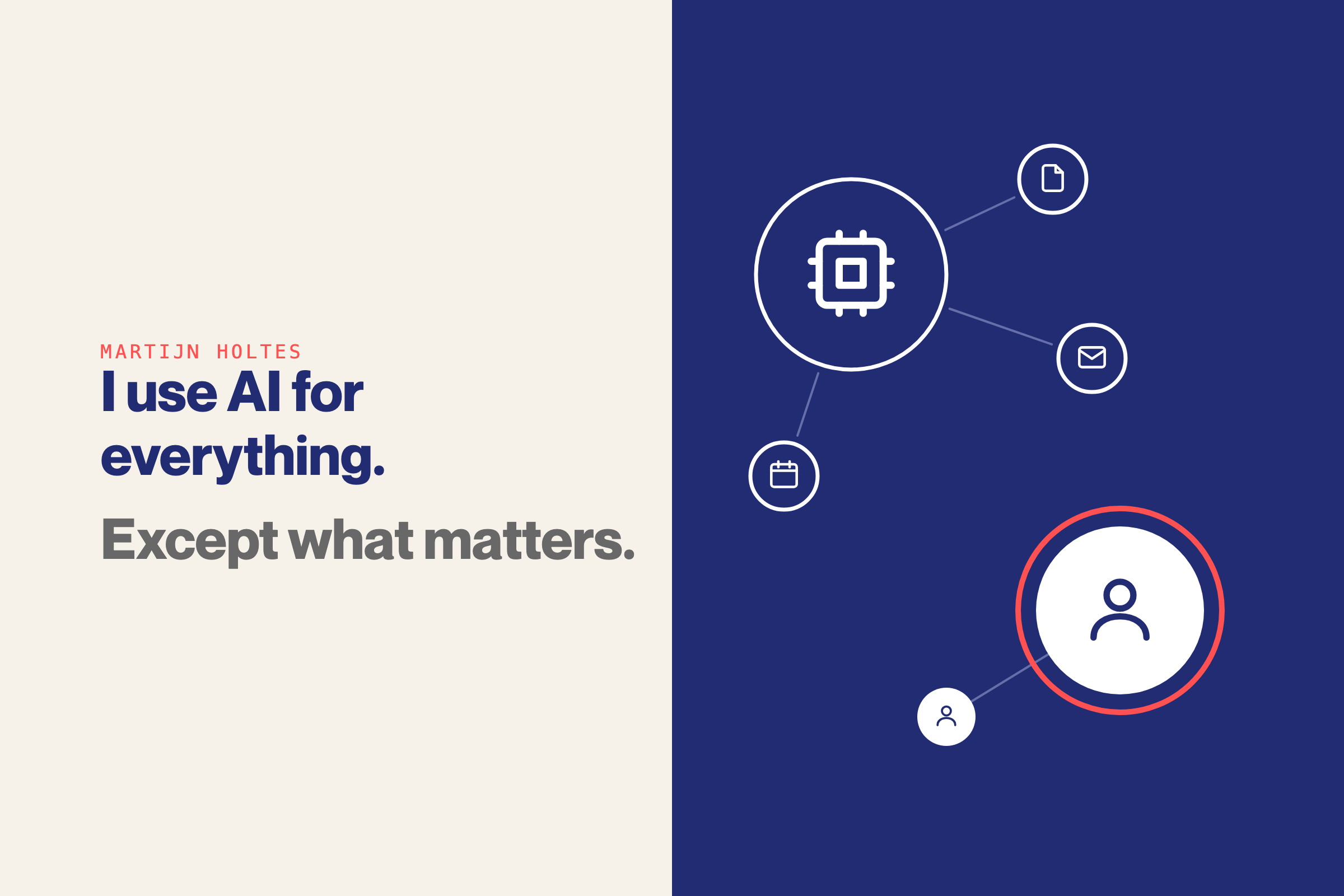
The human part is the whole point.
Someone leaves a thoughtful comment on your post and gets a robot reply?
You’ve lost more trust than the post created.
So where do you start?
I wrote about this before, the Backstory framework.
Six questions that help you find your Angle, Authority, and Voice.
Those three statements are the foundation AI needs from you.
Without them, you’re asking AI to guess who you are.
And it will. It’ll guess wrong.
The order that works
- Build your backstory (your positioning statements)
- Pick your angle on a specific topic
- Use AI to help you draft, research, and edit
- Keep your engagement human
Most people start at step 3.
Then we wonder why the output is so bad.
That post someone sent me? It had everything except a point of view.
That’s the one thing worth protecting.