Google “personal branding on LinkedIn” and you’ll drown in formulas. The 5 P’s of personal branding, the 7 pillars, the 4 C’s, a 30-day challenge with a downloadable workbook and a stock photo of someone pointing at a whiteboard.
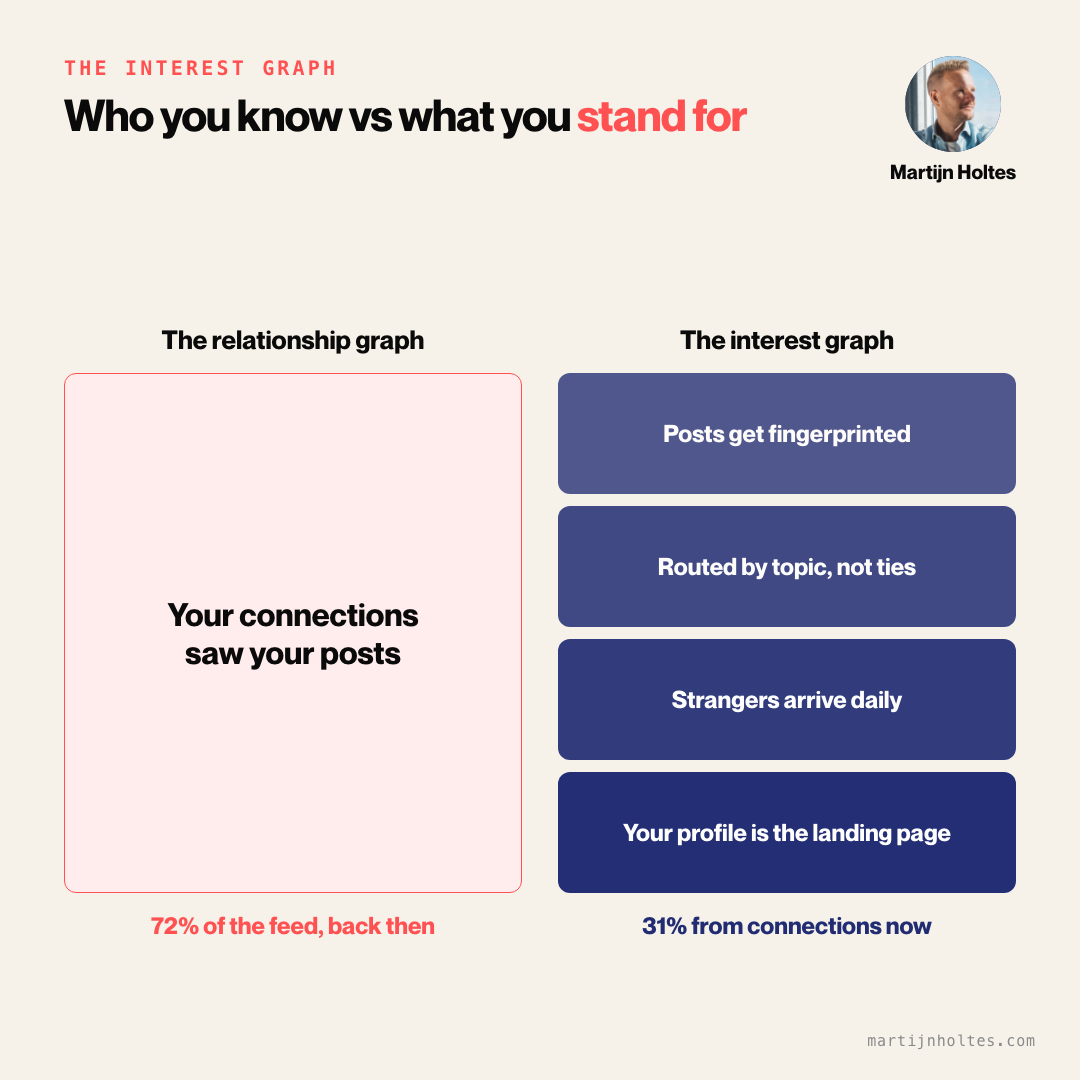
Meanwhile, LinkedIn rebuilt the machine underneath all of it. In spring 2025 the platform moved from a relationship graph, where your connections saw your posts, to an interest graph, where the system routes content to whoever it predicts will care, follower or not.
The share of your feed coming from your own connections dropped from 72% to 31%.
Follower counts and reach stopped moving together: the Algorithm Report 2026 of Richard van der Blom found median follower counts grew 31% while impressions came in around 29% below what that growth used to predict.
Which means most personal branding advice is answering a question from 2020.
The new question isn’t “how do I grow my network.” It’s “can the system and the humans work out what I stand for.” And after 16 years of building this with 250,000+ professionals, I’ll say the part most people don’t want to hear. Most profiles fail that test before a single post gets written.
This is the long answer to what works now: the positioning that comes first, the profile that does three jobs, the content rhythm that feeds the machine without feeding the slop pile, and what all of it costs.
In this article
- The short answer
- How the interest graph decides who sees you
- Position before you polish
- Your profile has three jobs now
- The fields that do the heavy lifting
- The content that works in 2026
- What does personal branding on LinkedIn cost?
- The system that keeps it running
- Questions I get about personal branding on LinkedIn
The short answer
Building a personal brand on LinkedIn in 2026 comes down to four moves, in this order.
Decide what you stand for, two or three topics, named in plain words.
Rebuild your profile around that positioning so it confirms, converts and classifies.
Show up on those topics through posts and, underrated, comments.
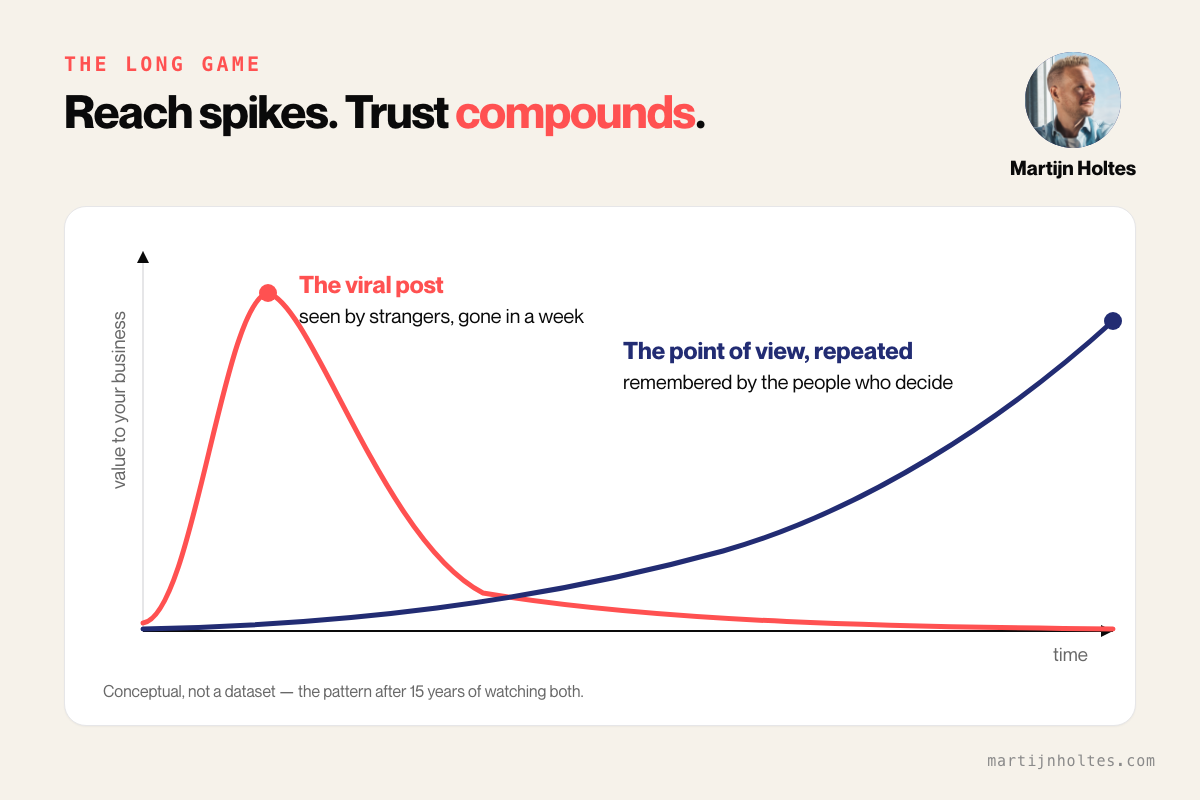
And hold the line long enough for the system and the market to trust the pattern, which takes about ninety days.
Everything below unpacks those four, with the specifics that changed this year.
How the interest graph decides who sees you
Worth two minutes of mechanics, because every practical tip below follows from them.
LinkedIn’s distribution now runs on what the engineers call topic fingerprinting. Every post gets a fingerprint from its language, topics and early engagement. Every member gets one from their behaviour. When a post’s fingerprint matches a reader’s interests, the system routes it to them, connection or not.
Underneath sit two systems in sequence: a large language model (LinkedIn calls it 360Brew) that selects candidate posts on semantic relevance, and a ranking model that reads each member’s full interaction history as a pattern.
If LinkedIn can’t file you under a topic, it can’t send you to anyone.
Two consequences follow for your brand. First, your profile fields, headline, About, skills, experience, are inputs to that classification. A vague profile, “passionate connector of people and ideas,” is unclassifiable, which hurts your distribution before you write a single post. Clear used to be a favour to the human reading you. Now the machine needs it too, or it can’t send you to anyone.
Second, the system reads patterns, not single actions, and it evaluates your topic consistency on a rolling 90-day window. Strong, consistent topic signals earn larger initial distribution and posts that keep traveling up to 40% longer. Scattered signals get you almost no reach.
Part of me dislikes this. My brain loves detours, and this machine rewards whoever’s easiest to file, which means it punishes anyone with range, like me. But it’s the machine we post in, and the workaround is simple enough: pick the lane, and bring your detours home by showing what they mean for your topic.
Position before you polish
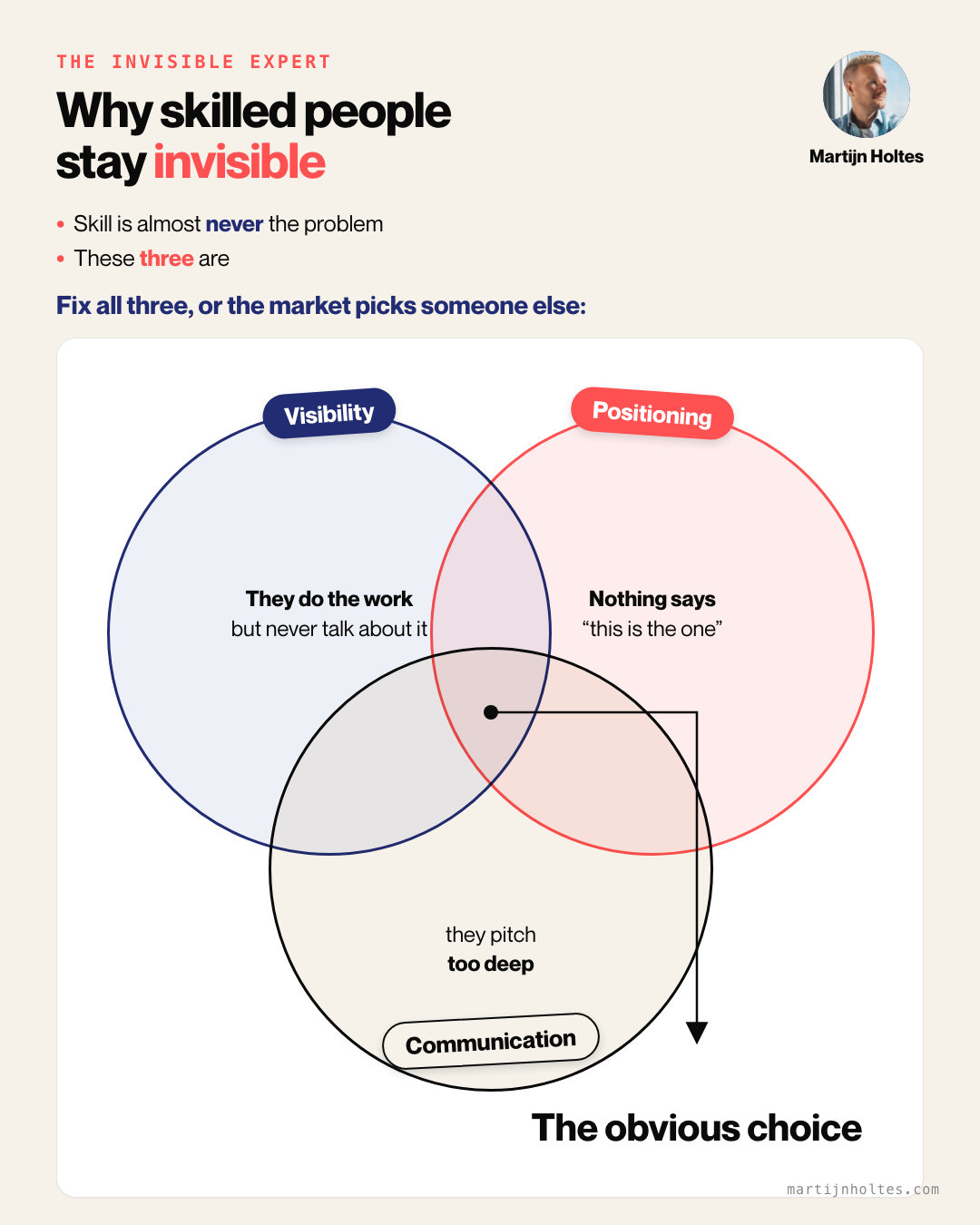
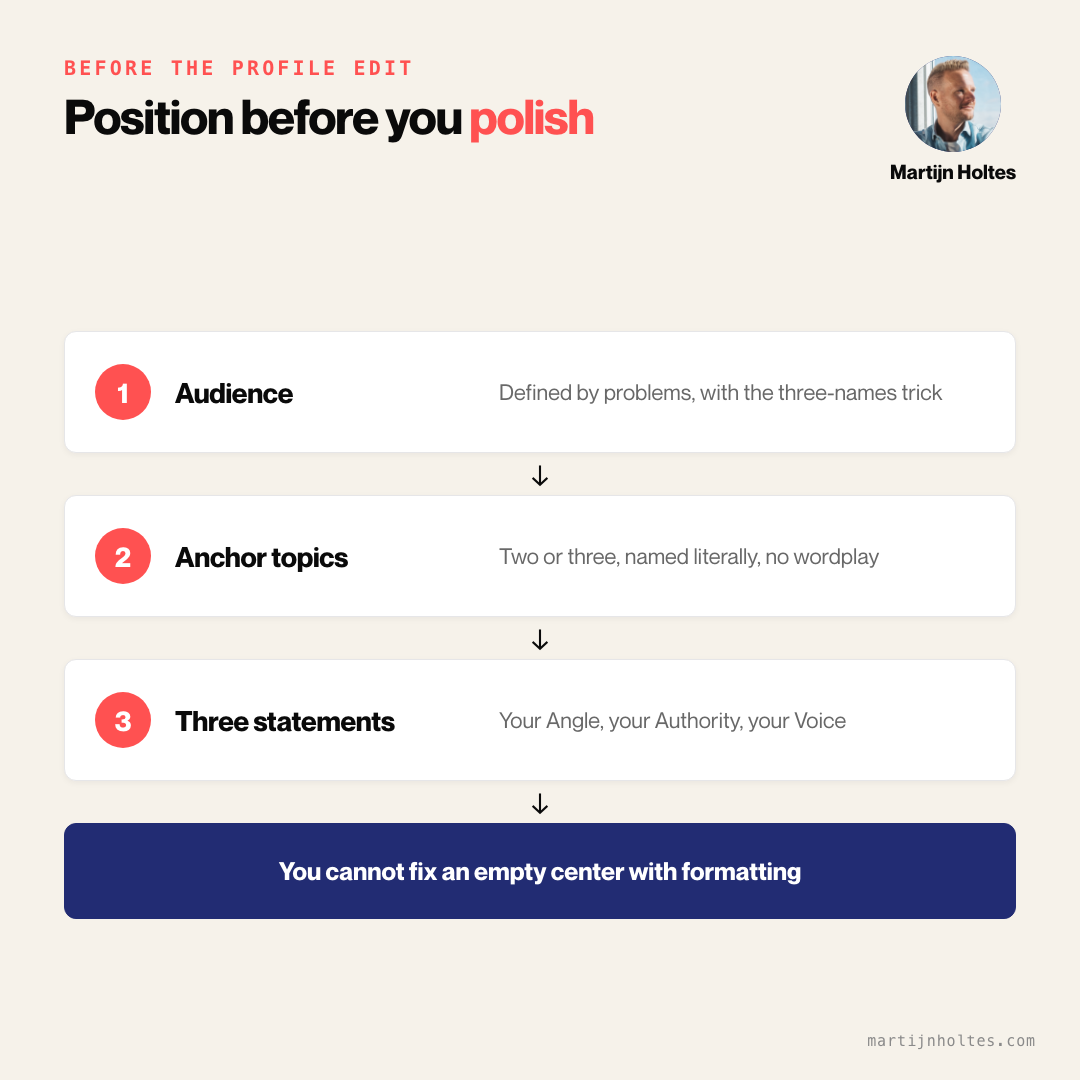
The biggest personal branding mistake happens before the profile edit: people optimise how they look before they know what they’re saying. New headline, new banner, new About section. It looks good. And it says nothing, because there’s no anchor underneath. You can’t fix “I don’t know what I’m saying” with a nicer banner.
So start with the positioning work, on one page.
Your audience, defined by problems. Not “decision-makers in tech,” but the people whose specific problem you solve. A trick I use: write down three real companies or people you’d love as clients, and find what they share. That shared trait is your audience definition, and it’s never “companies with 50 to 500 employees.”
Two or three anchor topics, named literally. The intersection of what you know and what your audience needs, in the plain words people search: “employee advocacy,” “B2B pricing strategy,” “supply-chain risk.” Not “helping organisations thrive,” which classifies you as nothing and routes you to nobody. Clever wordplay in your headline used to look smart. Now it tells the system nothing, so it sends you nowhere.
Three statements from your backstory. Your Angle: the view from your experience that your industry gets wrong. Your Authority: the specific problem you solve, not your job description. Your Voice: the message people should hear from you consistently, the conversation you want your name attached to.
If those feel abstract, mine your backstory: the moment that changed how you see your industry, the thing people keep asking you about, the one thing you wish every professional understood. The answers already exist. They’ve been building for years. You’ve never written them down.
Everything else in this article executes that one page. Without it, you’re polishing a profile that still doesn’t say anything.
Your profile has three jobs now
In the interest graph era, strangers arrive at your profile because a post got routed to them. The typical path: someone sees three to five of your posts, gets curious, and visits. At that moment your profile has three jobs: confirm, convert, classify.
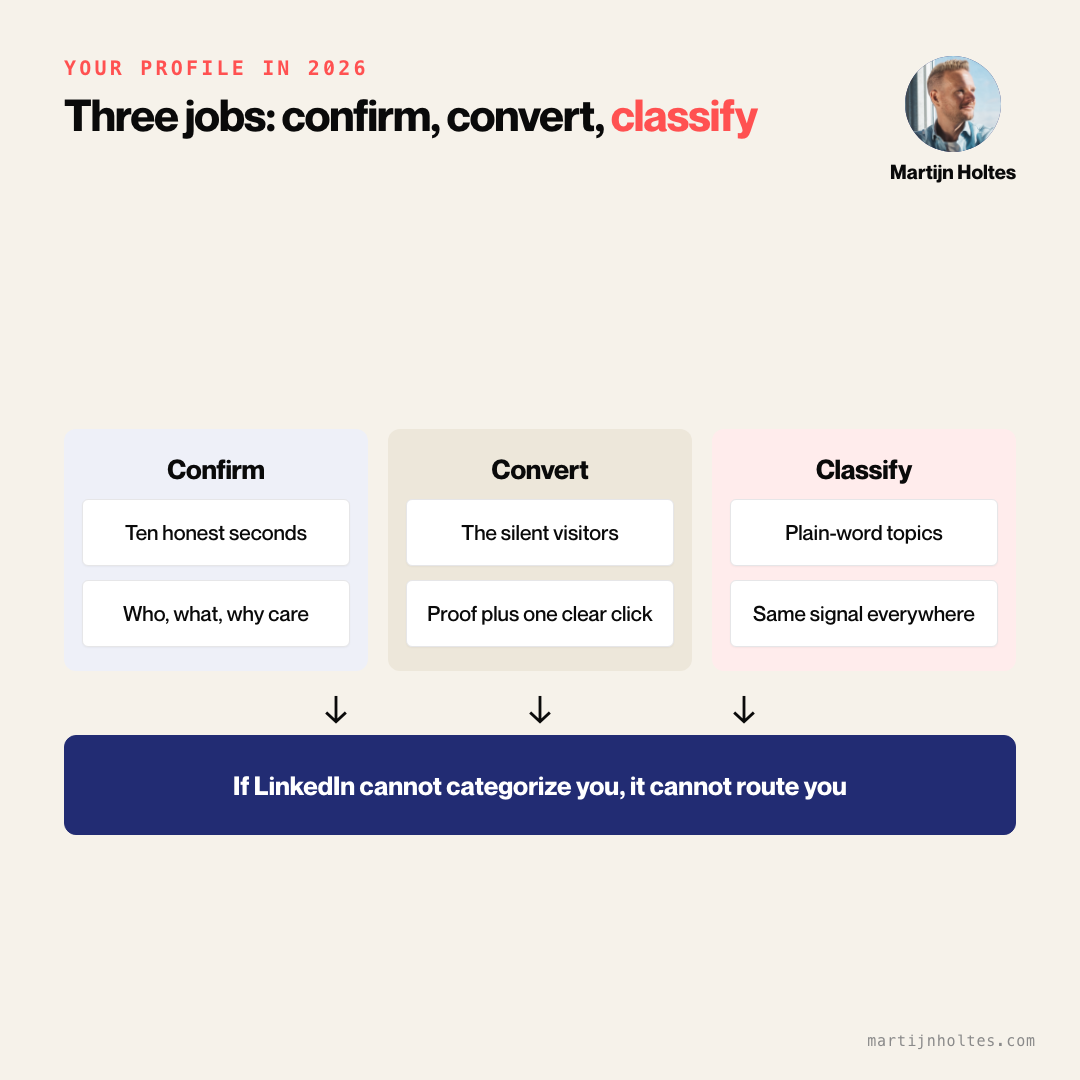
Confirm. The visitor came for a topic, and your profile has about ten seconds to confirm you’re the person for that topic; eye-tracking research says the first impression forms in roughly seven. Run the test in a private browser: can a stranger answer who you are, what problems you solve and why they should care, without scrolling or clicking?
Most profiles fail because they’re written as a CV for people who already know you, and a CV only works on people already looking for you. Your posts found these visitors. Your profile has to keep them.
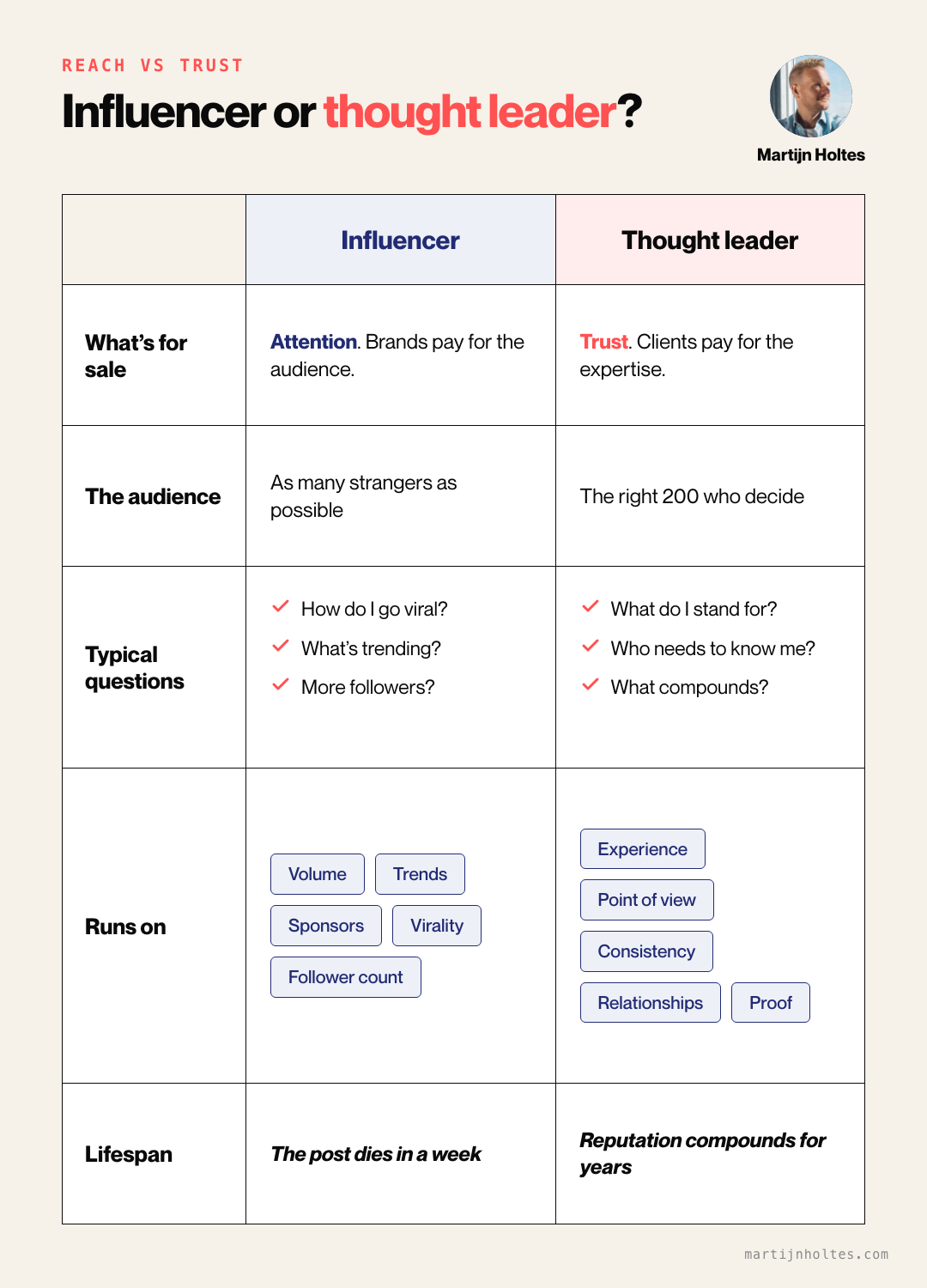
Convert. The visitors who matter most are silent. Picture three rings around your content: a virality zone of strangers who’ll never buy, a target audience of peers who supply most of your likes, and your ideal audience, the people with budget and decisions, who barely engage at all.
They read, they visit, they decide in silence, and they reach out when they’re close to a decision. So your profile is a landing page for people who will never comment. Give them something: a headline with proof, a Featured section with one useful low-commitment resource, an About text about their problem instead of your career history.
Classify. Your profile feeds the algorithm’s understanding of you. The same two or three topics, in plain words, across headline, About, current role, skills and, ideally, recommendations, is what gives the system semantic confidence to route you.
Consistency is the multiplier: one clear signal repeated across five locations beats five clever ones. Use variants of the terms, not the same phrase five times over, but keep the signal identical.
A clear profile is step one. Being known takes a system.
I build that system with professionals and executives. 250,000+ professionals trained since 2011.
See how I build itThe fields that do the heavy lifting
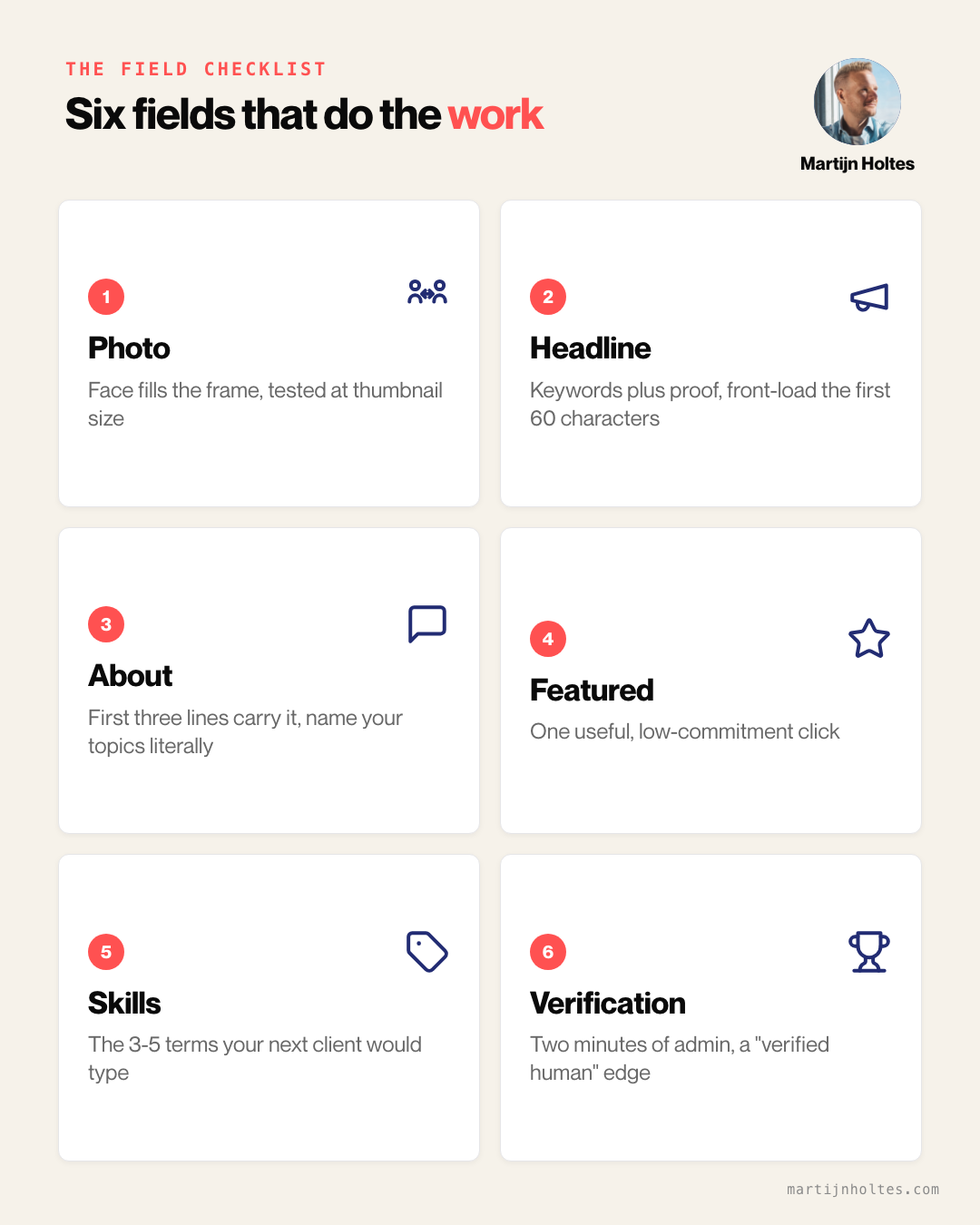
Photo and banner. The much-quoted LinkedIn stat has profiles with a proper photo getting 14x more views and 36x more messages, and whatever the exact multiplier, the direction is obvious: this is your first trust signal. Face and shoulders, face filling most of the frame, recent, sharp, tested at thumbnail size.
The banner is a free billboard most people leave as blue wallpaper: put your value message on it in under ten words, and check it on a phone, where more than half your visitors are and where the edges crop.
The headline, your most-distributed asset. It travels with every post, every comment, every connection request, so it works harder than any other line you’ll write. You get 220 characters; the sweet spot is 150 to 200, and only the first 45 to 60 show in search results and comments, so front-load the part that matters.
Skip the “I help X achieve Y” template. Everyone uses it, so it can’t set you apart. Build it from keywords plus proof instead: the topics you want to be found for, and evidence you’re worth trusting.
Keywords get you found, proof gets you trusted; mine carries “950+ companies” for exactly that reason. Pipes between elements, no emojis, and none of the buzzwords, “passionate,” “visionary,” “guru,” that mark a profile as decoration.
The About section, read by the few who matter. Only around 15% of visitors read it, and barely anyone clicks “see more,” which sounds like a reason to neglect it until you realise who that 15% is: disproportionately your ideal audience, doing their silent homework.
Two consequences. The first three lines are a standalone deliverable, open with the question your reader can’t dismiss, the tension they recognise, or the moment they’ve lived, because that’s all most will see. And the body follows a simple arc: the problem you solve, who you are professionally and personally, the value you bring, the proof, and how to reach you.
Name your two or three topics literally in it, “I write about X, Y and Z,” first person, short paragraphs, somewhere between 1,500 and 2,000 characters. It’s a conversation starter, not a biography.
The evidence layer. Your current role description is the workhorse: write it for your audience, who you help, how, with what proof, instead of a responsibilities list, and let the job-title field carry keywords, search engines index it. Link every role to the official company page so the logo renders.
Use the Featured section as your conversion shelf: two to five items, always including one low-commitment, high-value click, a guide, a checklist, your newsletter, and rotate it every quarter. Skills feed the search: pick the three to five terms your next client would type, backed by a longer list of variants.
And recommendations are your risk-reducers, because hiring you is a risk for them, and a strong recommendation lowers it: three strong, recent, audience-relevant recommendations beat ten generic ones, and the best moment to ask is the week a project lands well. Make the whole profile proof-dense; no screen-length stretch should pass without evidence.
The content that works in 2026
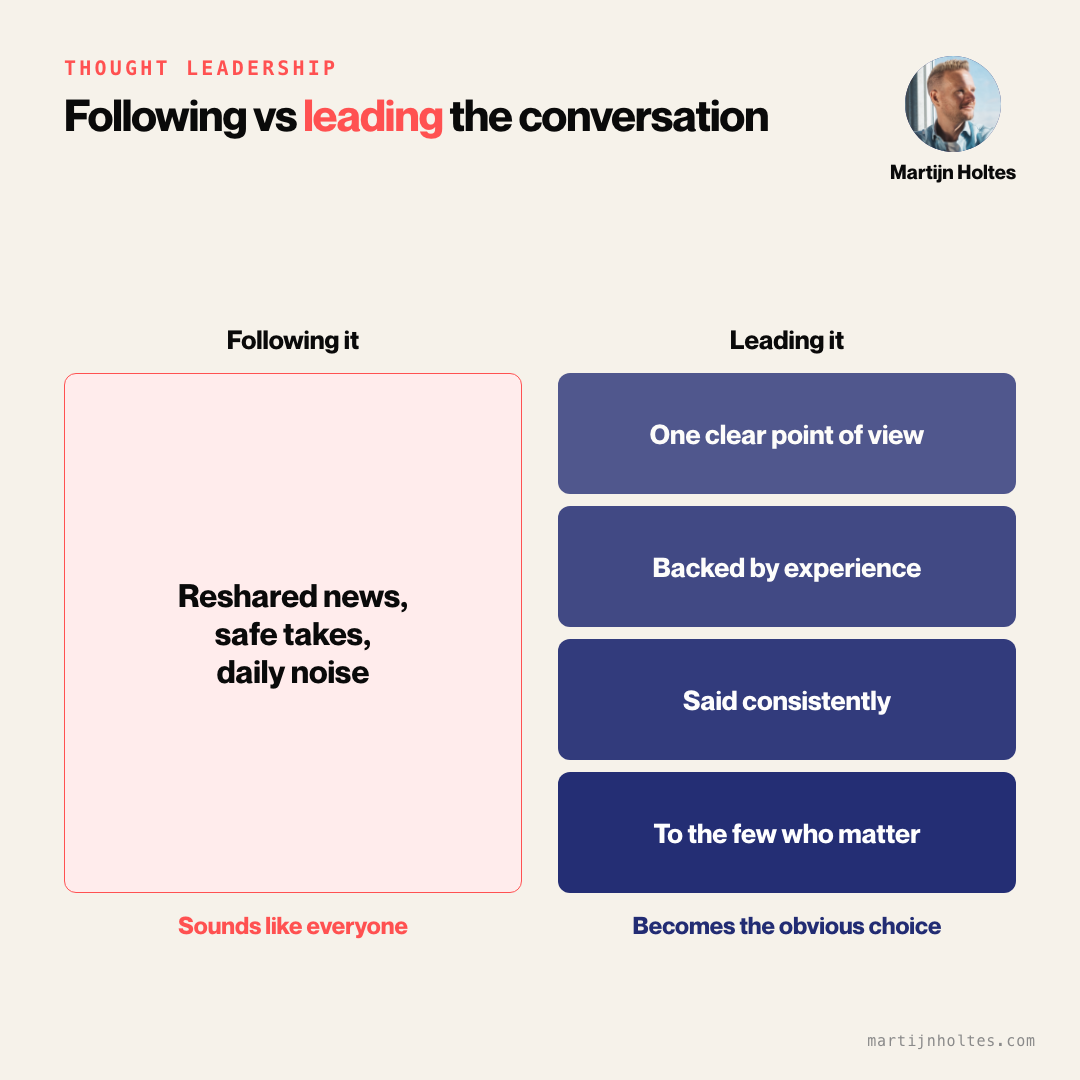
The feed rewards a recognisable point of view on a narrow lane. The algorithm doesn’t admire conviction; it finds a consistent topic pattern easy to classify and route, and readers remember the person who says one thing clearly over the person who comments on everything.
The rhythm.
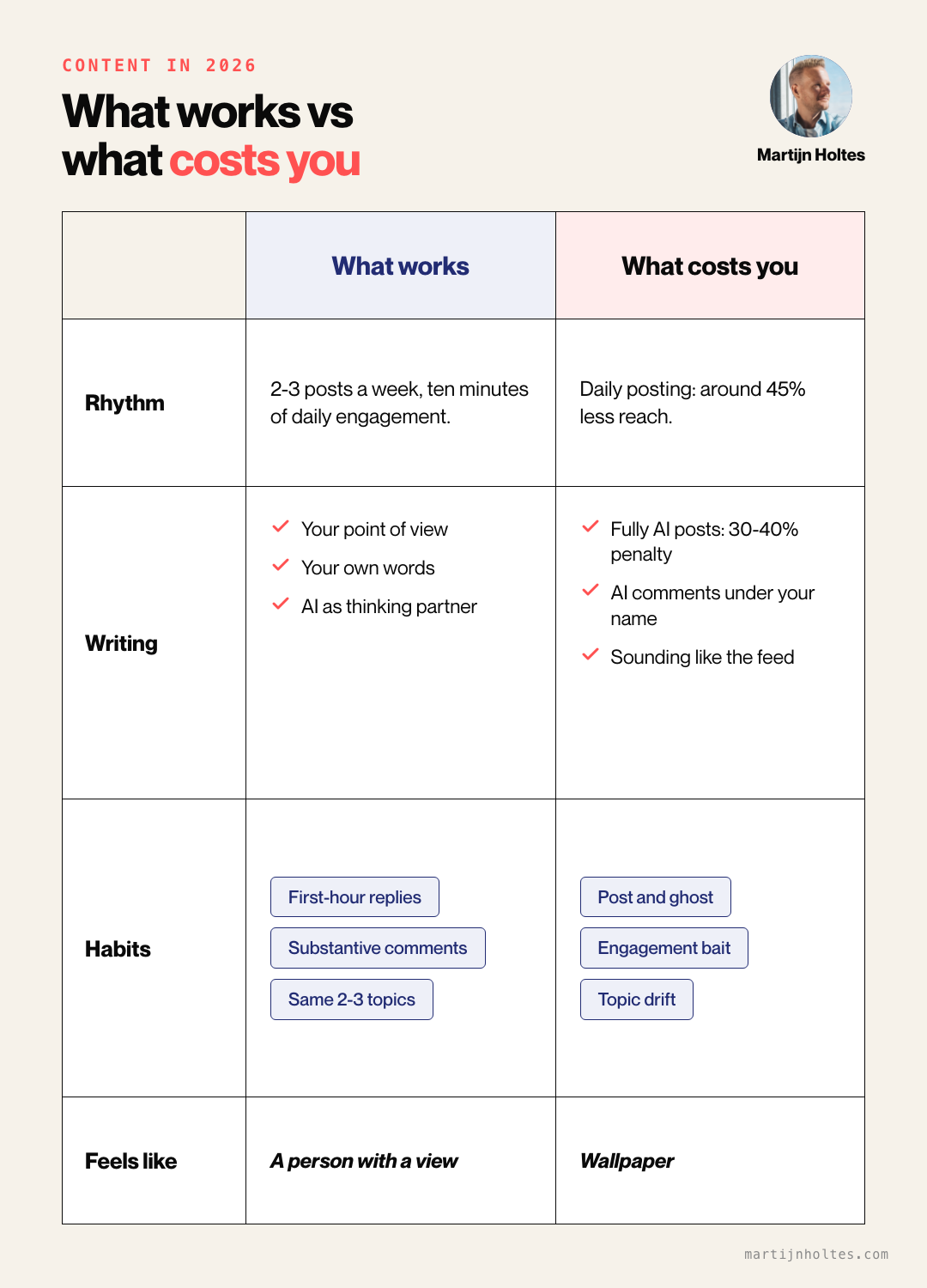
Two to three posts a week is the working optimum, with daily engagement in the ten-to-twenty-minute range. More is worse: daily posting measurably cuts reach, around 45% in the current data, because the system now caps volume in favour of quality. If you can’t manage that, the working baseline is two posts a month plus twice-weekly engagement, held without fail. Two posts a week for a year beats daily for three weeks and then nothing.
The mix.
Weight your posts toward your expertise: roughly half authority content, your take on your topics, and the rest split between proof (results, cases, recommendations), personality (the human behind the expertise), and the occasional direct ask. If every post is an ask, you’re a brochure; if none is, you’re a very helpful stranger forever.
Comments, the most underrated move on the platform.
A substantive comment, a real opinion of three or more sentences, carries roughly fifteen times the weight of a like in the current engagement models, shows up in front of the author’s entire network, and takes your headline with it.
Five substantive comments a day generate more impressions than two posts a week, which means the busy professional’s excuse, no time to create content, is dead. Commenting is also how you feed your own 90-day fingerprint on the days you don’t post. Ten focused minutes. That’s the entry price.
The first hour or so.
When you do post, stay around: replying to comments in the first 30 minutes measurably extends a post’s life, because early conversation tells the system the post is worth routing further. Post-and-ghost is a real penalty now. You wouldn’t throw a party, open the door and leave.
And write your own material.
Fully AI-generated posts take a 30 to 40% reach penalty, and the audience penalty is bigger than the algorithmic one, because the feed is drowning in identical AI sludge and readers now skip anything that smells like it. Use AI to sharpen your thinking, to argue with, to compress research, but the point of view has to be yours, because your point of view is the one thing the machine can’t generate and the audience can’t get elsewhere.
And never let AI write your comments.
A bot complimenting posts under your name is the fastest way to turn your brand into background noise.
What does personal branding on LinkedIn cost?
The full breakdown, because the question deserves better than “it depends.”
In money: the platform costs nothing that matters here. Premium is optional, useful mainly for the custom profile button and search, not required to build a brand. The real spend, if you choose it, is help: a positioning and profile session, a masterclass, or coaching over a few months.
Prices vary wildly across the market, so anchor the decision to the unit this pays out in: one client, one speaking gig, one job offer. If a program can’t plausibly return one of those, skip it, and be suspicious of anyone promising you virality instead.
In time: an afternoon for the positioning page, a day for the profile rebuild, then ten minutes of daily engagement and two or three posts a week. That’s the full bill.
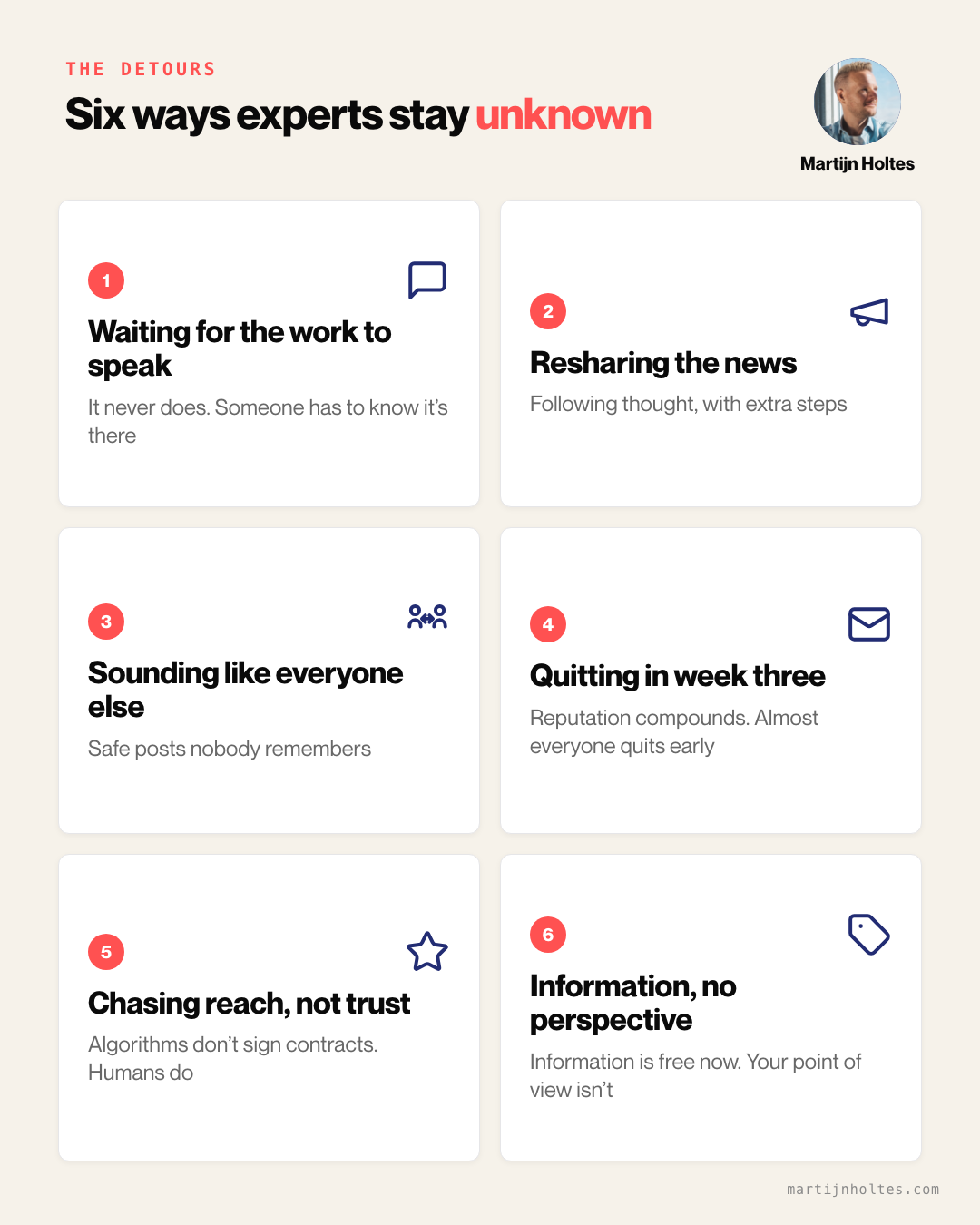
The expensive version of personal branding isn’t the coaching. It’s doing nothing for another two years while less skilled, more visible people keep winning opportunities you never hear about. The cost is invisible, which is exactly what makes it so easy to keep ignoring.
The system that keeps it running
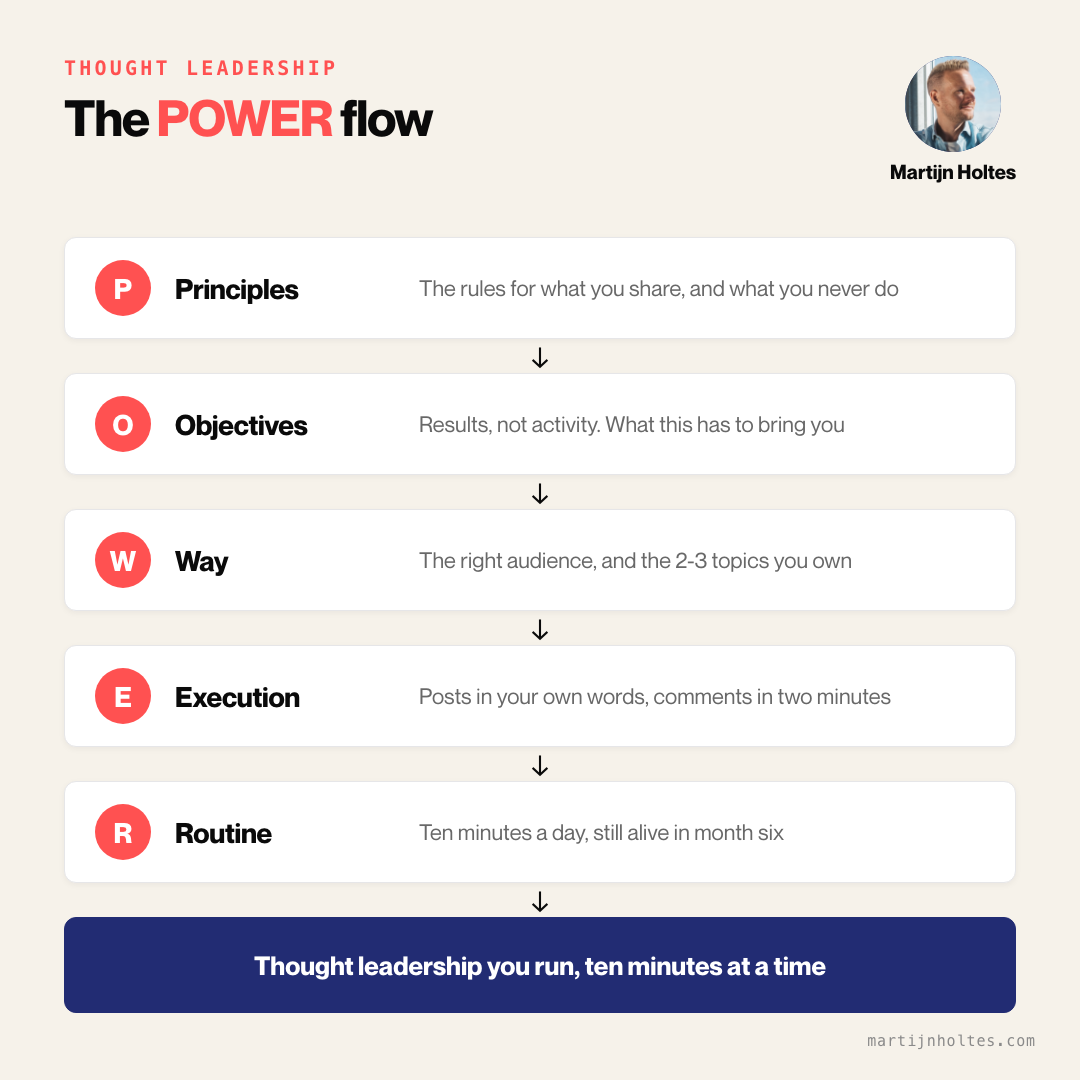
Knowing all this and doing it for six months are different problems, and the second one is where personal brands die. That’s why I run a program with professionals and executives: what you share and what you skip, the objectives it has to hit, the audience and two or three topics you own, formats that fit a busy week, and the ten minutes a day that keep it alive in month six.
The framework won’t do the work for you. It makes the boring weekly part something you can keep up, and that’s the whole game.
Maintenance is light but real: review your positioning quarterly, your topics drift as your work does, and give your profile a fresh ten-second test twice a year. Expect the first measurable signals, profile visits from the right people, better acceptance rates, inbound conversations, after two to three weeks of profile fixes and two to three months of consistent activity.
Tonight, do one thing: open your profile and give yourself ten seconds. If a stranger can’t tell what you stand for, you don’t have a personal branding problem. You have a decision to make, and now you know exactly which one.
Failed your own ten-second test?
Start with an intake call. Tell me where you’re stuck, and I’ll tell you straight if I can help, and how.
Schedule your intake callQuestions I get about personal branding on LinkedIn
How do I build a personal brand on LinkedIn?
In order: define your Angle, Authority and Voice and pick two or three anchor topics in plain words. Rebuild your profile so it confirms your topic in ten seconds, converts silent visitors and classifies cleanly for the algorithm. Then show up: two to three posts a week, daily substantive comments, same topics, for at least ninety days.
What content works best for personal branding in 2026?
Your own point of view on your two or three anchor topics: lessons from real work, opinions you can defend, experience the reader can use. Substantive comments count double for the effort: around fifteen times the weight of a like, visible to the author’s whole network, with your headline attached. Fully AI-generated content costs you reach and, worse, reader trust.
Is there a formula for personal branding, like the 5 P’s or 7 pillars?
There’s no magic formula, and everyone selling one is selling packaging. What holds is a sequence: positioning before polish, profile before content, consistency before results. I run it as a program with clients, a system for keeping it going, not a secret.
What does personal branding on LinkedIn cost?
The platform: nothing that matters. The work: an afternoon of positioning, a day of profile rebuilding, then ten minutes a day plus two or three posts a week. Paid help, from masterclasses to coaching, buys speed and sharper positioning; measure it against the value of one client or one opportunity. The most expensive option is staying invisible.
How long before a personal brand shows results?
Profile fixes show in two to three weeks: more visits from the right people, better acceptance rates. Content compounds on the 90-day window the algorithm itself uses, which is also about how long human trust takes to form. Expect inbound conversations around month three, and don’t quit in the silent first month; that’s where everyone quits.
Do I need thousands of followers for this to work?
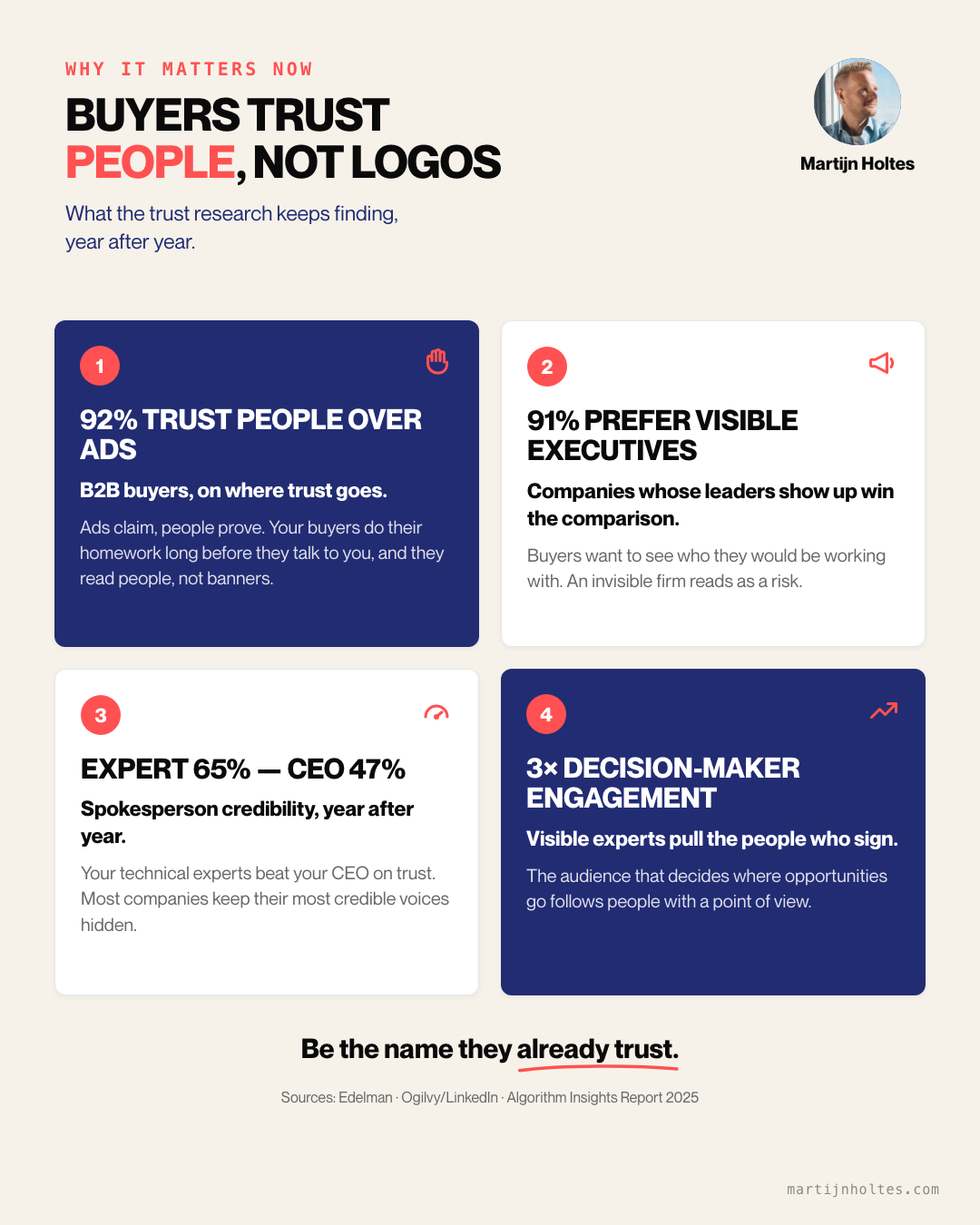
No, and 2026 made that official: distribution now follows topics, not follower counts, and reach has decoupled from audience size. A clear profile with a consistent point of view can outperform a big unfocused account, because the interest graph routes clarity, and buyers trust it.
Does using AI for LinkedIn content hurt my personal brand?
Fully AI-written posts lose roughly 30 to 40% reach, and readers discount them further, the feed is full of them and they all sound the same. Use AI as a thinking partner and editor, keep the point of view and the words recognisably yours, and never let it write comments in your name.
What matters most on my profile?
In visitor order: photo and headline (the first impression forms in seconds), then your activity, then the About section that only your most serious visitors read. Fix them in that order, keep the same two or three topics across all of them, and make every section carry proof. One page of positioning beforehand makes every field ten times easier to write.