You read something, nod along, think “I should use that”, and then close the tab. By Friday it’s gone, buried under the next forty things you read.
Most of us are knowledge workers and get paid for what we know. But what you know is trapped in your head and scattered across a hundred half-read articles, presentations and emails.
The fix isn’t reading faster, or saving more. It’s what you do with the good stuff once you find it.
For years I tried to find a system that would surface the right thing at the right moment. Bookmarks, saved articles, even writing it down in a journal, none of it did shit. Turns out reading something does nothing. You have to put it in your own words before your brain actually keeps it. The moment you rewrite an insight instead of just saving it, it clicks.
This is what worked for me. Five moves, and they all happen to start with C.
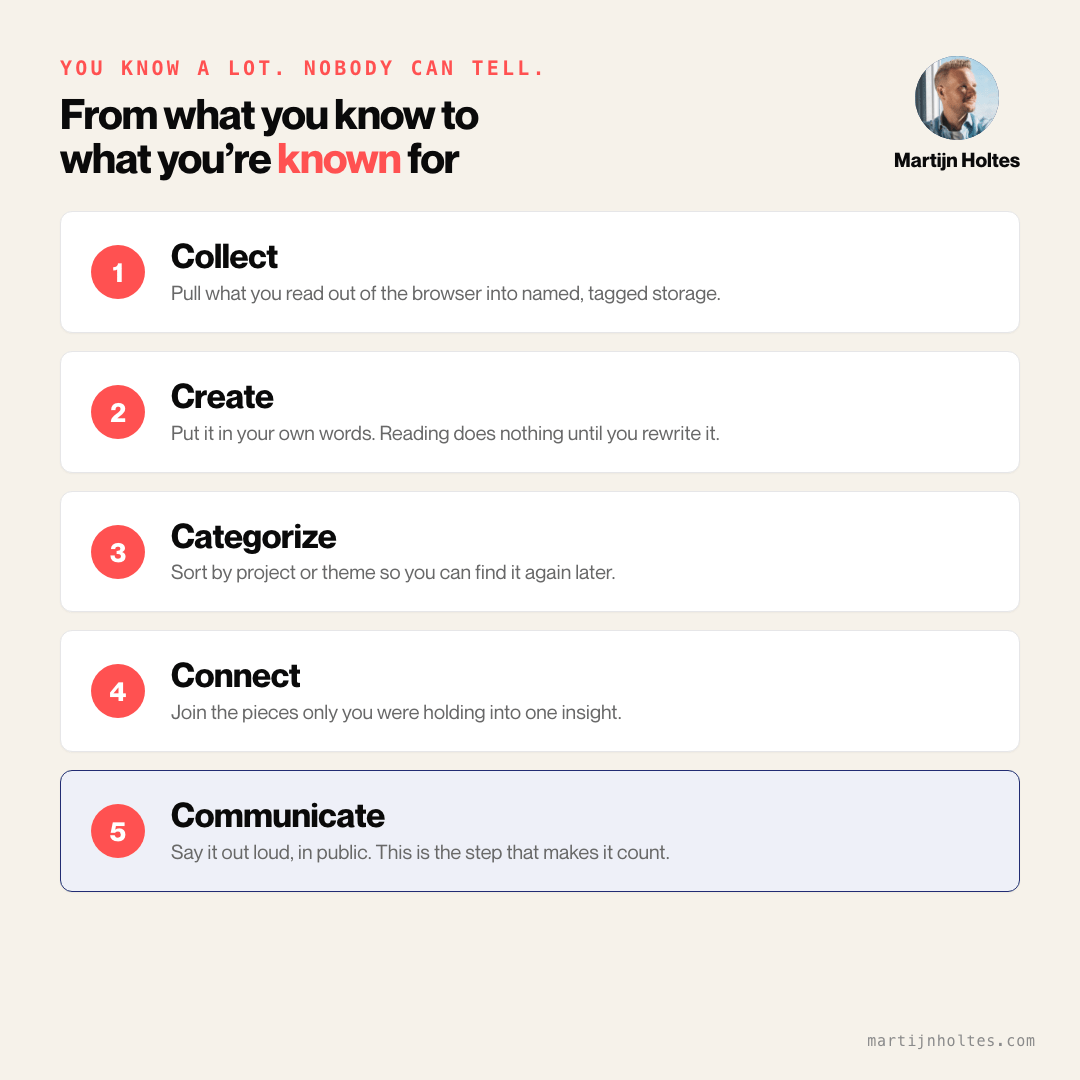
The 5 C’s
Collect. Reading it doesn’t count. Collecting means getting it out of the browser and into a place with a name, so you’ll find it again. Bookmark, note app, whatever works. Read a sharp piece on client retention? Save it, tag it “client relationships,” done. If it lives in an open tab, it’s already lost.
Create. This is where most people stop, and it’s the one that pays. Don’t just clip the article, react to it. Write down the key point AND how you’d use it on the thing you’re working on right now. A note is a conversation with your future self, so ask it a question, argue with it, connect it to your actual work. A quote you saved just sits there. A quote with your own take stapled to it is something you can use next week.
Categorize. Information you can’t find again does nothing for you. Give every project and theme its own folder or tag so future-you pulls the right thing in ten seconds instead of ten minutes. It’s boring admin, and it’s the difference between finding the thing and never seeing it again.
Connect. This is where it gets good. Take two things that were never near each other, a point from an article on consumer behavior and a number from your own last report, and put them side by side. New idea, one only you could have, because only you were holding those two particular pieces. This is the move AI can’t do for you, by the way. It can connect the average of everything ever written. It can’t connect the two things only you happen to be holding.
Communicate. Knowledge grows when you give it away. Turn what you learned into a post, a talk, a memo to your team. Not only does it help other people, it forces you to actually understand the thing, and it does something else: it makes you the person known for this. The person who gets known isn’t the one who knows the most. It’s the one people actually hear from.
The whole point is the last one
You can nail Collect, Create, Categorize and Connect and still be invisible. A beautifully organized brain that never says anything out loud is a tidy way to stay unknown.
The reputation, the referrals, the “we should get him in for this,” all of it comes from Communicate. That’s the step that turns private knowledge into a public position. And it’s the one people skip, because it’s the one that feels risky, and because the first four feel like progress while committing to nothing.
So build the system, yes. Collect, create, categorize, connect. But if it all dies in your notes app, you’ve just built a sophisticated place to hide. Say the thing out loud. That’s where the knowledge finally starts paying you back.