Most people hear “social selling” and think “how do I squeeze the most leads out of my LinkedIn network.” That’s the exact reason it doesn’t work for them.
Building trust, specifically when it comes to social platforms like LinkedIn, pays off nothing in the short term and can pay off enormously over the years.
Treat it like a relationship, because that’s what it is. You can sleep with someone the first night and have a fine time, but that’s not how anything lasting starts. Lasting starts with respect and the patience to get to know each other. Your prospect isn’t a lead to shove down a fucking funnel. Leads are people and most people aren’t stupid. They can smell it the second you’re only being nice because you want something.
So asking “what’s the ROI of networking” is like asking for the ROI on a first date. So don’t and get these four things right instead.
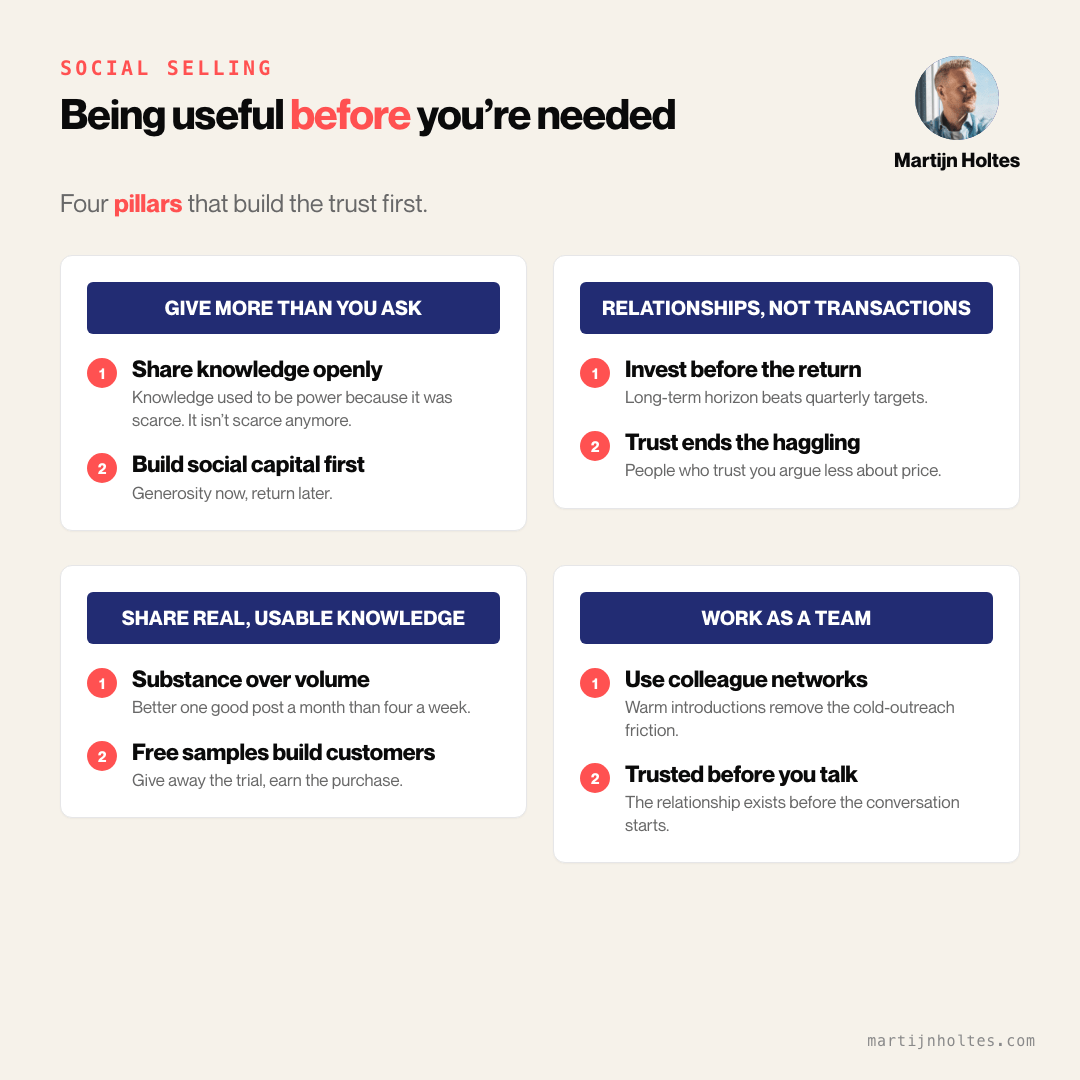
1. Give more than you ask for
Top of the list, and the one most people underrate. We’re trained to justify our time by what it produced, so giving something away with no immediate return feels weird, but in a connected world that’s the whole strategy.
A coffee with a “less interesting” lead can turn into an introduction to exactly the person you needed. Direct and indirect audiences blur together, and the more you give, the more social capital you build, until one day you launch something or need a door opened and it turns out you’re owed a hundred small favors you never asked for.
The main thing you give away is insights and knowledge. Knowledge used to be power because it was scarce. It isn’t scarce anymore, so hoarding it buys you nothing. Share it, apply it to your specific niche so your specific audience recognises it instantly, and let people find and value you for the substance. Yes, that means you need to create better content and share your experience and thinking publicly. In a world this transparent, it’s how you stand out.
2. Build relationships, not transactions
“Are you the sales tiger we’re looking for?” I always wonder who the hell writes those job ads. If I had to hand part of my sales process to someone, I’d take a calm, useful human over a tiger who bites my clients’ heads off every time.
Anyway that’s my frustration about the sales industry
Social selling runs on long-term relationships. You invest first, and sometimes that means not closing a deal, because the buyer isn’t better off buying right now. Adding value is the only thing that counts, and if you’re not convinced you can, it’s better to wait. Because in a connected world a bad deal travels fast, and so does a good one.
There’s a bonus in this too: when you lead with the relationship, you spend a lot less time haggling over price. People who trust you argue less about your rate.
None of this is news, I know. The reason short-term targets still rule is that the whole economy is built on them. Shareholders want good numbers by the next meeting, the freshly promoted manager wants to show he can double revenue this quarter. It’s also, I’d bet, why family businesses tend to ride out downturns better. They think in years, so they’re steadier.
3. Share real, usable knowledge, openly
Plenty of companies will help you “do content.” Many of them scream for attention with ads and empty posts, and some even get results with it, but that’s not the game I’m playing.
I only share something when it’s relevant and think it’s worth your time. Sharing knowledge is never about volume, always about substance. Better one good post a month than four a week of noise. Think of it like the free samples in a supermarket: you taste the drink, and a chunk of people put a bottle in the cart, and some of those buy it again. Drug dealers apply the same tactic but let’s not go there
Give away a real piece of your expertise now so you can invoice the bigger piece, the training, the project, later.
And even if your network does nothing for you yet, it’s still smart to publish. Search engines and LLM’s reward content that answers the questions people actually ask, so write it down and your audience finds you on their own. Saves you a pile of those fucking annoying cold calls nobody wants to get.
4. Work as a team
“Using” your colleagues sounds cold, so let’s call it what it is: strengthening each other. When you work with people you actually get on with, they’ll usually help you, especially when it costs them two minutes.
In a networked world you can see into each other’s networks. Who knows whom, and how that helps you. LinkedIn even shows you exactly who’s in your colleagues’ network, and a warm introduction beats a cold approach every time. Remember the top of this article: don’t jump on everyone the second you spot them. Get introduced and you at least won’t look like a desperate idiot
I trained many sales reps who do this now as a habit. Every meeting, they pull up their prospects, everyone checks their LinkedIn networks side by side, and figures out who can introduce whom. The prospect gets approached either with genuinely useful knowledge or through someone they already trust. The polished sales pitch is gone, because by the time they talk, the prospect already knows this person at least has a chance to solve their problem.
So by the time they’re ready to buy, they already trust you.
Everyone else is still cold-calling. And cold calls are fucking annoying…