What is thought leadership, or what is a thought leader?
I get introduced as one, usually right after the “16 years, 250,000 professionals helped” part.
Most of us, including me, have or had no idea what the concept really means.
Is it an ego trip or is there something substantial about it? To me, it is defined by something really simple.
The people we call thought leaders usually aren’t smarter than everyone around them. They just said what they thought out loud, with their name on it, while everyone else kept quiet.
That’s the whole trick. It’s got nothing to do with intelligence and everything to do with your experience, in-depth knowledge of the topic and the nerve to share a point of view even if people disagree with it.
That nerve is also why most people never do it, and I get why.
Put an opinion out with your name attached and someone can push back, quote you, and push a screenshot in your face, when you’ve changed your mind.
Staying quiet feels safer, and for a long time, it was.
Not anymore.
We’ve got machines now that hand anyone a competent, reasonable answer to almost any question in about four seconds. If your value was knowing the standard answer, I have bad news for you.
The scarce thing now is a person who’s done the work, innovates, reads and holds a point of view you can’t get from a prompt.
What AI doesn’t have is your experience, the mistakes you paid for, and the opinion you formed at 2am after a project blew up. And the more AI floods the world with average answers, the more a point of view makes you antifragile.
So let me answer the question properly, because the term deserves a better definition than the people who ruined it.
In this article
- What is thought leadership, in simple words
- How the term got ruined
- Is thought leadership just marketing?
- Why does this matter more than five years ago
- Why the most skilled people stay invisible
- Thought leadership vs personal branding
- Thought leadership vs influencer
- The mistakes that keep professionals unknown
- What about a point of view feels risky (and what’s true)
- A model for Thought Leadership
- Where to start, before any framework
- Questions I get about thought leadership
What is thought leadership, in simple words
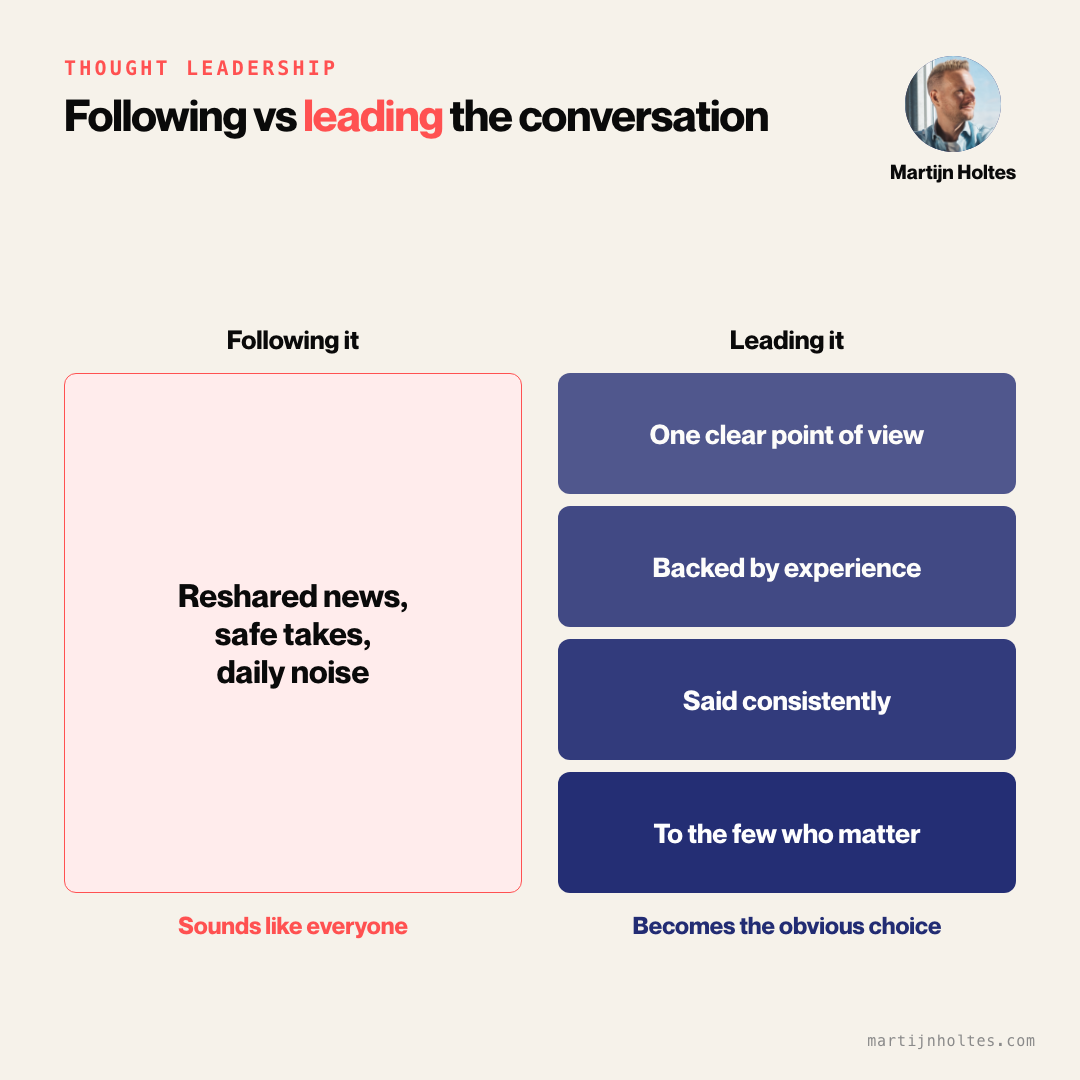
Thought leadership is getting known for a clear point of view by the people who decide where the opportunities go.
That’s the whole thing.
You know something from experience. You say it in public, in your own words, consistently.
And after a while the right people connect your name to that topic, so when a project, a speaking gig or a lead needs what you have, your name comes up first.
Notice what’s not in that definition.
No follower counts, viral posts or daily video of you walking through an airport.
You don’t need to be louder than everyone else, you need to be clearer, to the few who matter.
In practice it is almost boring.
It is a tax lawyer known for one sharp view on holding structures.
An IT manager whose posts get forwarded inside client companies.
A consultant whose name comes up in meetings she’s not part of, because the people who make the decision have been reading her content for a year.
That’s what leading thought means: when your topic comes up, you’re already in the conversation, even when you’re not there.
How the term got ruined
Somewhere along the way, thought leadership got hijacked by people posting daily selfies with a lesson attached. “I just had my lunch, this is what it taught me about B2B sales.”
Add the gurus promising that if you post at 7:00 sharp every morning, with a million-dollar template, your pipeline will explode and everything will be amazeballs, and you can see why serious professionals want nothing to do with the label.
Those people made the term sound like a self-promotion scheme.
And because the loudest examples are the worst ones, plenty of skilled people concluded the whole category is fake. Which suits the fakers fine, because it keeps the people with real expertise out of the arena.
When someone reshapes their opinions weekly to match whatever trends, that’s content.
When a ghostwriter produces safe platitudes under an executive’s name, that’s PR.
When someone who’s done the work for years shares what they’ve learned, takes a position and defends it, that’s thought leadership, and we as readers can tell the difference faster than you’d think.
Is thought leadership just marketing?
Yes, in the sense that it makes you easier to find, easier to trust and easier to buy from.
If that offends you, you’ll need to explain to me why being findable by people with the exact problem you can solve is a bad thing.
But no, in the sense that it can’t be faked the way marketing can.
A campaign can claim anything.
A point of view has to survive contact with an audience that knows the subject, week after week, in public.
If you wanna figure this out, ask this question: would this person hold the same opinion if nobody was watching?
If yes, you’re reading thought leadership.
If the opinion changes with the algorithm, you’re reading an ad with a face on it.
There’s also an ethical line, because the question “is thought leadership ethical” gets me asked more than you’d expect.
Claiming expertise you don’t have, buying engagement, and fabricating results is just a lie packed in a content calendar. People eventually find out, and the industry is full of people finding out right now.
Why does this matter more than five years ago
Being good at what you do no longer sets you apart. Not because skill lost value, but because it became the baseline. AI hands everyone the same competent answer, and every competitor claims the same quality in the same words. Information went from scarce to free, which means knowledge alone doesn’t make you valuable anymore.
What no tool can copy is the way you see a problem, shaped by everything you’ve done that nobody else has.
Your point of view is the one asset that doesn’t devalue when the machines get better.
But a point of view only counts if the right people know it’s there.
And the buying side has already moved.
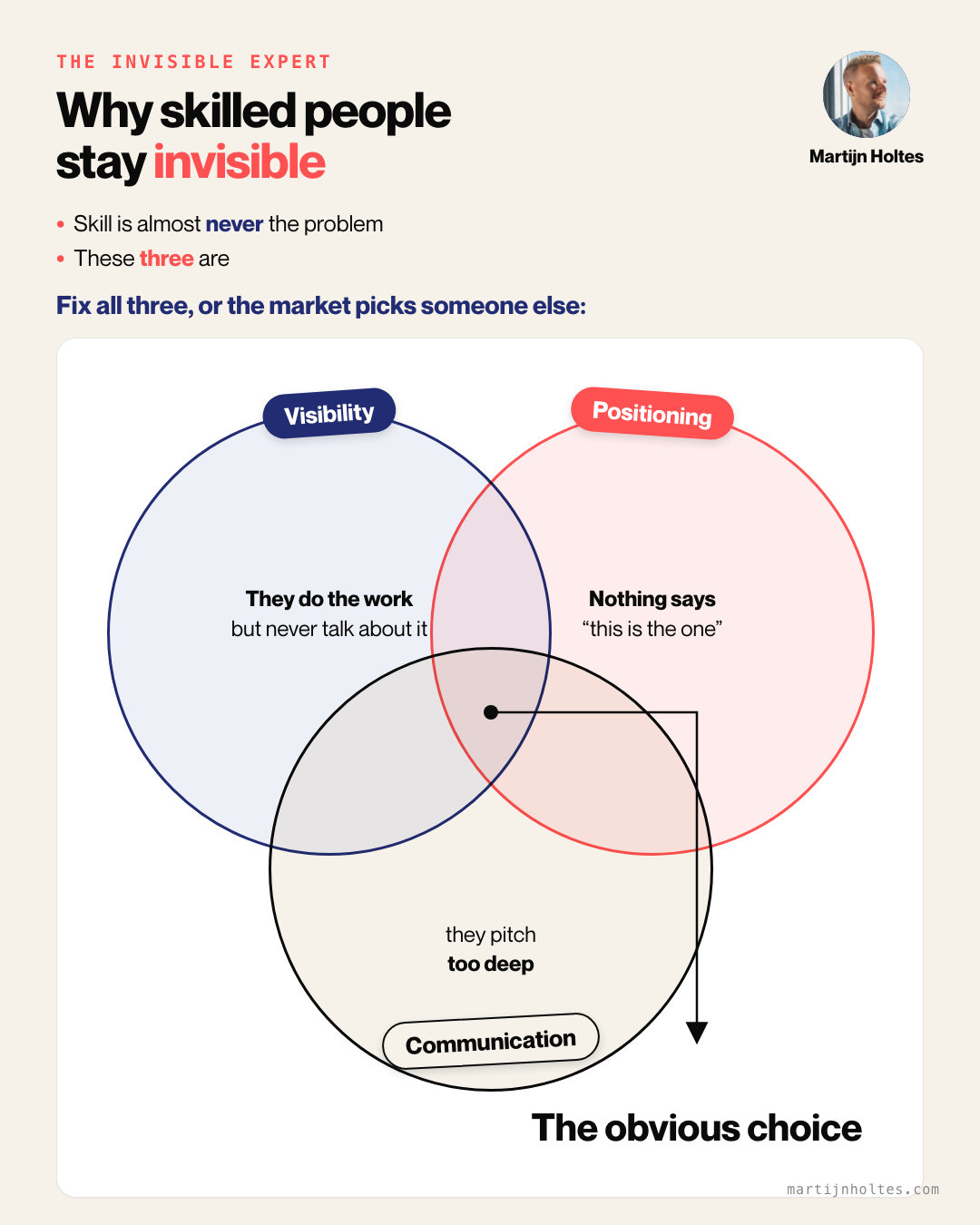
The Edelman and Ogilvy/LinkedIn research came to the same conclusion year after year:
✅ 92% of B2B buyers trust people over ads,
✅ 91% prefer companies with visible executives,
✅ A technical expert scores 65% on credibility, where a CEO gets 47%.
Read that last one again: your experts beat your CEO.
Buyers do most of their homework before they ever talk to a salesperson, reading, comparing, and building a mental shortlist.
If they can’t find a person with a point of view at your firm, they find one at your competitor.
Why the most skilled people stay invisible
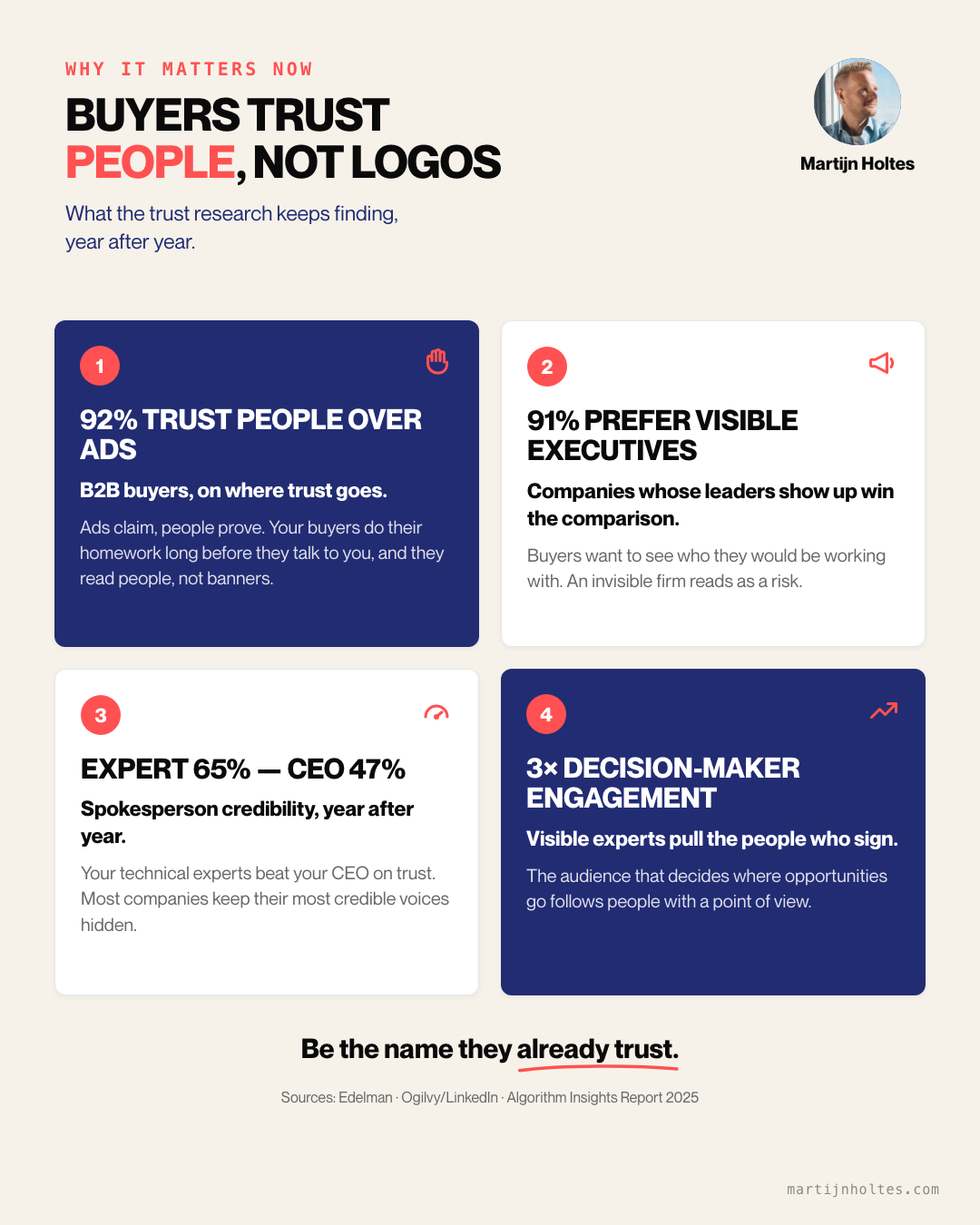
Three things keep skilled people stuck, and most invisible experts are stuck on at least two.
Visibility.
They do the work but never talk about it, so the people who need them don’t know they exist.
I know cause I am one of them 🫣
They were told the work speaks for itself, but it doesn’t anymore.
Quality is the baseline, not the differentiator, and your competitors who are half as good but twice as visible will win the deals. Not because they’re better, but because the buyer found them first and never looked further
Positioning.
Even when they’re visible, nothing marks them as the obvious choice.
Same titles, same claims, same “passionate about helping businesses grow.”
If I could swap your profile text onto your competitor’s page and nobody would notice, you don’t have a positioning problem, you have a positioning problem.
Communication.
They pitch at the wrong level, too deep inside their own expertise.
When you get that good, you forget what it was like not to know, and your audience still needs you to close that gap. The expert who can’t be understood loses to the expert who can, every time, regardless of who knows more.
Notice that none of these are fixed by posting more.
That’s why “be more active on LinkedIn” is such useless advice: it treats a positioning problem as a volume problem.
Thought leadership vs personal branding
People treat these as rivals, but they’re the same work from two sides.
Personal branding is how you’re known. Thought leadership is what you’re known for.
You can have a personal brand without thought leadership.
A recognizable face, a polished profile, and nothing to say.
You can’t have thought leadership without a personal brand, because a point of view nobody can find isn’t leading anything.
In practice you build them together, and the point of view does the heavy lifting, because a strong opinion clearly argued is memorable in a way a nice headshot will never be.
Good at the job, invisible to the people who need you?
That’s fixable, and it doesn’t take a personality transplant. I’ve done this with 250,000+ professionals at 950+ companies.
See how I build itThought leadership vs influencer
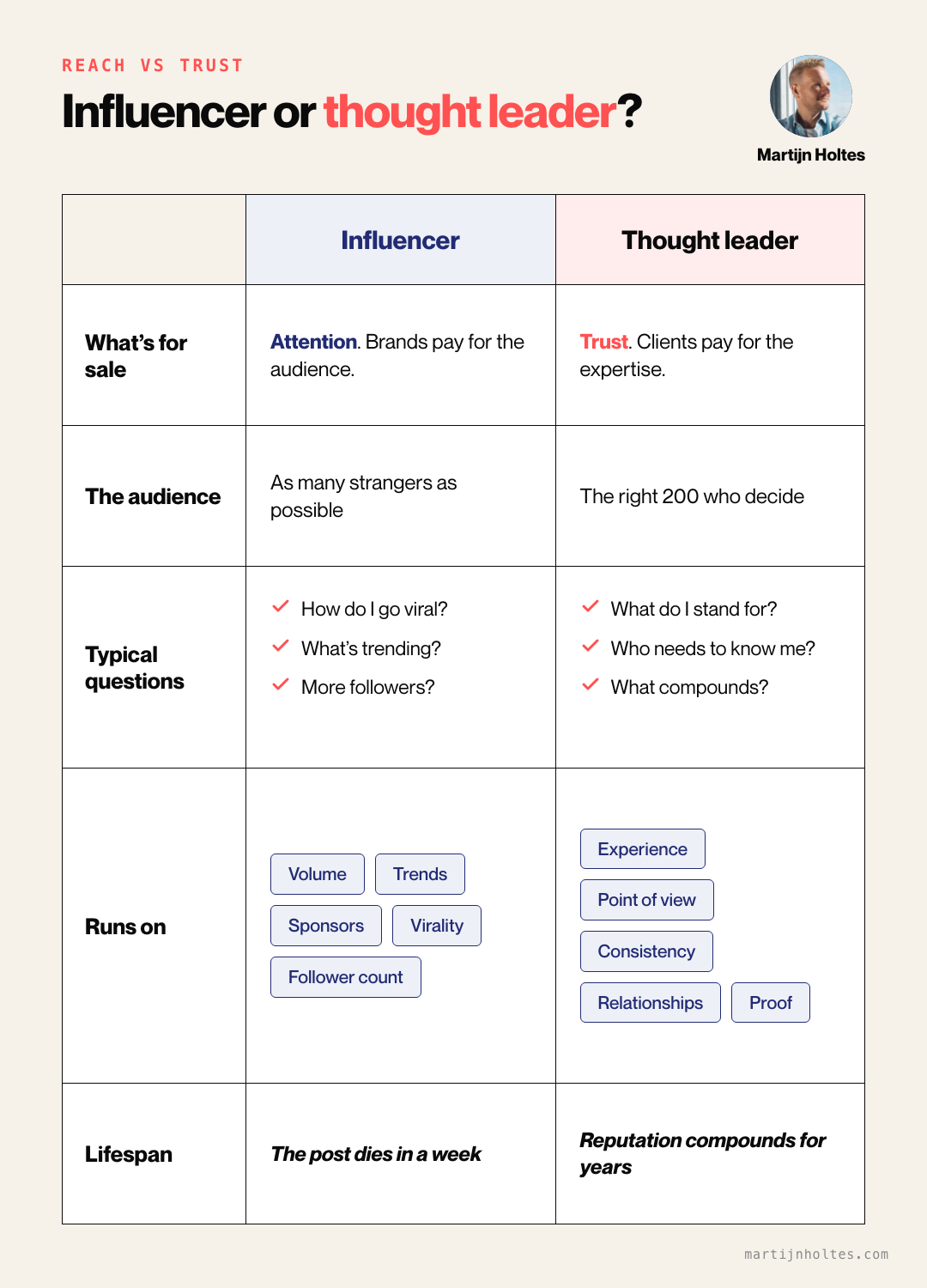
An influencer’s audience is the product.
They get paid because many people watch, and the topic can be sneakers today and software tomorrow.
A thought leader’s product is trust.
They get hired because the right two hundred people believe they understand the problem.
Which is why follower count tells you almost nothing here.
I know consultants with 3,000 followers who win seven-figure projects from their posts, and creators with 80,000 who can’t sell an e-book.
Reach is about being seen by strangers.
Thought Leadership is about being trusted by the people who sign.
Different game, different scoreboard, and the biggest mistake in this whole subject is playing the first game while needing the results of the second.
The mistakes that keep professionals unknown
After working on this for many companies and with many participants on this for years, these are the top mistakes I noticed.
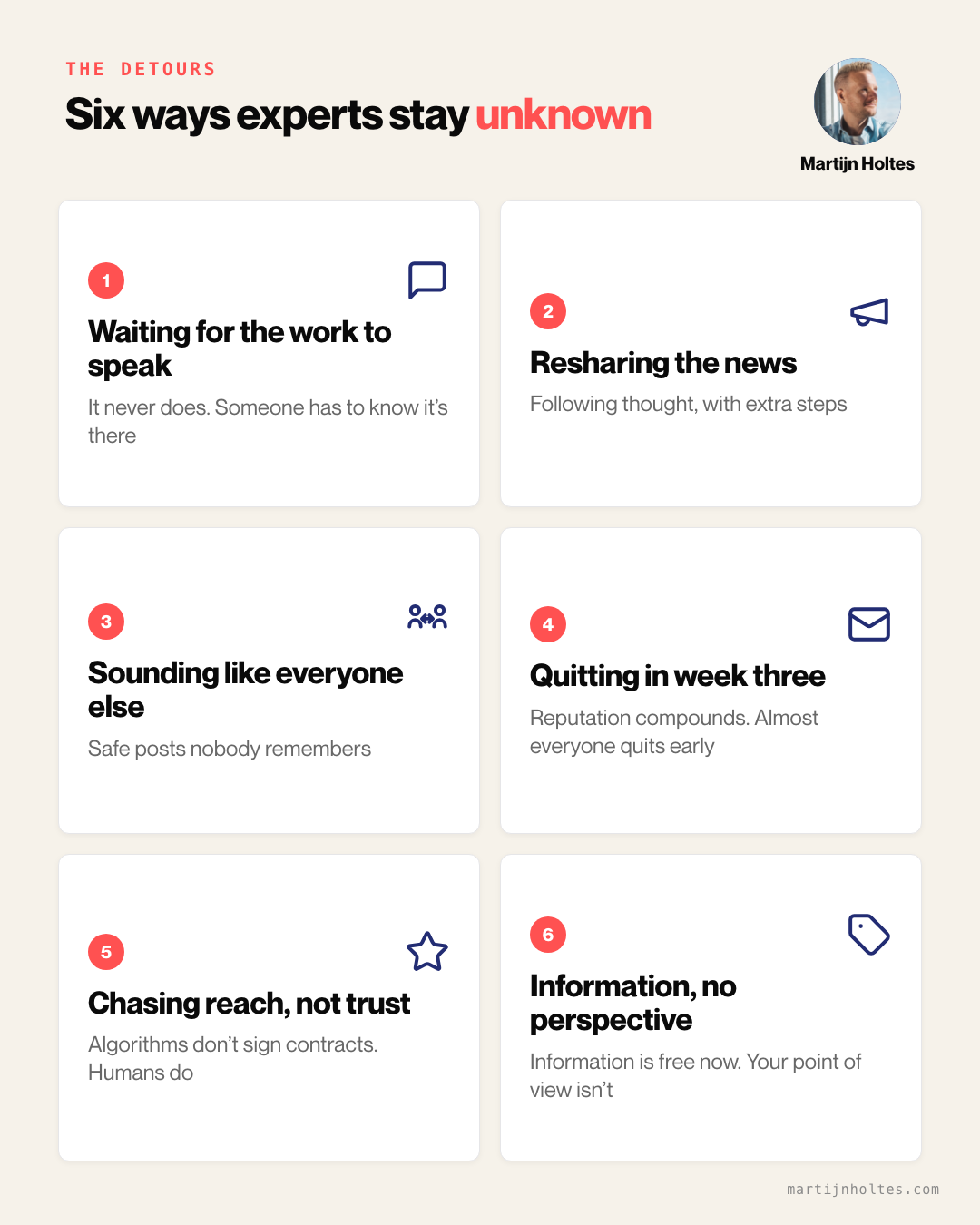
Waiting for the work to speak for itself.
It never does. Someone has to know it’s there. Your work can’t speak if nobody knows it exists, and the buyer’s shortlist gets built from what they can see, not from what’s true.
Resharing industry news and calling it a day.
Reposting someone else’s article with “interesting read!” isn’t leading thought. It’s following it, with extra steps.
The value was never the news, it’s what you think the news means for your corner of the market. No take, no thought, no leadership.
Sounding like everyone else.
Safe, agreeable posts that nobody could disagree with, because nobody could remember them either.
The profile that says “passionate about innovation,” the post that congratulates the industry on another insightful event. Most people hide their real opinion behind professional wallpaper, and then wonder why nothing comes back.
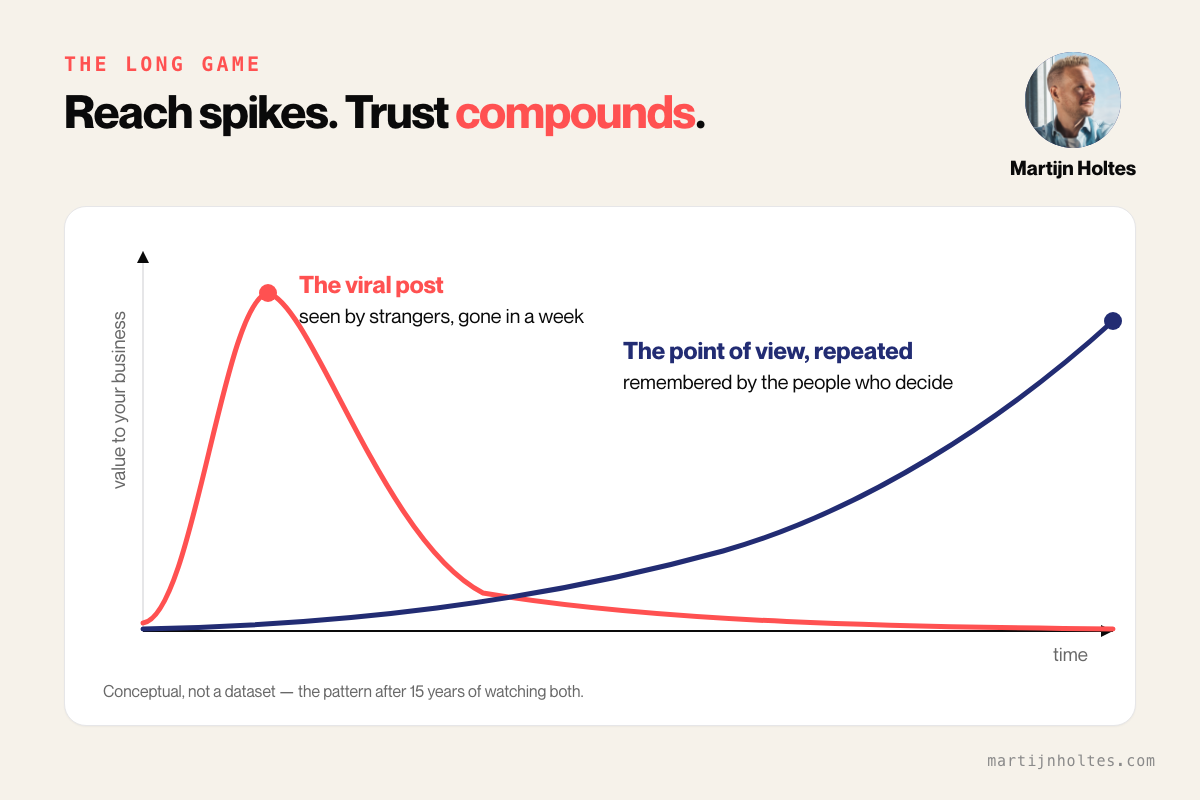
Quitting after three weeks.
You post four times, nothing comes back, and you conclude it doesn’t work.
Reputation compounds slowly and then all at once, and almost everyone quits during the slow part. The silence at the start isn’t failure, it’s the buyers watching before they trust. They’re there. They’re reading. They’re not ready to wave yet.
Sharing information instead of perspective.
The how-to listicle that any competitor, or any chatbot, could have written. Useful, forgettable, and interchangeable. Information is free now. Your point of view isn’t, and it’s the only part worth publishing under your own name.
Chasing reach instead of trust.
A hundred thousand views from people who will never hire anyone do less for your business than one buyer who reads you for a month and then brings your name into a meeting. Algorithms don’t sign contracts. Humans do.
What about a point of view feels risky (and what’s true)
The most common pushback I hear specifically with larger companies or the ones in legal is :
“I work with confidential things, I can’t share opinions online.”
And there’s a milder version underneath it: “who am I to have a take?”
Nobody is asking you to share client information or start fights online.
A point of view is a clear answer to the questions your audience keeps asking.
You already have those answers, you give them across the table every week.
The only change is the size of the audience.
I sat on my own point of view for years because I’d decided I wasn’t smart enough to have one.
The questions I was embarrassed to ask turned out to be the questions half the room was too proud to ask, and answering them in public is now my job.
The bar for a valuable opinion is lower than your imposter syndrome says, because most of your competitors aren’t saying anything at all.
A model for Thought Leadership
Most thought leadership advice tells you to post more.
That’s not how reputation works, so I created a five-step method I run with executives and independent professionals. In this order, because each step sets up the next.
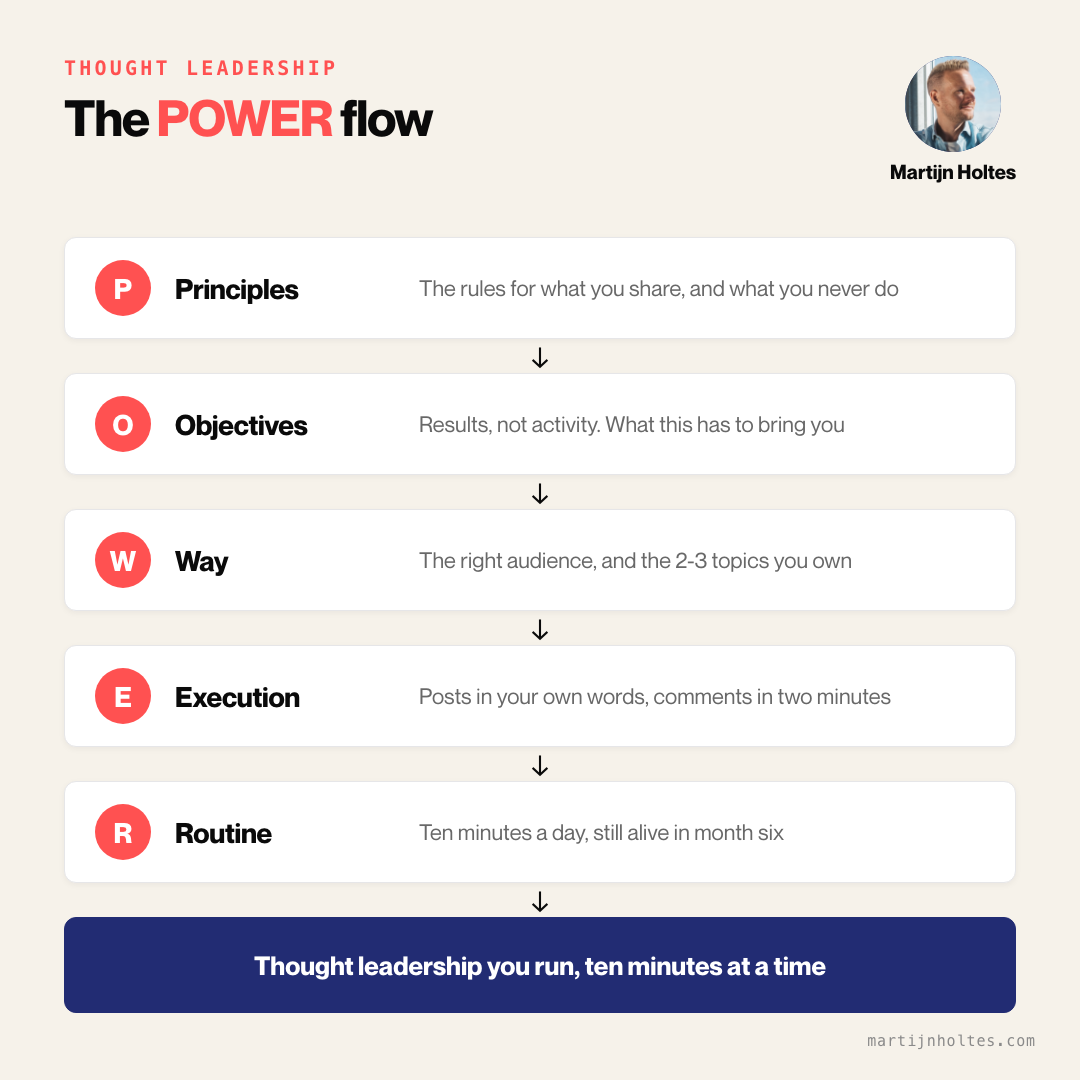
Principles.
The few rules for what you share, what you skip, what you never do, so you decide faster and stay consistent instead of debating every post. Without principles, every post is a fresh negotiation with yourself, and that negotiation is where most people quit.
Objectives.
What this has to bring you is a speaking gig, meetings with the right people, and a stronger reputation around your topic. Results, not activity, because if you can’t tell whether it was worth your time, you’ll stop.
Likes are not an objective. Nobody ever paid a salary or invoice with a like.
Way.
Who you want to reach and the two or three topics you want to own. Narrow feels scary, but it’s exactly what makes people connect your name to something specific.
Nobody refers to “someone who knows about business.”
Execution.
Simple formats that fit a busy week so you can actually do this in the long run.
Posts in your own words, and comments that show your expertise in two minutes instead of two hours.
A substantive comment under the right post, seen by the right people, does more than 5 superficial posts do.
Routine.
Ten minutes a day or more, whatever you can keep up, because this only works if you’re still doing it in month six. Intensity is what beginners bring. Consistency is what winners bring.
Building Thought leadership is a system you run.
Not a personality type you’re born with, and not a full-time job on top of your job.
Where to start, before any framework
You don’t need a strategy document to begin.
You need a clear answer to the questions your audience keep asking.
Write down the three questions colleagues, partners or clients ask you again and again, and what you tell them .
That answer, the one you’ve given fifty times, is a point of view.
You’ve been leading thought in private for years; you’ve only kept the audience to one person per meeting.
Then say one of those answers in public this week, in the same words.
Nobody’s grading your first posts, and the silence you’re afraid of is where everyone starts.
The market wasn’t waiting for me to feel ready, and it isn’t waiting for you.
It’s choosing from the people it can see, every single week.
Want this applied to your situation?
Start with an intake call. No form, no gatekeeper. Tell me where you’re stuck, and I’ll tell you straight if I can help, and how.
Schedule your intake callQuestions I get about thought leadership
What is thought leadership in simple words?
Getting known for a clear point of view by the specific people who decide where opportunities go. You share what your experience taught you, consistently and in public, until the right people connect your name to your topic and come to you.
What’s the difference between thought leadership and personal branding?
The same work from two sides. Personal branding is how you’re known, thought leadership is what you’re known for. A brand without a point of view is a face without a message; a point of view nobody can find isn’t leading anything.
Is thought leadership just marketing?
It makes you easier to find and trust, so in that sense it works like marketing. The difference: it can’t be faked long. A point of view has to survive a knowledgeable audience week after week. The test: would this person say the same thing if nobody was watching?
What’s the difference between a thought leader and an influencer?
An influencer monetizes attention from a large audience, and the topic is interchangeable. A thought leader earns trust from a small, specific audience on one topic, and gets hired because of it. Reach versus trust, in short, and only one of them shows up in your pipeline.
What does thought leadership look like in practice?
A tax lawyer known for one sharp view on holding structures. A supply-chain director whose posts get forwarded inside client companies. A consultant whose name comes up in meetings she’s not in, because the decision-makers have been reading her for a year, in silence. Day to day it’s ten focused minutes: one clear take, a few substantive comments, repeated for months.
What are the most common thought leadership mistakes?
Waiting for the work to speak for itself, resharing news instead of taking a position, sounding like every competitor, chasing reach instead of trust, publishing information instead of perspective, and quitting in week three because reputation compounds slower than a dashboard refreshes.
Do you have to post every day to be a thought leader?
No. Saying more won’t get you known; saying one thing clearly will. A couple of posts a week plus real engagement beats daily volume, and the opinion you keep holding back is worth more than your next ten safe posts combined.
How long does it take to build thought leadership?
Months, not weeks. The first signals, profile visits from the right people, inbound questions, your name mentioned in rooms you’re not in, tend to show after two to three months of consistency, and it compounds from there. Reputation is the asset that keeps working after you stop paying for it, which is exactly why it takes longer than an ad.