Everyone’s using AI and it makes us all fucking lazy. Open LinkedIn and you can smell it. Tidy paragraphs that have no soul, a neat three-point takeaway, and underneath it all, nothing anyone actually thinks. A whole feed of people who typed “write me a post about leadership” and posted what came back, then wondered why it landed like a wet napkin.

The tool isn’t the problem. Your laziness to build context is. You’re handing the best writing tool you’ve ever had one vague sentence and expecting it to read your mind. It can’t, or at least not yet, so it gives you the average of everything ever written on the topic.

The fix is not that hard, and it’s not some €47 magic prompt you buy off a guy in your DMs. It’s five things you tell the AI before you ask it for anything.

The five things a good brief has

Think of it like briefing a freelancer on day one. You wouldn’t say “write something good” and walk off. You’d tell them who to be and what you actually need. Same here, and basically it comes down to five things.

Persona. Who it should be. Tell the AI what role to play. “You’re a copywriter with 20 years in B2B.” “You’re a skeptical CFO.” The role shapes everything that follows, and “helpful assistant” is not a role.

Task. What it should do. One clear job. “Summarize the newest trends in digital marketing.” Not “help me with marketing.” The vaguer the ask, the more generic the answer.

Tone. How it should sound. “Professional but informal with a 7/10 humour twist.” Leave it out and you get the default AI voice, the one everyone’s learned to scroll past.

Context. What it’s working with. The one people skip, and the one that matters most. Give it the real material: the post you’re replying to, the client’s situation, an example of how you actually write. this is the most essential part. The more context you build the better it is

Format. What it should look like. “Give it to me as a table, sorted by topic.” “Three short paragraphs, no bullet points.” Tell it the shape or it’ll guess, and it guesses wrong!

Stack those five and the output reads like something you’d put your own name on, instead of something a robot skimmed off a marketing blog.

The trick most people miss

You don’t have to write the perfect brief yourself. Make the AI do it. Paste your rough prompt in and tell it:

You’re an expert at writing prompts. Improve the one below. Sharpen the focus so the question is specific, structure it so the answer is richer and more detailed, and if I gave you an example, swap in a better one. Here’s my prompt: [paste].

It’ll hand you back a version three times better than what you started with. You’re using the tool to write its own brief.

What the prompt bros leave out

You can master all five and still produce forgettable garbage. Because a brilliant brief with nothing behind it just gets you to generic faster.

The thing AI genuinely cannot do is have your point of view. It’ll copy any style you want and nail any format. What it can’t do is have an opinion. It’s never sat across from the client who walked out, and it doesn’t have your years of experience. That part’s yours, and the best “prompt” is really just you feeding the machine your own take and letting it do the typing.

So implement the five, it will save you hours. But a perfect brief with nothing behind it just gets you to generic faster, and the AI will happily help you sound like everyone else at record speed.

The brief is the easy part. What goes into it is the whole game.
Category: Articles

  • The problem isn’t the AI. It’s your lazy brief.

    The problem isn’t the AI. It’s your lazy brief.

    Everyone’s using AI and it makes us all fucking lazy. Open LinkedIn and you can smell it. Tidy paragraphs that have no soul, a neat three-point takeaway, and underneath it all, nothing anyone actually thinks. A whole feed of people who typed “write me a post about leadership” and posted what came back, then wondered why it landed like a wet napkin.

    The tool isn’t the problem. Your laziness to build context is. You’re handing the best writing tool you’ve ever had one vague sentence and expecting it to read your mind. It can’t, or at least not yet, so it gives you the average of everything ever written on the topic.

    The fix is not that hard, and it’s not some €47 magic prompt you buy off a guy in your DMs. It’s five things you tell the AI before you ask it for anything.

    The five things a good brief has

    Think of it like briefing a freelancer on day one. You wouldn’t say “write something good” and walk off. You’d tell them who to be and what you actually need. Same here, and basically it comes down to five things.

    Persona. Who it should be. Tell the AI what role to play. “You’re a copywriter with 20 years in B2B.” “You’re a skeptical CFO.” The role shapes everything that follows, and “helpful assistant” is not a role.

    Task. What it should do. One clear job. “Summarize the newest trends in digital marketing.” Not “help me with marketing.” The vaguer the ask, the more generic the answer.

    Tone. How it should sound. “Professional but informal with a 7/10 humour twist.” Leave it out and you get the default AI voice, the one everyone’s learned to scroll past.

    Context. What it’s working with. The one people skip, and the one that matters most. Give it the real material: the post you’re replying to, the client’s situation, an example of how you actually write. this is the most essential part. The more context you build the better it is

    Format. What it should look like. “Give it to me as a table, sorted by topic.” “Three short paragraphs, no bullet points.” Tell it the shape or it’ll guess, and it guesses wrong!

    Stack those five and the output reads like something you’d put your own name on, instead of something a robot skimmed off a marketing blog.

    The trick most people miss

    You don’t have to write the perfect brief yourself. Make the AI do it. Paste your rough prompt in and tell it:

    You’re an expert at writing prompts. Improve the one below. Sharpen the focus so the question is specific, structure it so the answer is richer and more detailed, and if I gave you an example, swap in a better one. Here’s my prompt: [paste].

    It’ll hand you back a version three times better than what you started with. You’re using the tool to write its own brief.

    What the prompt bros leave out

    You can master all five and still produce forgettable garbage. Because a brilliant brief with nothing behind it just gets you to generic faster.

    The thing AI genuinely cannot do is have your point of view. It’ll copy any style you want and nail any format. What it can’t do is have an opinion. It’s never sat across from the client who walked out, and it doesn’t have your years of experience. That part’s yours, and the best “prompt” is really just you feeding the machine your own take and letting it do the typing.

    So implement the five, it will save you hours. But a perfect brief with nothing behind it just gets you to generic faster, and the AI will happily help you sound like everyone else at record speed.

    The brief is the easy part. What goes into it is the whole game.
  • Stop reorganizing your apps. Build a system instead.

    Stop reorganizing your apps. Build a system instead.

    Recognize this scenario?

    You know you saved it. You can even picture it, a link, a PDF, a note you made after a call with the exact number you now need. And you’ve just burned ten minutes hunting through Notes, Drive, your email, Slack, and two apps you forgot you were paying for. So you give up and google it again, and land on a worse version of something you already had. You just can’t find it, and no new app fixes that, because the app was never where the mess was.

    The app graveyard

    I love a new app. Especially the ones that promise me I’ll finally be productive and effective and for the love of God finally have some calm. To-do apps, note apps, micro-note apps, bookmarks, three cloud drives. I collect them like other people collect gym memberships in January, and with the same results.

    The trap is always the same and I’m stupid enough to keep falling for it. Every app promises to be the one place everything lives. But you do different kinds of work in different phases, and no single app handles all of it well. So you spread your stuff across ten of them, and six months later you have no idea what you were using each one for. The mess just moved into nicer software.

    What actually fixes it is a system that sits on top of all your apps, the same shape everywhere, so it stops mattering which one you open.

    That system is PARA.

    PARA, in plain terms

    Tiago Forte built PARA as the backbone of his “second brain” idea. Four buckets, and the whole thing works because there are only four:

    • Projects — things with a deadline and an end. Launch the website. Write the talk. Paint the shed. A project finishes, so its folder changes constantly.
    • Areas — things you’re responsible for with no end date. Your health. Your finances. Your team. You don’t “finish” your health. You just keep the standard up.
    • Resources — stuff you’re keeping because it’s useful across projects: articles, book notes, PDFs, references. Not tied to one deadline.
    • Archive — anything from the first three that’s gone quiet. Project done, area no longer relevant, interest faded. Out of sight, still there if you need it.

    The one distinction people get wrong is Projects versus Areas, and it’s worth getting right because everything else hangs off it. A deadline makes it a project. “Run a marathon in October” is a project. “Stay fit enough to grow old” is an area. It’s the same topic in two different buckets, and if you file them together the whole system turns to mush.

    The point is you use it everywhere

    PARA works because you run the same four buckets in every place you keep information. Your note app, your cloud drive, your email, all the same structure. So your brain only ever learns one filing system, and finding something stops being a treasure hunt.

    You don’t have to do it all at once. Start in one app. I ran PARA in my notes first, saw it hold up, then rebuilt it in Dropbox, then moved to Obsidian and now have a powerful Exo-Brain.

    How to actually start

    I’ve gone a long way since I got in touch with the personal knowledge management sphere in 2019. But if I were to start all over again, this is what I would do.

    1. Brain dump. Everything you’re carrying: things to do, things to learn, responsibilities, half-ideas. Get it out of your head and onto a page. You can’t organize what you can’t see.

    2. Name the projects. Go through the dump and pull out anything with a deadline and an end. “Lose 5 kilos by summer” is a project. “Eat like an adult” is an area. Be honest about which is which.

    3. Build the Projects folder first. One folder, a subfolder per project, and drop in the files you already have for each. Mirror the exact same list in your to-do app (Things, Asana, whatever you use) with the subtasks and deadlines.

    4. Go do the work, then test it. The whole promise of PARA is that you find what you need for a project faster and without friction. So use it on a real project and see if that’s true. If it is, roll it into the next app. If it isn’t, your buckets are probably mislabeled, go back to step two.

    PRO-TIP! If you can ensure your information won’t be locked in by a vendor (for example, if you are going to use Microsoft tools for this), it will be very hard to pivot to Google. Last year, I switched to Obsidian and now have all my information in the markdown format. Markdown is readable by every computer no matter the operating system you use and is very easy to read and write for any AI

    Why this matters more now than it used to

    A tidy second brain used to just save you time. But if your boss pays you eight hours a day, you don’t give a crap about that. But since the adoption of AI in almost every company, it is more essential than ever. AI is only as good as the context you hand it, and most people hand it nothing, so they get the same generic answer everyone else gets. The person who’s kept their own notes and client context in a system they can actually pull from feeds the machine something nobody else has. Your organised knowledge becomes the thing that makes your AI output yours instead of everybody’s.

    Start with one app. Brain dump first, structure second. And the next time you know you saved something, you’ll find it.

  • Information is free now. Your point of view isn’t.

    Information is free now. Your point of view isn’t.

    For years I collected information like it was going to save me. I saved articles I never reopened. Built an extensive and way too complicated Notion database in a weekend and abandoned by Tuesday. I had 40 browser tabs I kept alive for weeks because closing them felt like admitting I’d never read them. I told myself I was “staying sharp.” The truth is I was like a fucking hoarder, piling up newspapers in his living room. And the worst thing is that under all that saved brilliance, my decisions got worse, not better.

    I thought that more information was more edge. Turns out that’s exactly backwards, and the last two years made it painfully obvious.

    Those brilliant insights you were saving are now infinite

    Information used to be scarce. That’s why we treated it like currency. If you knew the thing the other one didn’t, you had an advantage.

    That world is gone. AI will hand you a decent answer to almost any question in four seconds, then write you a thousand words on it, then make you a slide deck about it before you’ve finished your coffee. Content isn’t scarce anymore. It’s the cheapest thing on earth.

    And when something is everywhere and free, it stops being worth anything. Even the most valuable information you have is worthless within 24 hours, killed by a new study, a better take, or a world that moved while you were reading. Knowing things is no longer the job.

    Your brain didn’t get the memo

    Your brain is built to grab every scrap of information in sight, because for most of our human history missing a signal could get you eaten. That instinct doesn’t switch off because you work in an office now. So you feel the pull constantly, to check one more thing, read one more take, open one more tab. Those executive fuckers at social media platforms know this, so don’t blame yourself too hard for scrolling two hours

    You can feel it right now, probably. Some part of you is already halfway to a different screen.

    The result is that we treat information like an all-you-can-eat buffet and then wonder why we feel sick. There’s junk information and there’s healthy information, exactly like food, and most people are on a diet of crumbled up Doritos over a donut . Notifications, doomscroll, the rate of burnout and stress in knowledge work isn’t a mystery. We’re drowning a brain that was never built to swim in this.

    Piling up more won’t fix a problem caused by too much going in. You can’t out-read the firehose.

    The scarce thing now is a point of view

    So the edge isn’t information anymore. It’s your personal point of view.

    A lived through, structured way of looking at the world, so you can put information in context instead of just swallowing it. A clear signal on what matters and what doesn’t. Paul Saffo put it better, years ago: “In a world of hyper-abundant content, point of view will become the scarcest of resources.” He wrote that before AI could generate infinite content on demand.

    Think about what AI actually does. It takes everything ever written and averages it into a competent, completely generic answer. It’s the best information-processor ever built, and it has no point of view at all. Yes you can go crazy with skills, tone of voice docs, etc. etc., but since I have done all of this stuff, I can tell you for sure it still asks me for lived experience as an example when I write articles like this.

    The one thing AI structurally cannot do is the one thing that’s worth everything now. Have an experience-based point of view. The way you, specifically, see this problem after doing the work. The thing nobody can copy isn’t what you know, everyone can get that now. It’s how you see it.

    Perspective first, apps later

    Most people go wrong at exactly this point, and I went wrong here for years too. They decide they need a “system.” They open Notion, OneNote, or whatever tool got hyped that week, and they spend a month building an empty cathedral of folders they’ll never fill. The tool becomes the hobby. The thinking never happens. (Believe me I’ve been there and done that)

    Personal knowledge management (PKM) is real and it’s worth building. It’s the set of habits and tools that turn information into actual outcomes instead of a bigger pile. But it starts with your perspective, not with software.

    Before you touch an app, answer two questions on paper:

    • What projects are you actually working on right now? Everything. The new website, the spare room you’re renovating, the bike trip you need to plan. Write them all down.
    • What else in your life needs attention? Your health, your relationships, the interests you keep saying you’ll get to.

    Only once that’s on the page do you build structure around it. PARA (Projects, Areas, Resources, Archives) is a clean way to do that and worked for a while for me. But no matter what fancy system you use the order matters Reality first, the filing system second.

    Once you have the lens, the firehose changes. Instead of weighing every piece of information for importance, which is impossible, you filter everything through one question:

    Does this serve what I’m actually working on?

    Most of it doesn’t, and now you can let it go without guilt. The rest you keep, not because it’s interesting, but because it’s useful to you, now.

    Development isn’t a straight line

    One more thing, because it’s the part people skip. Having a point of view doesn’t mean deciding once and defending it forever. That’s not perspective, that’s ego.

    A point of view gets tested against reality. You put it into the world, watch what comes back, and adjust. You don’t find your angle in a seminar or a nice course, you find it by executing and seeing what survives. Growth doesn’t move in a straight line, it runs in loops, and the only way to run the loop is to actually do something with what you think.

    Which, ironically enough, is the opposite of hoarding. Hoarding is safe cause it feels like progress and commits to nothing. Putting your point of view out there, where it can be wrong, is scary. But it’s the whole game.

    Anyway. Go close some tabs.

  • The cheapest pipeline you’ll ever build

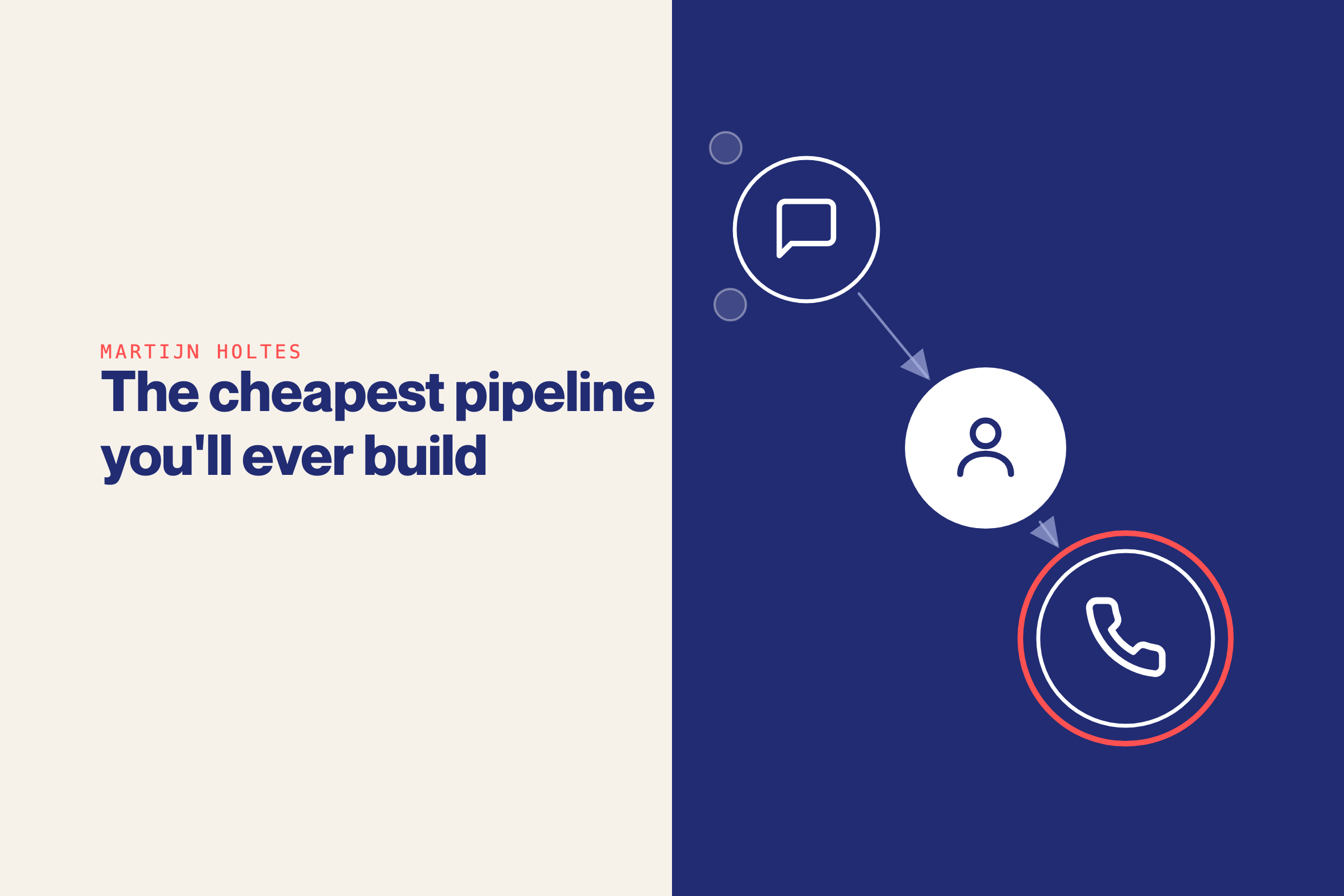
    The cheapest pipeline you’ll ever build

    Last year I worked with an IT company* whose sales team had split into two camps, and they defended those camps like it was religion. One half lived on cold outreach, firing connection requests at anything with a pulse and a job title. The other half had given up on that and sat back waiting for inbound, which is a strategy the way waiting for rain is in agriculture.

    The board had been arguing about it for months to determine the best strategy. Meanwhile the pipeline stayed thin for months too, which should have settled the argument, but sales teams don’t work that way.

    The cold callers were burning through lists and getting ignored, because they were reaching people who’d never heard their name. The inbound folks were waiting for a ring or message that never arrived, because nobody hands their business to a company they’ve never heard of.

    Two different ways of being a stranger.

    What we did instead

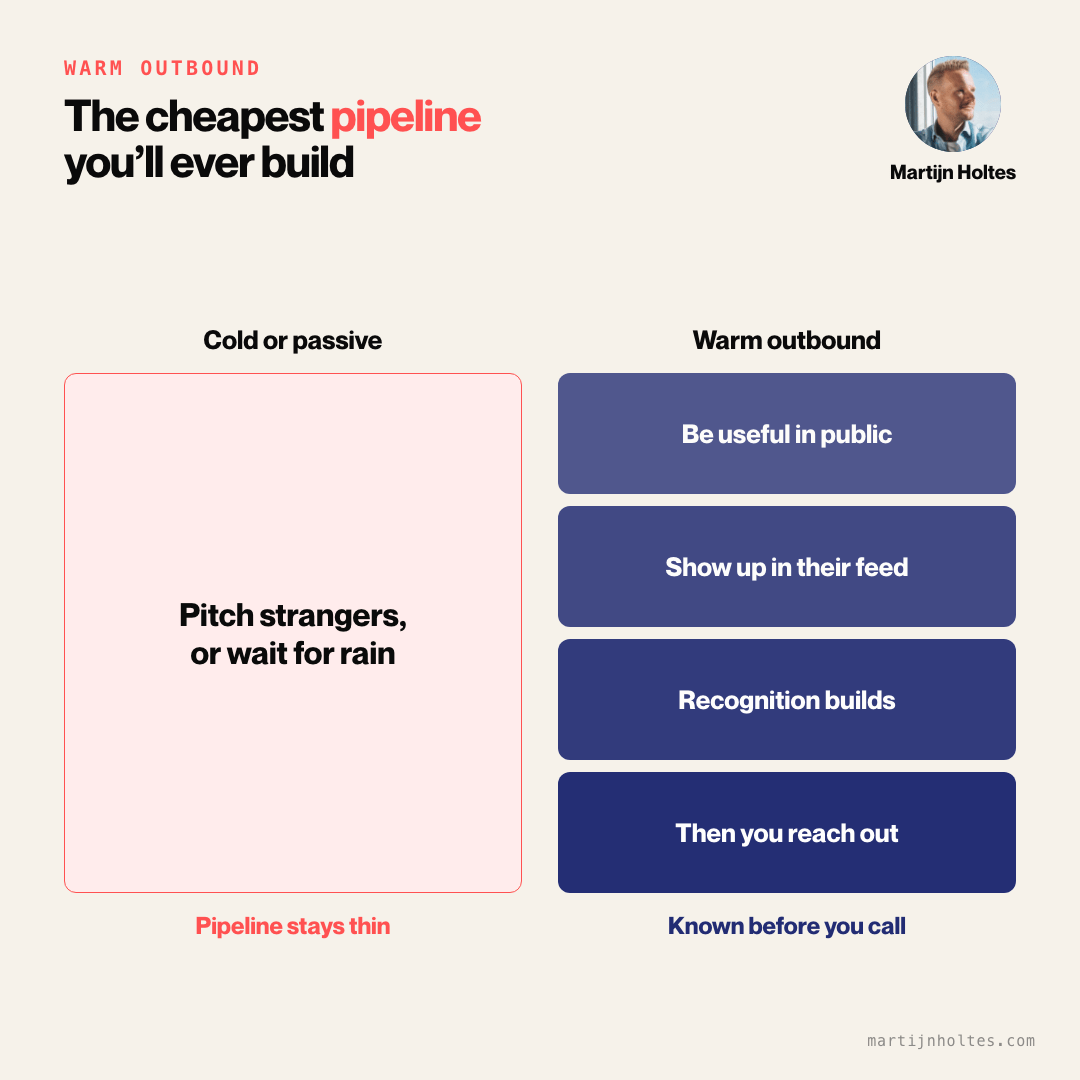
    We stopped treating it as a choice between the two. The reps started being useful in their prospects’ LinkedIn feeds first. Posting and commenting on the real problems those buyers deal with all day, weeks before anyone mentioned the product. No “great post, thanks for sharing” BS, but the kind of content that makes someone think this person gets my issues.

    For a while that was the whole job: be useful in public, in front of the exact people they’d wanted a call from.

    Then they called. Same people as they would have cold-called, except now the name on the screen wasn’t a stranger’s. Call it warm outbound: outbound timing, except the prospect already knows who you are when you call.

    Same team, same product, same list. The only thing that changed was that people knew who was knocking before they knocked.

    Why teams skip the cheapest option

    Being useful in public before there’s a deal in sight costs no budget, only patience and giving something away before you’ve earned the right to ask for anything, which is why most skip it.

    Being visible and building an online reputation gets treated as marketing’s job, something that happens somewhere else. Yes, commenting eats hours too, but an hour of being useful keeps paying out for months, and an hour of dials is gone by lunch.

    From what I’ve seen, the problem is that being useful never shows up on this quarter’s numbers, so it’s the first thing to get cut. There’s no number on the dashboard for the prospect who takes your call in three months because you were useful to them today.

    Try putting “I was useful to a stranger in March” in the CRM and see what your sales manager thinks of it.

    The grinding feels like work; that’s the trap. Even the rejection feels like effort. But when someone already knows your name and has a rough sense of how you think, the call stops being an interruption and becomes the next step in a conversation they were half in already.

    So the fight those two camps were having was the wrong fight.

    What matters is the thing underneath.

    Do the people you want to sell to know who you are before you show up? Build that, and the pipeline gets cheaper every month, because rented attention expires the day you stop paying, and a name people know keeps working for free.

    And no, you don’t need to become an influencer for this. Ten comments a week, in the feeds of the people you want to call, and the only thing a comment has to do is prove you understood the problem.

    The cheapest pipeline you’ll ever build runs on people who already know your name before you call. For everything else, you either pay for one cold dial at a time or you sit by a phone that doesn’t ring.

    *All examples are real. Names and industries changed to protect my clients’ privacy.

  • Your company’s reputation has a single point of failure

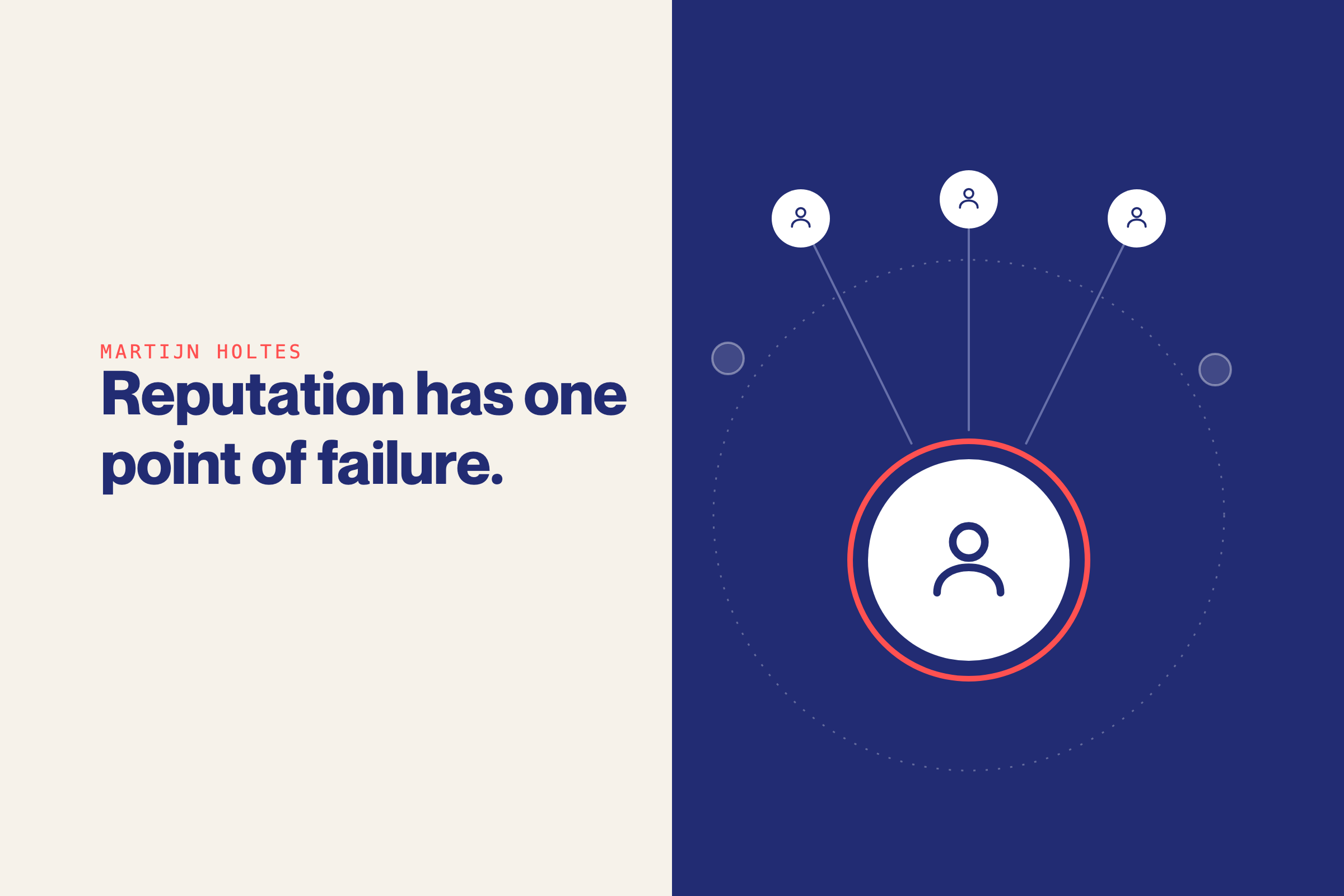
    Your company’s reputation has a single point of failure

    I teach companies how to show up on LinkedIn, and our own company page might be the loneliest place on the internet. I post there a few times a year, feel like I did a proper job for a day, and then go back to my personal profile, because that’s where the clients come from. Turns out I stopped believing in company pages years before I was ready to say that out loud.

    Lucky for me, I did spend some serious time in those years learning about tech and innovation, and somewhere along the way I understood how blockchains work. I’m not going to play crypto influencer here, because I’m not one, but stay with me, because blockchain engineers figured out the exact problem your company has.

    A dollar works because one central bank says it works, and your page works because one person keeps it alive. Crypto skipped that weakness on purpose. No head office, no server in a basement someone can switch off to bring the whole thing down. It runs on blockchains across thousands of machines that don’t answer to any center, so you can kill one part and the rest carries on like nothing happened.

    Say I sneak into your accounts tonight and start switching things off, one by one, to see when a client notices. I unpublish the company page first. Nothing happens, because the last post was a birthday cake for the office manager and three colleagues liked it.

    Then I “unplug” the personal account of a few business developers and consultants who have been posting once in a while, and by Friday you will see the numbers on your dashboard plummet.

    So the page you maintain is decoration, and the people your clients listen to aren’t even in the plan. That’s your single point of failure.

    It was never the page. It’s the two or three people who carry your brand, and nobody’s managing that.

    You built it that way because control feels safe. One page, one logo, one careful voice that waits for approval before it says anything. I call it corporate broadcasting, and it’s exactly those messages nobody gives a crap about.

    Kill the approval chain.

    Now let’s say you spread that same message across the people who do the work, the partners, the consultants, and you get lots of voices with no off switch. Unplug one and the other 14 keep talking. That’s the crypto trick, minus the stupid coins.

    People carry the company’s brand because they have something to say about the work they do every day. And when you help them do that, three things happen that a company page never will.

    One message becomes many angles

    The page says the thing once, in the approved way, usually six weeks after it mattered. Fifteen people who do the work say it fifteen ways. The one who runs the deals explains how the work gets done, the one who sits with clients explains why it matters to them, the one who trains the juniors shows what it’s like on the inside.

    So the market hears a company that’s clearly good at what it does, confirmed from every direction at once.

    It reads as help, not marketing

    When someone shares their own point of view, in their own words, nobody reads it as an ad. Edelman has said the same thing for years: people believe the person long before they believe the logo.

    That “these people know what they’re doing” feeling can’t be manufactured from a page everyone knows exists to make the company look good. It only shows up when it comes from a real person.

    Every reputation feeds the next

    Each person who builds a name makes the company look stronger, and a stronger company makes the next name easier to build. Rented reach, a.k.a. ads, stops the second you stop paying, but this lives in the relationships those people have already built, not in an account you have to keep topping up.

    You can’t mandate any of this, and that’s the part most old school companies hate. The second you script people or drop them onto a posting schedule, you kill the thing that made it work, because a forced post is obvious and it does nothing for the author.

    Give people a reason to want it, then get the hell out of the way.

    Put the company’s name in the hands of the people who do the work, and there’s nothing left to unplug. And nobody’s grading you on the years the page did all the talking. The market only hears what comes next.

    Anyway. I have a company page to go ignore.

  • Your employees are adults. Your social media policy disagrees.

    Your employees are adults. Your social media policy disagrees.

    I got my first BMX when I was a kid. A big blue second-hand BMX that was way too big for me, but I didn’t care. Every free moment I was on that bike.

    Soon, I knew every cross track in the neighbourhood, and I had my first crash pretty quickly, too.
    Took a corner too fast and scraped up both knees, misjudged a jump and went straight over the handlebars.
    The kind of crashes that look dramatic but heal in a week when you’re a kid.

    Nobody took the bike away. My parents checked if I was okay, told me to watch the track, and let me ride again the next day.

    That bike, way too big, slightly dangerous, sparked something that’s still with me decades later. Cycling is how I clear my head, and it’s been that way for as long as I can remember.

    But what would have happened if my parents had locked that BMX in the shed after my first crash? I’d never have known that cycling would become my thing.

    That’s the exact tension every company faces when building an employee advocacy program.

    Two ways to kill a program

    Most companies pick one of two extremes.

    Lock the bike in the shed.
    Pre-write every post and review every message before sending.
    Control over trust.
    I get why.

    • Legal is nervous, comms is nervous, and everyone’s imagining the worst-case scenario before a single employee has posted anything.
    • The result is that no one learns to ride and no one wants to try.
    • The “program” becomes a content distribution channel where employees share messages they didn’t write and don’t believe in.
    • Your audience can smell that from a mile away.

    Hand them the keys and say “good luck.”
    No training, no guidelines, no support.

    • It usually happens when someone in leadership reads that employee content gets 8x more engagement than brand content.
    • They get excited and skip the infrastructure.
    • Someone crashes, leadership panics, and the program dies.

    Two extremes, same outcome.

    Give the bike, show the track

    There are only four rules that everyone needs to understand:

    • Don’t share confidential information
    • Don’t post discriminatory content
    • Don’t attack competitors by name
    • Don’t speak on behalf of the company on topics you’re not authorised to address

    That’s it.
    Those are the boundaries of the track.

    • Try different content styles and share your perspective on industry trends.
    • Talk about what you learned at that conference, or write about a problem you solved.
    • Build your voice and make mistakes along the way.

    Fall off the bike, we will help you get back on.
    Ride into the wall? We remind you why the wall is there.
    But we don’t take the bike away.

    Boundaries are not control

    The companies winning at employee advocacy are the ones with the clearest boundaries.

    Tight controls say: “We’ll review every word before you post it.”
    Clear boundaries say: “These four things are off-limits. Everything else is yours.”

    If you treat people like responsible adults you get responsible adults.
    If you treat people like children you get compliance, or silence.

    “But what if someone says something wrong?”

    The benefits are worth the problems.
    The first time an employee in a program I helped build posted something that made even me hold my breath for a second, I understood exactly where that fear comes from.

    But if you hire smart people, train them well, and set clear expectations, most will act responsibly.
    Not naive optimism, just what I’ve seen play out across dozens of programs.

    The honest mistakes are coaching opportunities.
    Pull them aside and talk about what happened, and they’ll be more careful and more confident next time.
    And if someone intentionally crosses boundaries?
    That’s a mentality and performance issue, not a policy problem.

    What kills programs is building your entire system around the 2% who might cause problems, while suffocating the 98% who just want to share their expertise.

    The one requirement you need

    This only works if senior leadership commits.
    Not some fake ass board meeting where they sort of get it, but real commitment and trust in employees.

    If the CEO won’t defend someone who makes a well-intentioned mistake on LinkedIn, lock the bike in the shed.
    Heck, please throw the bike away.

    But if leadership is willing to say “we trust our people within clear boundaries” and mean it when things get uncomfortable, that’s when things start to shift.

    I can tell you one thing…
    The best thing anyone ever did was not take that bike away.

  • How I use AI for content (and where it fails)

    How I use AI for content (and where it fails)

    A few weeks ago, someone sent me a LinkedIn post they’d written with AI and asked for feedback.
    It was clean, well-structured and had zero grammatical errors.
    And I had no damn clue what this person believed.

    The post could have come from anyone in their industry.
    Right keywords, popular hook format, call-to-action at the end.
    Checked every box.

    This is what happens when you give AI a topic but not a perspective.
    You get content that looks professional, but it’s contributing to AI slop.

    The problem isn’t the tool

    I use AI a lot.
    Even this article that you’re reading right now, Claude has helped me put it together.
    I know many experts say you shouldn’t use AI for content creation.
    But that’s sort of the same as saying you can’t use a car to go from A to B, because a horse would be more authentic.

    If you get poor results, you aren’t using the wrong tools.
    You are probably skipping the thinking that makes AI useful in the first place.

    For example:
    Level one: you ask AI to write a post about thought leadership.
    Level two: you type “thought leadership is not about being smart or knowing everything. It’s about having the courage to share your professional point of view. Please give me five angles on how I can approach this message.”

    Same tool, same topic, completely different output.
    The difference is the instruction.
    And the best instructions aren’t a prompt template from someone’s viral newsletter, they’re a clear picture of who you are, what you stand for, and who you’re talking to.

    p.s. please make sure you are at least at level two this week

    Where AI helps

    There is a ton of information and instructions out there on how you can use AI in your day-to-day workflow and operations.
    Below you’ll find some simple examples if you’re getting started.

    1. Research and inspiration
    I use AI to scan what’s happening in my industry. What questions are people asking? What topics are getting traction? What’s been said to death?

    I used to use Google Alerts for this, but now it’s a combination of Perplexity, Google Gemini, and Claude Code. It saves me hours of reading and surfaces things I would have missed on my own.

    2. First draft acceleration
    Once I know what I want to talk about, I use AI to build a first draft.
    I feed it my positioning statements, tone of voice guidelines and the summary of one of the topics from my research.
    The draft is never published, but it gives me something to react to instead of a blank page.
    I rewrite, rearrange, add my own examples and cut anything that feels like it could have come from anyone.

    3. Editing and formatting
    AI is good at tightening sentences, catching repetition and cleaning up flow.
    I use it as a second pair of eyes after I’ve written my version.
    One catch.
    Instruct your AI to only highlight the things that are wrong.
    Don’t let it rewrite your text, to make sure your writing stays your own.

    This is where AI adds the most value with the least risk.
    The thinking is done, the POV is mine, and AI helps clean it up.

    Where AI sucks

    1. Your backstory
    AI doesn’t have your experience.
    It doesn’t know the client who changed your mind, the failure that taught you more than success ever did, or the contrarian view you built over the years.

    Ask AI to generate your positioning, and you’ll get something that sounds reasonable.
    And means nothing.
    Your POV has to come from you.
    No shortcut.

    2. Your angle on a topic
    AI can give you both sides of an argument.
    What it can’t do is pick a side based on what you’ve lived through.

    Your take, the specific perspective that comes from years of doing this work, is the part that makes content worth reading.

    Hand that to AI and you’ve handed over the only thing that makes you different.

    3. Your engagement
    Comments, replies, DMs, real conversations.
    It is where trust gets built and there is no way to automate that.
    It’s the part where people are most tempted to use AI because it saves time.

    Don’t.

    The human part is the whole point.
    Someone leaves a thoughtful comment on your post and gets a robot reply?
    You’ve lost more trust than the post created.

    So where do you start?

    I wrote about this before, the Backstory framework.
    Six questions that help you find your Angle, Authority, and Voice.
    Those three statements are the foundation AI needs from you.

    Without them, you’re asking AI to guess who you are.
    And it will. It’ll guess wrong.

    The order that works

    1. Build your backstory (your positioning statements)
    2. Pick your angle on a specific topic
    3. Use AI to help you draft, research, and edit
    4. Keep your engagement human

    Most people start at step 3.
    Then we wonder why the output is so bad.

    That post someone sent me? It had everything except a point of view.
    That’s the one thing worth protecting.

  • Your employees will never write a post on LinkedIn

    Your employees will never write a post on LinkedIn

    I’ve audited a lot of advocacy programs over the past years. They all make the same mistake: they design for one type of participant and expect everyone to fit.

    It never works.

    Some companies aim too high. They expect every participant to create original content, post weekly, and build a following. It’s the best way to burn out 80% of the participants before you even get started.

    Others aim too low. A few likes and shares, and some additional followers on the company page. The people who want to create get bored and disengage.

    Either way, participation drops, skepticism grows, and the program dies.

    Richard van der Blom and I spent a long time looking at this problem. Why do most programs fail to sustain engagement beyond the first quarter? The answer turned out to be people, not content or tools.

    The result is a framework we call VIBE.

    Four levels of advocacy

    Voice. Influence. Boost. Engage. Four levels of participation, each with expectations that match what people are willing and able to do.

    Voices are the thought leaders

    These are people with deep expertise who are building serious professional authority. They create in-depth content, speak at events or star as a guest on a podcast, and develop and share original perspectives. Typically, you can find them on LinkedIn with 2-3 major pieces of content per week.

    The mistake I see companies make is assuming Voices are always executives. They’re not. It could also be the specialist who solved complex problems or the consultant who built innovative processes. Expertise lives throughout organisations, and what sets these people apart isn’t their title. It’s that they’re willing to invest.

    Influencers are the brand ambassadors

    This level consists of professionals who create original content regularly but aren’t aiming to become industry voices. They share project successes, add perspectives on trends, and bring context when they share company content. Typically, they are active on LinkedIn by engaging with other people and sharing two to four original posts per month.

    Boost, aka the engagement advocates

    People who amplify what others create, with thoughtful comments, strategic shares or a simple like. They spend some time on LinkedIn, mainly engaging with what their colleagues have posted.

    Don’t make the mistake of thinking this level isn’t important. Engagement Advocates are a substantial percentage of your program, and algorithms favour quick engagement. When Engagement Advocates interact with posts from Thought Leaders and Brand Ambassadors, they multiply visibility.

    Engage, the potential promoters

    This level has two groups in it:

    • The internal promoters, who won’t post or comment, but will repost content if you ask them to.
    • The external promoters, such as partners, stakeholders, and collaborators.

    Both serve the same strategic purpose, but they differ fundamentally in relationship, activation approach, and management.

    External engagement carries more algorithmic weight than internal engagement. On LinkedIn, a reaction from someone outside your organisation is valued roughly 1.6x more than a reaction from a colleague. This makes external promoters disproportionately valuable for reach and credibility, even at low activity levels.

    Your partners, clients, and industry peers are worth more to your program’s reach and credibility than another ten employees hitting the like button.

    But you can’t manage external promoters through an advocacy platform. They’re not employees, so you can’t assign them content or add them to a dashboard.

    External promotion is relationship-based. It works through co-creation, strategic planning, shared events, and content that serves both parties. The moment it feels transactional, credibility is gone.

    People choose their own level

    One principle that makes VIBE work is that people choose their own level, based on their capacity and motivation.

    Force people into roles they don’t fit, and they either burn out or check out. Create clear levels with appropriate expectations, and people find where they belong. The VIBE framework accepts people where they are and gives room to grow to the next level.

    For example, an Engagement Advocate might experiment with creating content and move to Brand Ambassador. A Brand Ambassador develops confidence and steps into Thought Leadership. But only when they’re ready and only because they want to.

    How each layer builds on another

    We’ve tested this, and ignoring it is why many employee advocacy programs fail.

    Without Voices, there’s nothing original to share. Without Boost and Engage, even strong content gets limited reach. Without the external track, you’re missing the highest-value trust signals. Each layer makes the others more effective.

    I noticed that many companies are putting all their energy into creating more Thought Leaders. That’s the wrong focus. The real opportunity is activating the Boost and Engage levels that make existing content travel, and building the external relationships that give it credibility.

    Two questions for your next review

    If you’re running an advocacy program, I’d suggest you look at two things.

    • Are your participants in the right level? Are you expecting Engagement Advocates to create content they don’t want to create? Are your Brand Ambassadors bored with activities designed for beginners?
    • And the harder one: have you mapped your external promoter ecosystem, or are you running a purely internal program and missing the most valuable engagement you could get?

    The companies I see winning at advocacy aren’t the ones with the most creators. They’re the ones where every type of participant contributes at the level that works for them. That’s when the whole system compounds.

    Running one of these programs? Let’s talk about how to make your next one work.

  • Why approval killed this Employee Advocacy program

    Why approval killed this Employee Advocacy program

    I worked with a company a few years back that had just launched its first employee advocacy program.

    They were excited, and so was I! They’d built a content library, even got an Employee Advocacy content tool, and hired me for guidance and training.

    Then the legal department stepped in and demanded that every employee’s post be approved, or that they post the scripted and approved posts from the library.

    Word… for… word…

    You can guess what happened.

    A few people shared some stuff out of obligation. The ones who did share got zero engagement, because their readers could smell corporate content from two screens away.

    Six months later, the program was declared a failure. But the program wasn’t the problem. The approach was.

    People aren’t distribution channels

    Most advocacy programs start with the company’s needs: more reach, more impressions, more brand awareness. So they build a system to push corporate messages through employee profiles: templates, approved copy, polished marketing speak.

    It sounds logical. It doesn’t work.

    People don’t engage with corporate messaging from personal profiles. They engage with real people sharing real perspectives. When you post someone else’s words, everyone can tell.

    Ownership over obligation

    There’s a better way to think about this. There’s a concept called employeeship.

    The idea behind it is that everyone in the company acts as a co-owner of their own professional growth, not an executor of the company strategy. They take responsibility for their own visibility, their own reputation and their own career.

    That does not mean everybody is going rogue. It’s companies creating the conditions where people want to share, rather than being told to share.

    Give people strict messaging guidelines and approved posts, and you get compliance. Give people clear boundaries and help them find their own voice, and you get ownership.

    Ownership is what makes advocacy last.

    How boundaries work

    Boundaries and control sound similar, but make no mistake, they’re not.

    • Control: “These are the three posts you can share this week. Don’t change the wording.”
    • Boundaries: “These are the topics we care about as a company. This is what’s off-limits. Everything else? Go ahead!”

    Control makes people dependent. With boundaries, people know what the playing field is, and within it they have room to play and develop their own voice. The difference looks small, but it’s exactly what 80% of employee advocacy programs get wrong.

    The backstory is the starting point

    I’ve written before about identifying your professional backstory and the six questions that uncover what you stand for.

    Your backstory is yours. You built it over years of experience, mistakes, and hard-won insights. No company created that for you. And no company should replace it with marketing messages.

    But a good company should help you use it.

    The best advocacy programs I’ve run don’t hand employees content, they give them the tools and support to find their own. And that starts with their backstory.

    In my training programs, people answer those six questions and turn their expertise into a clear POV. The employees who find their own voice become far better advocates than those who get a script, because they’re sharing from experience instead of repeating someone else’s message.

    Everybody wins!

    For the individual: Stop waiting for permission to be visible. You own your career path, and you build a reputation that goes with you, to the next project, the next role, wherever.

    For the organisation: You get real advocates. Posts from personal profiles reach 10 times as many people as company pages. Companies with visible employees are 58% more likely to attract top talent. And the advocacy lasts, because it comes from ownership, not obligation.

    Most companies I start working with think it’s one or the other: help employees build their own brand, or keep the message controlled. Employeeship says it’s both.

    A question worth asking

    If you’re an employee reading this, does your company help you find your voice, or do they try to replace it?

    If you’re a leader, are you activating what your people already have, or asking them to distribute what marketing created?

    The answer tells you more about your program’s future than any engagement metric.

  • Your backstory beats any AI prompt template

    Your backstory beats any AI prompt template

    Last month I was running one of my Thought Leadership training sessions. Fifteen executives, all with fifteen-plus years of experience.

    One of them asked:

    “Ok Martijn, I get it. Positioning myself and posting is important, but what should I post about and how? I don’t have time to dedicate one or two hours a week to writing, and I want to stay far away from those terrible AI-written posts.”

    So I asked why she was so interested in the industry, and what shaped how she sees it?

    Simple question, hard to answer.

    She had plenty of expertise and experience to build a point of view from. Nobody had ever asked her that question before.

    We start too quickly

    Everyone is rushing to use AI for personal branding. AI has all the answers, it’s easy to use, and let’s all agree we’re all a bit lazy. The problem is that optimising headlines and rewriting About sections for your profile won’t get you anywhere if you skip the hardest step.

    We go straight to “how do I look?” before answering “what do I want to be known for?”

    Skip that step and it’s like decorating your house before pouring the foundation. It looks nice until everything comes crumbling down.

    Your profile, your content, your conversations, they all need an anchor. Without it, you’re optimising without a solid foundation.

    That anchor is your backstory.

    What makes you different

    Your backstory isn’t your CV. It’s the collection of experiences that made you see your industry the way you do.

    • The client who changed your mind.
    • The failure that taught you more than any success.
    • The moment you realised everyone was approaching something the wrong way.

    That’s the stuff AI will never know about. And from what I’ve seen, it’s exactly what your audience is looking for.

    It’s difficult to get that backstory straight. Believe me, I’ve been struggling with it for the last three years. Last week I updated my personal website and finally had a breakthrough.

    The six questions I asked myself

    1. Turning Point
    “The moment that changed my perspective on my industry was when {blank}”
    Be specific. When did it happen? What shifted?

    2. Expertise
    “People often seek me out for guidance on {blank}”
    Not your job description but your expertise. What do people keep asking you about?

    3. Contrarian View
    “My experience taught me that most people get {blank} wrong because {blank}”
    What has your experience shown you that goes against common wisdom?

    4. Driving Mission
    “The industry challenge that energizes me to solve is {blank}”
    Not what you sell. What you care about fixing.

    5. Signature Insight
    “The one thing I want every professional in my field to understand is {blank}”
    If you had one message, what would it be?

    6. Leadership Topic
    “Based on answers 1 to 5, the industry conversation I should lead is {blank}”
    The conversation you want people to associate with your name.

    You don’t need to get this perfect on the first try. Write your answers, let them sit for a day, and then come back and sharpen them.

    From six answers to three statements

    Alright, that was the hard part, now the fun begins.
    Once you’ve answered the six questions, combine them into three positioning statements:

    Your Angle (Answers 1 + 3)
    Your turning point plus your contrarian view. This becomes the content that challenges your industry’s thinking.

    Your Authority (Answers 2 + 4)
    Your expertise plus your mission. This becomes your positioning, what you help people do and why.

    Your Voice (Answers 5 + 6)
    Your signature insight plus your leadership topic. This becomes the consistent message people hear from you everywhere.

    How this works in practice

    My example in social selling:

    My Angle:
    Early in my career, I realised selling should be about helping, not quota-chasing. Most people treat sales as a competition rather than a collaboration. My content challenges that assumption.

    My Authority:
    I help professionals build trust through social selling that prioritises human connection over automation.

    My Voice:
    As AI handles more of our processes, the professionals who win are those who create real human connections. That’s the conversation I want to lead.

    Three statements that guide my LinkedIn profile, my content, and who I connect with. When I’m stuck on what to write, who to connect with, or what to do, I go back to these.

    Do this before you touch AI

    AI is a tool. A good one, but it still needs guidance and direction. And the best direction isn’t a prompt template from someone’s viral post. It’s your positioning statements.

    From now on, use your Angle, your Authority, and your Voice in every chat. It will help you draft content that sounds like you. Definitely not perfect, but way better than a general “copy-pasted prompt” you found somewhere on the web.

    Your backstory is the angle AI needs. Without it, you’re outsourcing your thinking to a machine that doesn’t know you, your audience and your business.

    And outsourcing your thinking to AI? That is a stupid idea.

    The ones who stand out aren’t the ones with the best-optimised profiles, or the most polished message. They’re the ones who know what they stand for, and let everything else flow from that.

    Your backstory already exists. You’ve been building it for years. You haven’t written it down yet.