About 16 years ago, when I started as a solopreneur, I had a meeting with a lead and spent the first 15 minutes explaining everything I knew and could do for him. My methodology, my track record, the case studies, the results. I thought I needed to make an impression so that he would take me seriously.

When I finished, the guy leaned back and said, “That’s impressive. But you haven’t asked me a single question about my business.”

He was right, and I obviously didn’t get the deal.
I spent the ride home wondering where it went wrong. It took me a while to understand what had really happened.
I wasn’t selling, I was performing.
Most of what gets sold as “social selling” today is the same performance, repackaged for platforms like LinkedIn and preferably automated, so you can spam leads at scale.

So let me define the term the way I teach it, because it works, but it looks nothing like the DM that just arrived in your inbox.

What is social selling, in simple words

Social selling is being useful before you’re needed.

It’s being known, liked and trusted by your future clients, using online platforms like LinkedIn, and offline platforms like events, long before they’re ready to buy. You share the valuable stuff you know, you engage with their content and you become a familiar and trusted source, so that when the problem you solve arrives, you’re the first call instead of a stranger.

Most sellers hear “social selling” and think it is a method to squeeze leads out of a LinkedIn network.”
That’s the exact reason it doesn’t work for them. Leads can’t be shoved down a funnel anymore.
Leads are people, and most people aren’t stupid. They can smell it the second you’re only being nice because you want something.

Treat it like a relationship, because that’s what it is. Lasting things start with respect and the patience to get to know each other, and asking “what’s the ROI of Social Selling” is like asking for the ROI on a first date. Wrong question, wrong timescale. Trust pays nothing this quarter and enormously over the years.

What social selling is not

This is where many people get confused, so let me clarify some concepts.
I’ll try to keep my annoyance about these activities to a minimum. 🫣

It’s not automation.
Sequences that fire “personalised” messages written by a tool. Bots that view profiles to fish for attention.
AI messages pretending a human wrote them and scraped lists fed into connection machines.
That is not social selling.

I regularly encounter these tactics in training programs with my participants, and I also always ask them one question. How would you feel if someone sent this BS to your inbox?
If the answer is “annoyed”, congratulations, you’re about to annoy a thousand people with better efficiency than ever before.

It’s not the pitch-slap.
Connect on Monday, and send a pitch-slap message like “great to be connected, do you have 15 minutes, because we build websites…” on Tuesday.
That’s a cold call with extra steps, and it burns the one thing the connection gave you: the benefit of the doubt.

It’s not posting alone.
Content matters, but content without conversations is broadcasting. And broadcasting only works if you’re really, really talented. Which I am not…
The selling part of social selling happens in comments, messages and eventually meetings, with humans, not with an audience.

And it’s not a quick fix for an empty quarter.
If your lead list is empty, social selling won’t rescue this month.
It does, however, save you from getting there in the first place.
The best analogy to Social Selling is an obstacle run. It takes a long time sometimes you move fast, sometimes you go slow. But in the end, you improve your health, endurance, learn a lot, and make some friends along the way.
Yes, it takes effort and energy, but you’re way better off than sitting at your desk making some cold calls or sending some messages nobody likes to receive.
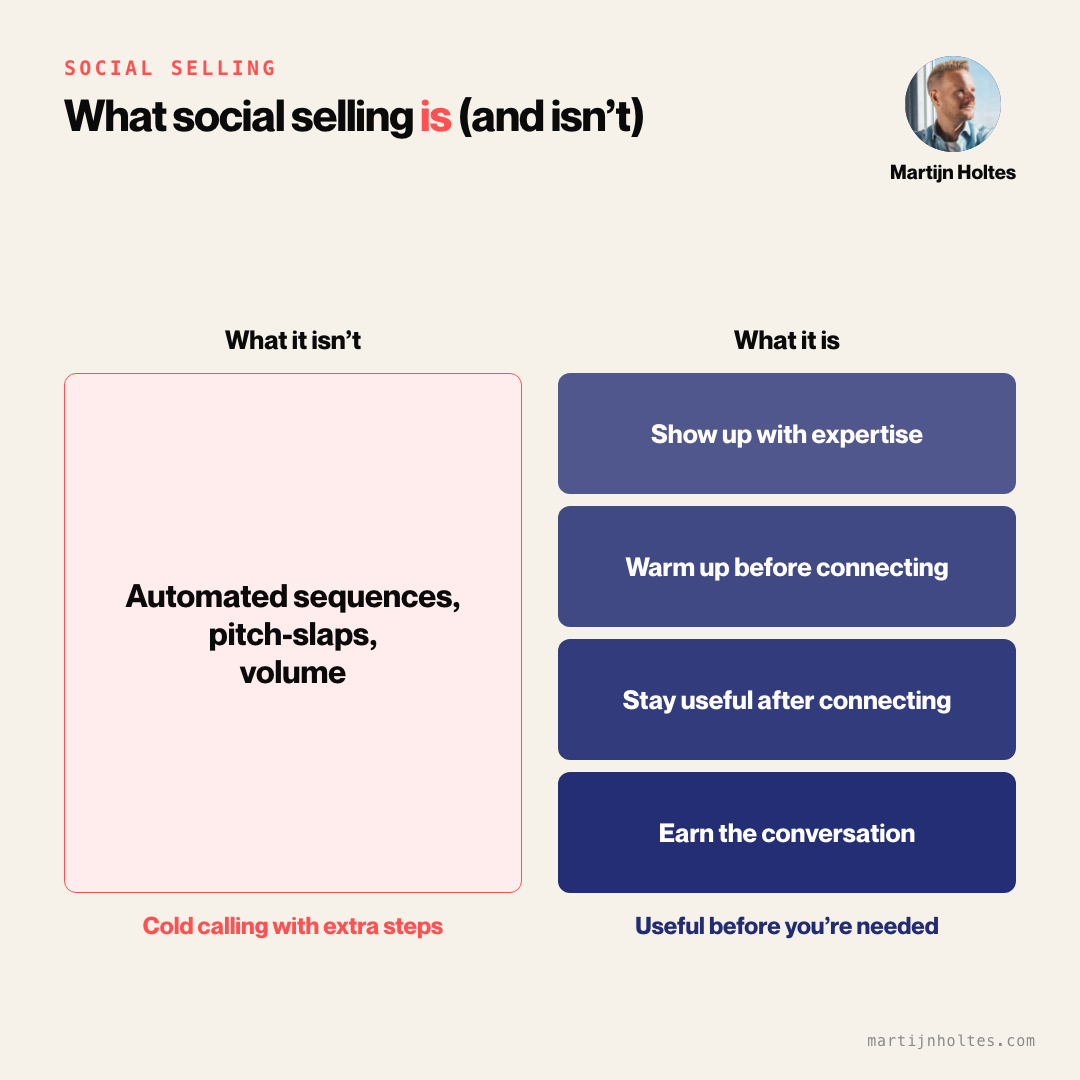
Contrast diagram: social selling is being useful before you're needed, not the automated pitch-slap

Social selling vs cold calling

Cold calling is interrupting a stranger and hoping the timing is right. By the way, is anyone still taking these calls?
Social selling is making sure you’re no stranger by the time the timing is right.

I tested the difference on my own outreach. For years I sent connection requests the way everyone does: find the right person, write a polite note, and hope for the best.
My acceptance rate hovered around 64%, which meant 36% of leads clicking ignore.

A few years ago I changed one thing: before sending a request, I made sure the person had seen my name once or twice. Sometimes I could make a comment on their post. Other times, I found something I could use from the company’s website or company page.
I tracked a full month of it: 40 warmed-up requests, 36 accepted, and the conversations afterwards started from “I’ve seen you around” instead of “who the hell are you?”

With one of my past clients with a team of 12 sales reps we took it even further.
They cut weekly connection requests from 25 to 5 and moved that time into commenting on people’s content. Not only the exact people they wanted to talk to, but also the people around them.
Within four months, their meeting requests ratio had doubled.
Fewer connections, more conversations.

That doesn’t make cold calling dead, although I must agree I hate to do it or get those calls, but it does make cold calling expensive.
People check your profile before they accept your invite, and they check your activity before they reply to your message.
If your last post was three months ago and your comment history is empty, you’re a stranger with a pitch, whatever channel you use.
Warm wins on every number, and the warm-up is something you can build deliberately instead of waiting for referrals to happen to you.
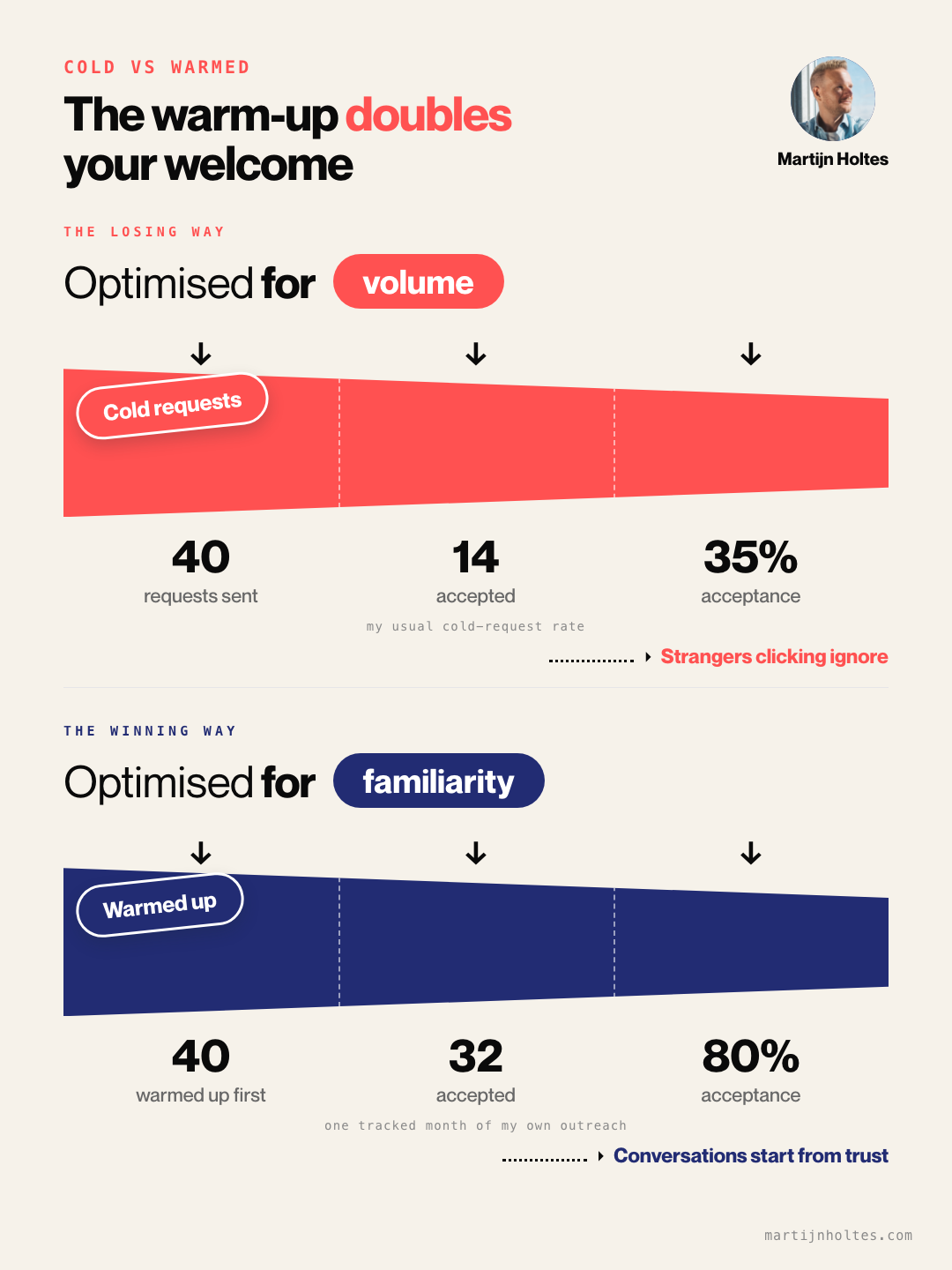
Funnel comparison: cold connection requests convert around 35 percent versus 80 percent for warmed-up requests, from a tracked month

Social selling vs social media marketing

Marketing talks to a market; selling talks to a person.
Social media marketing is your company building visibility with an audience, one to many.
Social selling is a person building trust with their ideal client profile, or even better, the full decision-making unit, one to one, under their own name.

They feed each other, but the buyer only signs with a person.
That’s why the seller’s profile, activity and reputation matter more here than any campaign, because people buy from people, and a logo has never bought anyone a coffee.

Social selling for B2B teams

Your pipeline runs on trust you haven’t built yet.

I train sales teams to build it, with PROVE as the backbone. 250,000+ professionals and 950+ companies since 2011.

See how I train teams

Why it works: every deal is a risk transfer

Every deal is a risk transfer, and the buyer carries all of it.
If the project fails, they’re the one explaining to their board why the budget is gone.
You move on to your next deal while they live with the consequences.

What I have found time after time is that the seller who reduces the most risk wins.
Not the best product, not the sharpest pitch, not even the best price.
The one who made it safest to say yes.

Building real trust is the fastest risk-reducer there is.
Everything in social selling- the visible expertise, the consistent presence, the helpfulness with nothing attached- is risk reduction the buyer can verify on their own, before they ever talk to you.

When you see deals this way, your whole approach changes. You stop trying to increase desire and start removing fear. References before they’re asked for, realistic timelines instead of optimistic ones, and what happens when things go wrong discussed up front.

The second principle is to diagnose before you prescribe.
Imagine a doctor writing your prescription before asking where it hurts.
You’d walk out, not because the prescription might be wrong, but because the doctor skipped the most important part of the job.

Most salespeople do exactly that: “we can help you with X” before someone has confirmed X is their problem.
I’ve lost count of the companies that told me they needed “content strategy” when the real problem was a sales team terrified of being visible online.

Diagnose first, and the eventual proposal doesn’t feel like a pitch, it feels like the obvious next step.


PROVE: the method behind it

To make this repeatable, I built the PROVE method.
Five steps, and you can’t skip one because each one sets up the next.
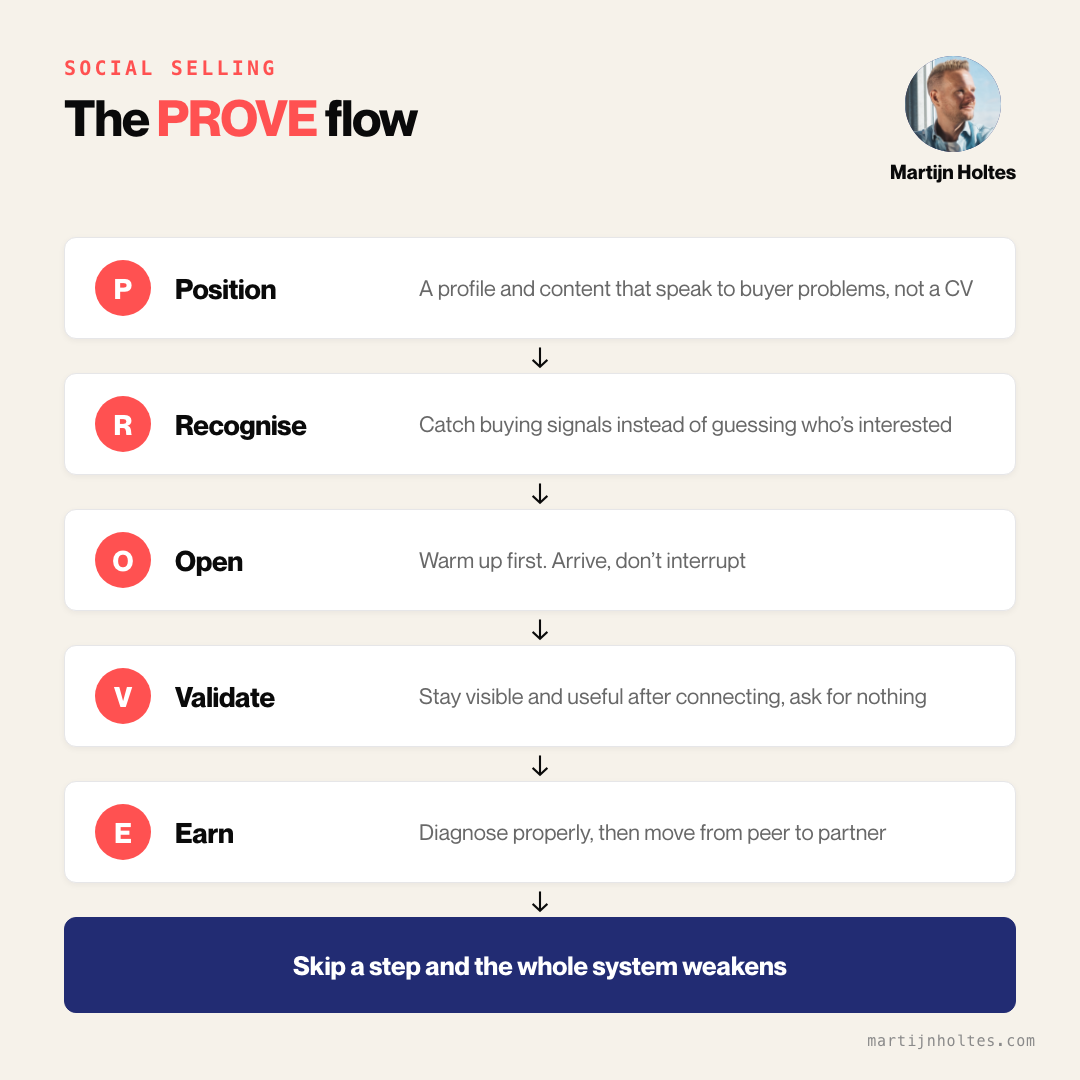
The PROVE method in five steps: Position, Recognise, Open, Validate, Earn

Position.
Your online presence is your 24/7 salesperson. It works while you sleep, while you’re in meetings, while you’re on holiday.
Most social profiles of people waste them cause they read like a CV with a job title, company, and responsibilities, which tells a prospect nothing about whether you understand their problems.
Position means a headline that speaks to your buyer’s challenges, an About section that shows you know their world, and content that proves it consistently.

Before any of it works, define your ideal customer by the problems they face, not by industry and company size. Demographics give you a list; problems give you a conversation.

Recognise.
Watch for real buying signals in the noise instead of guessing who might be interested.
A prospect changing jobs is more open to new approaches. A company announcing growth needs help scaling. Someone engaging with your content, even if it is a like, is already paying attention. A profile visit means they’re researching you.

Sort signals by urgency, act today, act this week, keep watching, and something odd happens once you’ve defined your three to five cues: you start seeing them everywhere.
It’s the red car effect. Buy a red car, and suddenly every street has one.

Train your attention on real signals and your pipeline starts filling itself, because most of the opportunities your competitors miss aren’t hidden, but just ignored.

Open.
Warm up before you connect. Engage with their content a few times with real insight (not “great post!”), become a familiar name, then send the request with context.

And before you go hunting for strangers at all, look at the three degrees of your network: deepen the relationships you already have, ask for warm introductions through mutual connections, and only then earn attention from people who’ve never heard of you.

Most salespeople pour everything into the third group, while the second converts around ten times better, because a referral borrows trust that already exists.
I’ve known teams who now do this after my training program as a habit. With every lead review, they check whose network holds the introduction they need.
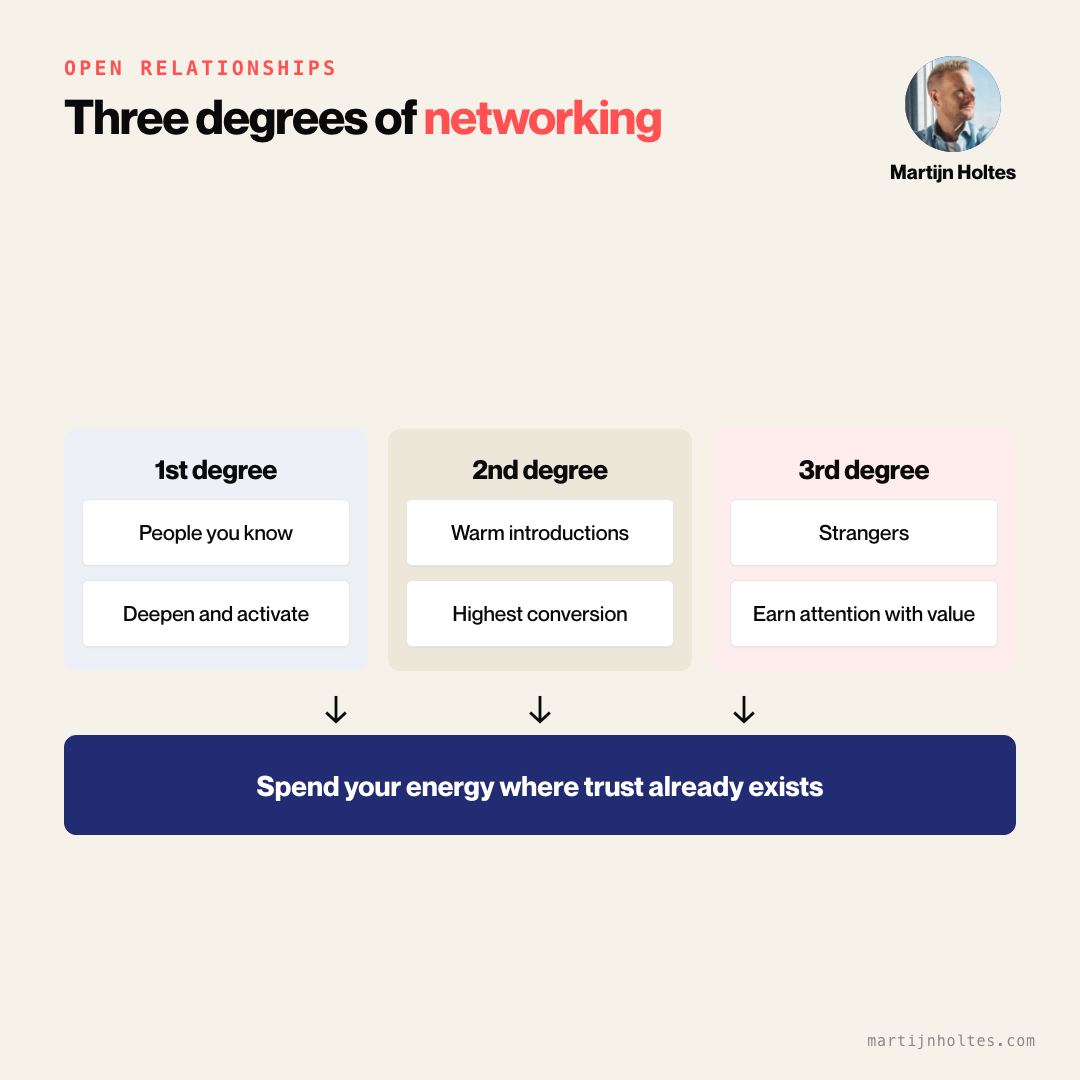
Three degrees of your network: deepen existing relationships, ask for warm introductions, then earn attention from strangers

Validate.
Stay visible and useful after connecting, because connecting is the start, not the finish.
Most people connect and pitch immediately, or connect and vanish until they need something. Share things relevant to the prospect’s world, engage with their updates, ask about their experience, and ask for nothing in return.

The person who isn’t ready today might be ready in three months, and if you stayed helpful in between, you’re the first call. If you disappeared after the first message, you’re just a connection or name in their inbox they can’t place.

Earn.
Recognise when the time is ready, and move from connection to potential partner without damaging what you built. This is where most social selling advice goes silent, because the transition can’t be scripted. You need to earn it by the four steps before it.
Confirm your diagnosis before you present anything, let them correct you, and be willing to say “I don’t think I’m the right fit” when that’s true.

Partners solve business problems, vendors deliver products, and everyone can tell.

Make the yes safe! A pilot, a proof of concept, guarantees you can stand behind and reduce the risk for the buyer to a minimum.
For calls with leads, mine is that you’ll walk away with concrete insights for your situation whether we work together or not, and I can afford that guarantee because it’s true.

Another one is that my clients have an insights guarantee. If by the second module none of the participants has learned something new, I will refund my invoice, no questions asked.
The risk is down to a minimum for my leads and clients.

For the PROVE system, you must be aware that when you skip a step, the system weakens and probably doesn’t work.
❌ Positioning without recognising signals means you look credible but talk to nobody.
❌ Opening without validating means connections that go cold.
❌ Most failed social sellers didn’t fail at effort, they failed at sequence.

What about automation and AI?

I won’t pretend efficiency doesn’t matter.
But somewhere in the last few years, people started to confuse efficiency with effectiveness.
Efficiency is doing things as fast as possible with the least amount of energy.
Effectiveness means all activities are aimed towards a specific outcome.
Using automation or AI to scale your relationship building might be efficient, but it isn’t effective at all!

Three questions decide what you should and shouldn’t automate.
Does this activity build or maintain trust with a specific person?
Keep it human.

Would the recipient feel misled if they knew it was automated?
Don’t automate it.


Does human execution add insight the machine can’t?
Keep it human.

Everything else, the list-building, the research prep, the CRM hygiene, the reminders, automate with my blessing.
The rule is dead simple.

Automate the work around the relationship, never the relationship.
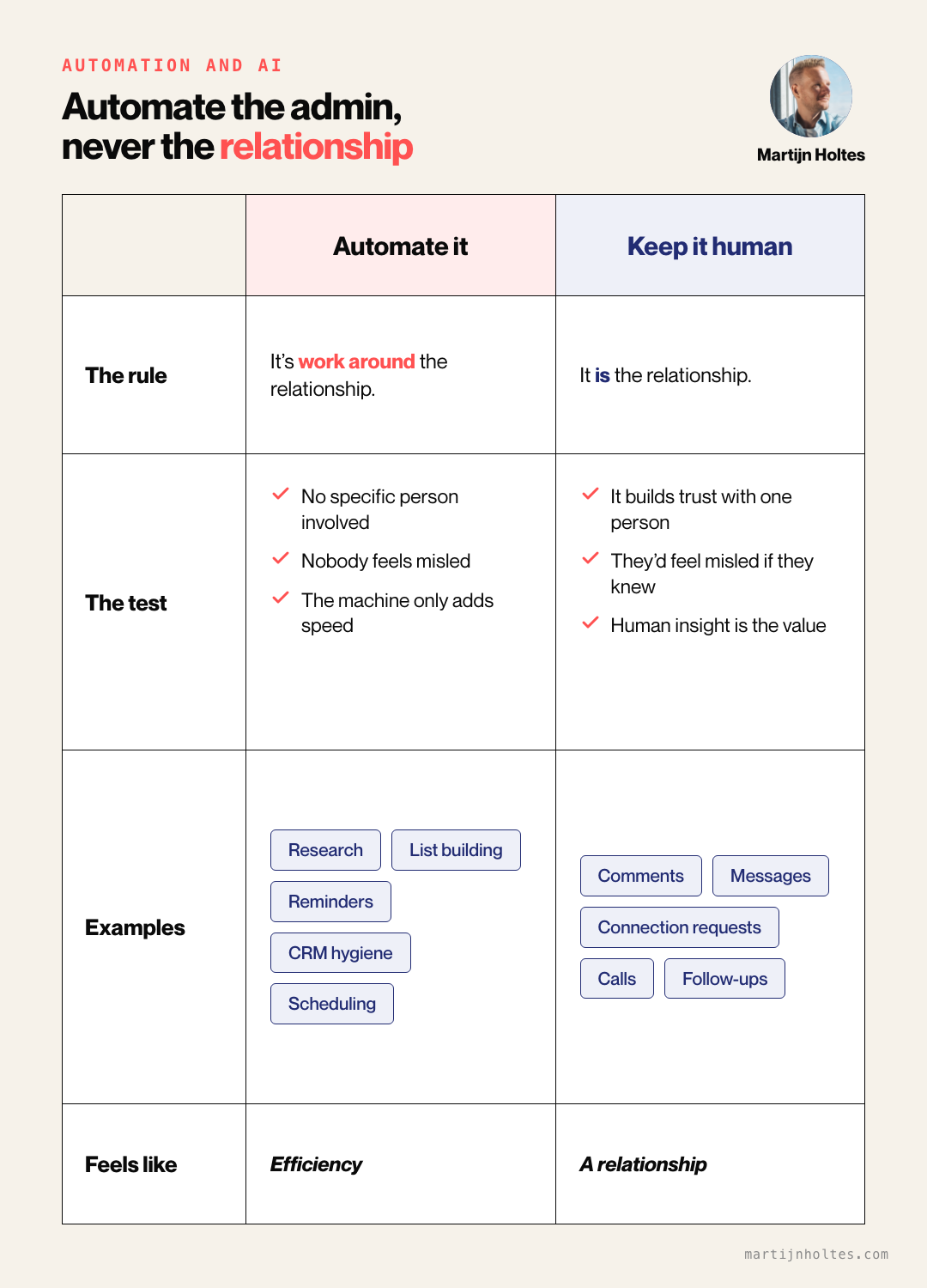
What to automate versus keep human in social selling: automate the work around the relationship, never the relationship

How to start (without quitting in week three)

Start smaller than you think, and build the system before you chase the outcome.

Daily, 15 to 20 minutes.
Comment with thought on posts from prospects and industry voices. Respond to those that engage with you and check your signals. Substantive means a real opinion in a few sentences. Nobody wants to be known as the “great post” person….

Weekly.
One piece of content every week or two is plenty at the beginning.
Ten good comments a week beat one masterpiece a month and follow up with the people who engaged.

Monthly.
Review your list: which relationships warmed up, which signals you acted on, what worked? Then improve and adjust.
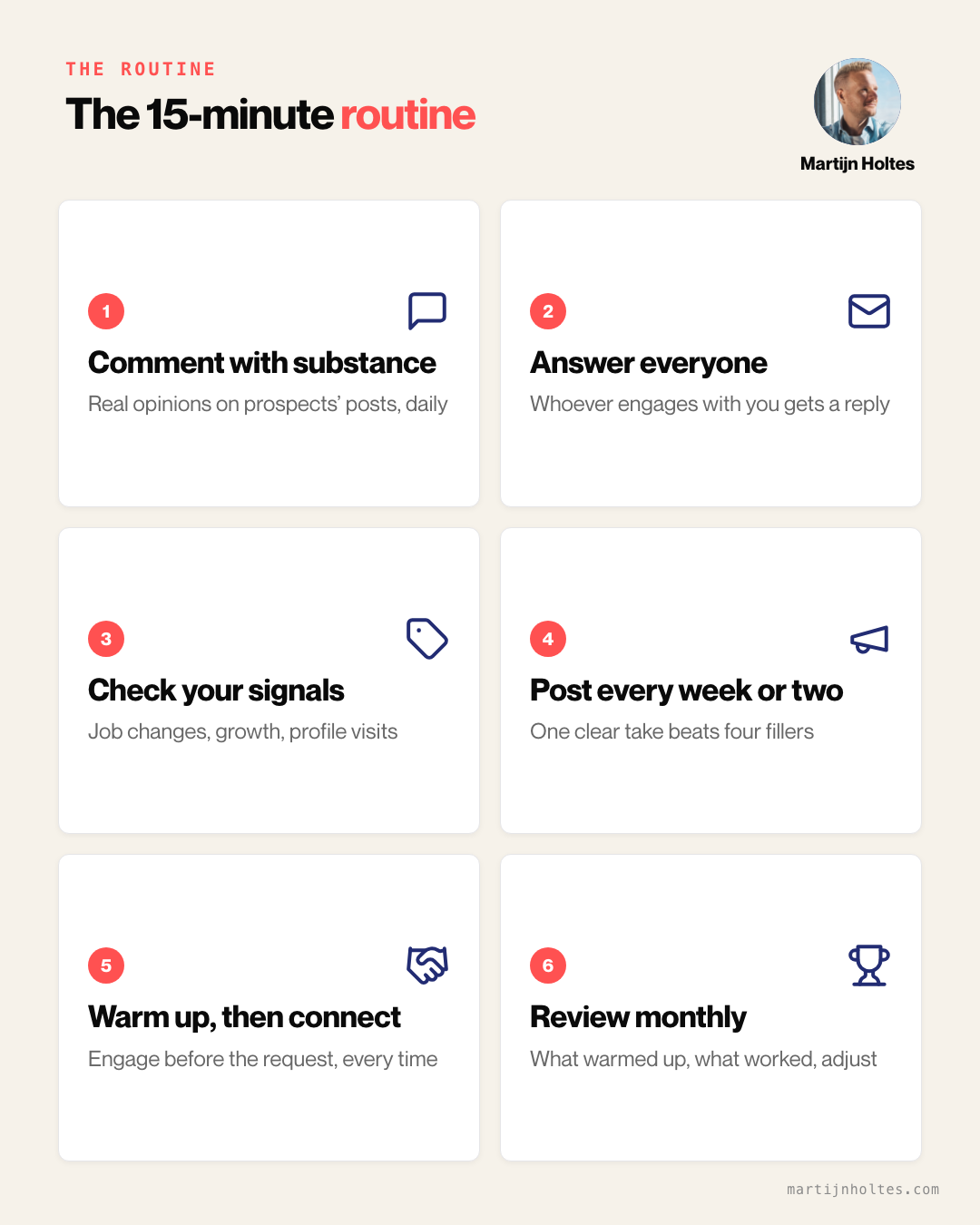
The fifteen-minute daily social selling routine shown as six cards

Give more than you ask for, structurally.
Share the knowledge, apply it to your niche, let people taste the expertise,
Like the free samples in a supermarket. You give away a real piece now so you can invoice the bigger piece later.

Knowledge stopped being scarce, so hoarding it buys you nothing.
Sharing it is how people find out you have it.

Even if your network does nothing for you yet, publishing pays, because search engines and LLMs reward content that answers real questions.
So your future buyers find you on their own, and it saves everyone time instead of those annoying cold calls.

How to measure social selling success

Track inputs and outcomes separately.
You can’t control how many meetings you book this week, but you can control how many substantive comments you write, how many relationships you warm up, how many helpful messages you send.
Inputs are the leading indicators. If they’re consistent, the outcomes follow, with a delay measured in months.

Month one feels slow and pointless….
Month two, signals start appearing, profile visits, replies, small recognitions.
Month three, conversations happen that you didn’t initiate.
By month six, prospects reach out to you, referencing things you posted that you’d forgotten writing.
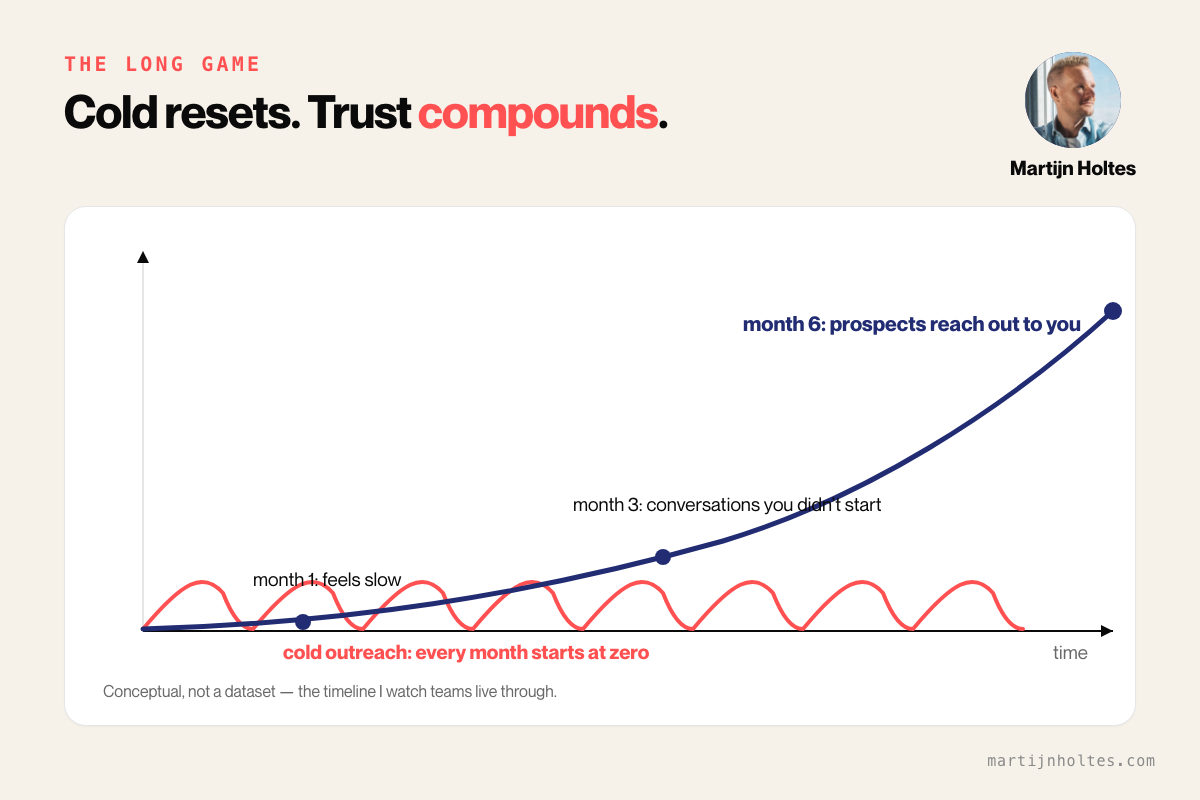
Line chart: cold outreach resets every month while trust compounds across months one, three and six

The results compound because trust compounds, and every post, comment and helpful message keeps working after you log off.

The people who succeed at this aren’t the ones who start big.
They’re the ones who don’t stop.

That lead from 16 years ago taught me more than most trainings I’ve paid for.
These days I open every first meeting with questions, and deals close faster than they ever did when I was pitching, because the people feel understood instead of hunted.
Meanwhile, somewhere out there, a sales rep’s automation tool cheerfully sends “quick question” number 4,000.

While everyone else is still cold-pitching, you don’t have to anymore.

The PROVE method

Want PROVE inside your sales team?

Start with an intake call. Tell me where you’re stuck, and I’ll tell you straight if I can help, and how.

Schedule your intake call

Questions I get about social selling

What is social selling in simple words?

Being useful before you’re needed. You build relationships and trust with future buyers on LinkedIn, through visible expertise and real conversations, so you’re the first call when they’re ready to buy, instead of a stranger pitching at the wrong moment.

What’s the difference between social selling and cold calling?

Cold calling interrupts strangers and hopes the timing works. Social selling makes sure you’re a familiar, trusted name before the timing arrives. In my own tracked test, warmed-up connection requests were accepted 80% of the time against roughly 35% cold, and the conversations start from trust instead of suspicion.

What’s the difference between social selling and social media marketing?

Marketing builds brand visibility with an audience, one to many. Social selling is an individual seller building trust with specific buyers, one to one, under their own name. Marketing warms the market; social selling wins the deal, because people buy from people.

What does a social seller do day to day?

Fifteen to twenty minutes of engagement: substantive comments on prospects’ and industry posts, responses to everyone who engages back, a check on buying signals like job changes and content engagement. Weekly: a piece of content and follow-ups. Monthly: review the list, adjust. It’s a routine, not a campaign.

How do I start with social selling?

Fix your positioning with your profile and content strategy so it speaks to buyer problems instead of listing your job history. Define your ideal customer by their problems, then build the daily routine: comments, conversations, warm-ups before connection requests, introductions through people you already know. Start with one post every two weeks and ten substantive comments a week, and don’t stop.

How do I measure social selling success?

Separate inputs from outcomes. Inputs: comments written, relationships warmed, useful messages sent, consistency held. Outcomes: conversations, meetings, pipeline. Inputs predict outcomes with a delay of months, so judge the first quarter on the activity you control, not on deals you can’t force.

Does social selling work in B2B?

That’s where it works best, because B2B deals are high-risk decisions made by multiple stakeholders, and trust is the fastest risk-reducer. The buyer who has read your thinking for months needs far less convincing than a stranger comparing five cold quotes on price.

Should I automate my social selling?

Automate the work around the relationship: research, lists, reminders, CRM. Never the relationship itself. Three questions decide it: does this build trust with a specific person, would they feel misled if they knew it was automated, and does a human add insight here? The moment a prospect senses a machine wrote “your post really spoke to me,” you’ve paid for efficiency with trust.
Category: Social Selling

  • What is social selling? (And what it isn’t)

    What is social selling? (And what it isn’t)

    About 16 years ago, when I started as a solopreneur, I had a meeting with a lead and spent the first 15 minutes explaining everything I knew and could do for him. My methodology, my track record, the case studies, the results. I thought I needed to make an impression so that he would take me seriously.

    When I finished, the guy leaned back and said, “That’s impressive. But you haven’t asked me a single question about my business.”

    He was right, and I obviously didn’t get the deal.
    I spent the ride home wondering where it went wrong. It took me a while to understand what had really happened.
    I wasn’t selling, I was performing.
    Most of what gets sold as “social selling” today is the same performance, repackaged for platforms like LinkedIn and preferably automated, so you can spam leads at scale.

    So let me define the term the way I teach it, because it works, but it looks nothing like the DM that just arrived in your inbox.

    What is social selling, in simple words

    Social selling is being useful before you’re needed.

    It’s being known, liked and trusted by your future clients, using online platforms like LinkedIn, and offline platforms like events, long before they’re ready to buy. You share the valuable stuff you know, you engage with their content and you become a familiar and trusted source, so that when the problem you solve arrives, you’re the first call instead of a stranger.

    Most sellers hear “social selling” and think it is a method to squeeze leads out of a LinkedIn network.”
    That’s the exact reason it doesn’t work for them. Leads can’t be shoved down a funnel anymore.
    Leads are people, and most people aren’t stupid. They can smell it the second you’re only being nice because you want something.

    Treat it like a relationship, because that’s what it is. Lasting things start with respect and the patience to get to know each other, and asking “what’s the ROI of Social Selling” is like asking for the ROI on a first date. Wrong question, wrong timescale. Trust pays nothing this quarter and enormously over the years.

    What social selling is not

    This is where many people get confused, so let me clarify some concepts.
    I’ll try to keep my annoyance about these activities to a minimum. 🫣

    It’s not automation.
    Sequences that fire “personalised” messages written by a tool. Bots that view profiles to fish for attention.
    AI messages pretending a human wrote them and scraped lists fed into connection machines.
    That is not social selling.

    I regularly encounter these tactics in training programs with my participants, and I also always ask them one question. How would you feel if someone sent this BS to your inbox?
    If the answer is “annoyed”, congratulations, you’re about to annoy a thousand people with better efficiency than ever before.

    It’s not the pitch-slap.
    Connect on Monday, and send a pitch-slap message like “great to be connected, do you have 15 minutes, because we build websites…” on Tuesday.
    That’s a cold call with extra steps, and it burns the one thing the connection gave you: the benefit of the doubt.

    It’s not posting alone.
    Content matters, but content without conversations is broadcasting. And broadcasting only works if you’re really, really talented. Which I am not…
    The selling part of social selling happens in comments, messages and eventually meetings, with humans, not with an audience.

    And it’s not a quick fix for an empty quarter.
    If your lead list is empty, social selling won’t rescue this month.
    It does, however, save you from getting there in the first place.
    The best analogy to Social Selling is an obstacle run. It takes a long time sometimes you move fast, sometimes you go slow. But in the end, you improve your health, endurance, learn a lot, and make some friends along the way.
    Yes, it takes effort and energy, but you’re way better off than sitting at your desk making some cold calls or sending some messages nobody likes to receive.

    Contrast diagram: social selling is being useful before you're needed, not the automated pitch-slap

    Social selling vs cold calling

    Cold calling is interrupting a stranger and hoping the timing is right. By the way, is anyone still taking these calls?
    Social selling is making sure you’re no stranger by the time the timing is right.

    I tested the difference on my own outreach. For years I sent connection requests the way everyone does: find the right person, write a polite note, and hope for the best.
    My acceptance rate hovered around 64%, which meant 36% of leads clicking ignore.

    A few years ago I changed one thing: before sending a request, I made sure the person had seen my name once or twice. Sometimes I could make a comment on their post. Other times, I found something I could use from the company’s website or company page.
    I tracked a full month of it: 40 warmed-up requests, 36 accepted, and the conversations afterwards started from “I’ve seen you around” instead of “who the hell are you?”

    With one of my past clients with a team of 12 sales reps we took it even further.
    They cut weekly connection requests from 25 to 5 and moved that time into commenting on people’s content. Not only the exact people they wanted to talk to, but also the people around them.
    Within four months, their meeting requests ratio had doubled.
    Fewer connections, more conversations.

    That doesn’t make cold calling dead, although I must agree I hate to do it or get those calls, but it does make cold calling expensive.
    People check your profile before they accept your invite, and they check your activity before they reply to your message.
    If your last post was three months ago and your comment history is empty, you’re a stranger with a pitch, whatever channel you use.
    Warm wins on every number, and the warm-up is something you can build deliberately instead of waiting for referrals to happen to you.

    Funnel comparison: cold connection requests convert around 35 percent versus 80 percent for warmed-up requests, from a tracked month

    Social selling vs social media marketing

    Marketing talks to a market; selling talks to a person.
    Social media marketing is your company building visibility with an audience, one to many.
    Social selling is a person building trust with their ideal client profile, or even better, the full decision-making unit, one to one, under their own name.

    They feed each other, but the buyer only signs with a person.
    That’s why the seller’s profile, activity and reputation matter more here than any campaign, because people buy from people, and a logo has never bought anyone a coffee.

    Social selling for B2B teams

    Your pipeline runs on trust you haven’t built yet.

    I train sales teams to build it, with PROVE as the backbone. 250,000+ professionals and 950+ companies since 2011.

    See how I train teams

    Why it works: every deal is a risk transfer

    Every deal is a risk transfer, and the buyer carries all of it.
    If the project fails, they’re the one explaining to their board why the budget is gone.
    You move on to your next deal while they live with the consequences.

    What I have found time after time is that the seller who reduces the most risk wins.
    Not the best product, not the sharpest pitch, not even the best price.
    The one who made it safest to say yes.

    Building real trust is the fastest risk-reducer there is.
    Everything in social selling- the visible expertise, the consistent presence, the helpfulness with nothing attached- is risk reduction the buyer can verify on their own, before they ever talk to you.

    When you see deals this way, your whole approach changes. You stop trying to increase desire and start removing fear. References before they’re asked for, realistic timelines instead of optimistic ones, and what happens when things go wrong discussed up front.

    The second principle is to diagnose before you prescribe.
    Imagine a doctor writing your prescription before asking where it hurts.
    You’d walk out, not because the prescription might be wrong, but because the doctor skipped the most important part of the job.

    Most salespeople do exactly that: “we can help you with X” before someone has confirmed X is their problem.
    I’ve lost count of the companies that told me they needed “content strategy” when the real problem was a sales team terrified of being visible online.

    Diagnose first, and the eventual proposal doesn’t feel like a pitch, it feels like the obvious next step.


    PROVE: the method behind it

    To make this repeatable, I built the PROVE method.
    Five steps, and you can’t skip one because each one sets up the next.

    The PROVE method in five steps: Position, Recognise, Open, Validate, Earn

    Position.
    Your online presence is your 24/7 salesperson. It works while you sleep, while you’re in meetings, while you’re on holiday.
    Most social profiles of people waste them cause they read like a CV with a job title, company, and responsibilities, which tells a prospect nothing about whether you understand their problems.
    Position means a headline that speaks to your buyer’s challenges, an About section that shows you know their world, and content that proves it consistently.

    Before any of it works, define your ideal customer by the problems they face, not by industry and company size. Demographics give you a list; problems give you a conversation.

    Recognise.
    Watch for real buying signals in the noise instead of guessing who might be interested.
    A prospect changing jobs is more open to new approaches. A company announcing growth needs help scaling. Someone engaging with your content, even if it is a like, is already paying attention. A profile visit means they’re researching you.

    Sort signals by urgency, act today, act this week, keep watching, and something odd happens once you’ve defined your three to five cues: you start seeing them everywhere.
    It’s the red car effect. Buy a red car, and suddenly every street has one.

    Train your attention on real signals and your pipeline starts filling itself, because most of the opportunities your competitors miss aren’t hidden, but just ignored.

    Open.
    Warm up before you connect. Engage with their content a few times with real insight (not “great post!”), become a familiar name, then send the request with context.

    And before you go hunting for strangers at all, look at the three degrees of your network: deepen the relationships you already have, ask for warm introductions through mutual connections, and only then earn attention from people who’ve never heard of you.

    Most salespeople pour everything into the third group, while the second converts around ten times better, because a referral borrows trust that already exists.
    I’ve known teams who now do this after my training program as a habit. With every lead review, they check whose network holds the introduction they need.

    Three degrees of your network: deepen existing relationships, ask for warm introductions, then earn attention from strangers

    Validate.
    Stay visible and useful after connecting, because connecting is the start, not the finish.
    Most people connect and pitch immediately, or connect and vanish until they need something. Share things relevant to the prospect’s world, engage with their updates, ask about their experience, and ask for nothing in return.

    The person who isn’t ready today might be ready in three months, and if you stayed helpful in between, you’re the first call. If you disappeared after the first message, you’re just a connection or name in their inbox they can’t place.

    Earn.
    Recognise when the time is ready, and move from connection to potential partner without damaging what you built. This is where most social selling advice goes silent, because the transition can’t be scripted. You need to earn it by the four steps before it.
    Confirm your diagnosis before you present anything, let them correct you, and be willing to say “I don’t think I’m the right fit” when that’s true.

    Partners solve business problems, vendors deliver products, and everyone can tell.

    Make the yes safe! A pilot, a proof of concept, guarantees you can stand behind and reduce the risk for the buyer to a minimum.
    For calls with leads, mine is that you’ll walk away with concrete insights for your situation whether we work together or not, and I can afford that guarantee because it’s true.

    Another one is that my clients have an insights guarantee. If by the second module none of the participants has learned something new, I will refund my invoice, no questions asked.
    The risk is down to a minimum for my leads and clients.

    For the PROVE system, you must be aware that when you skip a step, the system weakens and probably doesn’t work.
    ❌ Positioning without recognising signals means you look credible but talk to nobody.
    ❌ Opening without validating means connections that go cold.
    ❌ Most failed social sellers didn’t fail at effort, they failed at sequence.

    What about automation and AI?

    I won’t pretend efficiency doesn’t matter.
    But somewhere in the last few years, people started to confuse efficiency with effectiveness.
    Efficiency is doing things as fast as possible with the least amount of energy.
    Effectiveness means all activities are aimed towards a specific outcome.
    Using automation or AI to scale your relationship building might be efficient, but it isn’t effective at all!

    Three questions decide what you should and shouldn’t automate.
    Does this activity build or maintain trust with a specific person?
    Keep it human.

    Would the recipient feel misled if they knew it was automated?
    Don’t automate it.


    Does human execution add insight the machine can’t?
    Keep it human.

    Everything else, the list-building, the research prep, the CRM hygiene, the reminders, automate with my blessing.
    The rule is dead simple.

    Automate the work around the relationship, never the relationship.

    What to automate versus keep human in social selling: automate the work around the relationship, never the relationship

    How to start (without quitting in week three)

    Start smaller than you think, and build the system before you chase the outcome.

    Daily, 15 to 20 minutes.
    Comment with thought on posts from prospects and industry voices. Respond to those that engage with you and check your signals. Substantive means a real opinion in a few sentences. Nobody wants to be known as the “great post” person….

    Weekly.
    One piece of content every week or two is plenty at the beginning.
    Ten good comments a week beat one masterpiece a month and follow up with the people who engaged.

    Monthly.
    Review your list: which relationships warmed up, which signals you acted on, what worked? Then improve and adjust.

    The fifteen-minute daily social selling routine shown as six cards

    Give more than you ask for, structurally.
    Share the knowledge, apply it to your niche, let people taste the expertise,
    Like the free samples in a supermarket. You give away a real piece now so you can invoice the bigger piece later.

    Knowledge stopped being scarce, so hoarding it buys you nothing.
    Sharing it is how people find out you have it.

    Even if your network does nothing for you yet, publishing pays, because search engines and LLMs reward content that answers real questions.
    So your future buyers find you on their own, and it saves everyone time instead of those annoying cold calls.

    How to measure social selling success

    Track inputs and outcomes separately.
    You can’t control how many meetings you book this week, but you can control how many substantive comments you write, how many relationships you warm up, how many helpful messages you send.
    Inputs are the leading indicators. If they’re consistent, the outcomes follow, with a delay measured in months.

    Month one feels slow and pointless….
    Month two, signals start appearing, profile visits, replies, small recognitions.
    Month three, conversations happen that you didn’t initiate.
    By month six, prospects reach out to you, referencing things you posted that you’d forgotten writing.

    Line chart: cold outreach resets every month while trust compounds across months one, three and six

    The results compound because trust compounds, and every post, comment and helpful message keeps working after you log off.

    The people who succeed at this aren’t the ones who start big.
    They’re the ones who don’t stop.

    That lead from 16 years ago taught me more than most trainings I’ve paid for.
    These days I open every first meeting with questions, and deals close faster than they ever did when I was pitching, because the people feel understood instead of hunted.
    Meanwhile, somewhere out there, a sales rep’s automation tool cheerfully sends “quick question” number 4,000.

    While everyone else is still cold-pitching, you don’t have to anymore.

    The PROVE method

    Want PROVE inside your sales team?

    Start with an intake call. Tell me where you’re stuck, and I’ll tell you straight if I can help, and how.

    Schedule your intake call

    Questions I get about social selling

    What is social selling in simple words?

    Being useful before you’re needed. You build relationships and trust with future buyers on LinkedIn, through visible expertise and real conversations, so you’re the first call when they’re ready to buy, instead of a stranger pitching at the wrong moment.

    What’s the difference between social selling and cold calling?

    Cold calling interrupts strangers and hopes the timing works. Social selling makes sure you’re a familiar, trusted name before the timing arrives. In my own tracked test, warmed-up connection requests were accepted 80% of the time against roughly 35% cold, and the conversations start from trust instead of suspicion.

    What’s the difference between social selling and social media marketing?

    Marketing builds brand visibility with an audience, one to many. Social selling is an individual seller building trust with specific buyers, one to one, under their own name. Marketing warms the market; social selling wins the deal, because people buy from people.

    What does a social seller do day to day?

    Fifteen to twenty minutes of engagement: substantive comments on prospects’ and industry posts, responses to everyone who engages back, a check on buying signals like job changes and content engagement. Weekly: a piece of content and follow-ups. Monthly: review the list, adjust. It’s a routine, not a campaign.

    How do I start with social selling?

    Fix your positioning with your profile and content strategy so it speaks to buyer problems instead of listing your job history. Define your ideal customer by their problems, then build the daily routine: comments, conversations, warm-ups before connection requests, introductions through people you already know. Start with one post every two weeks and ten substantive comments a week, and don’t stop.

    How do I measure social selling success?

    Separate inputs from outcomes. Inputs: comments written, relationships warmed, useful messages sent, consistency held. Outcomes: conversations, meetings, pipeline. Inputs predict outcomes with a delay of months, so judge the first quarter on the activity you control, not on deals you can’t force.

    Does social selling work in B2B?

    That’s where it works best, because B2B deals are high-risk decisions made by multiple stakeholders, and trust is the fastest risk-reducer. The buyer who has read your thinking for months needs far less convincing than a stranger comparing five cold quotes on price.

    Should I automate my social selling?

    Automate the work around the relationship: research, lists, reminders, CRM. Never the relationship itself. Three questions decide it: does this build trust with a specific person, would they feel misled if they knew it was automated, and does a human add insight here? The moment a prospect senses a machine wrote “your post really spoke to me,” you’ve paid for efficiency with trust.
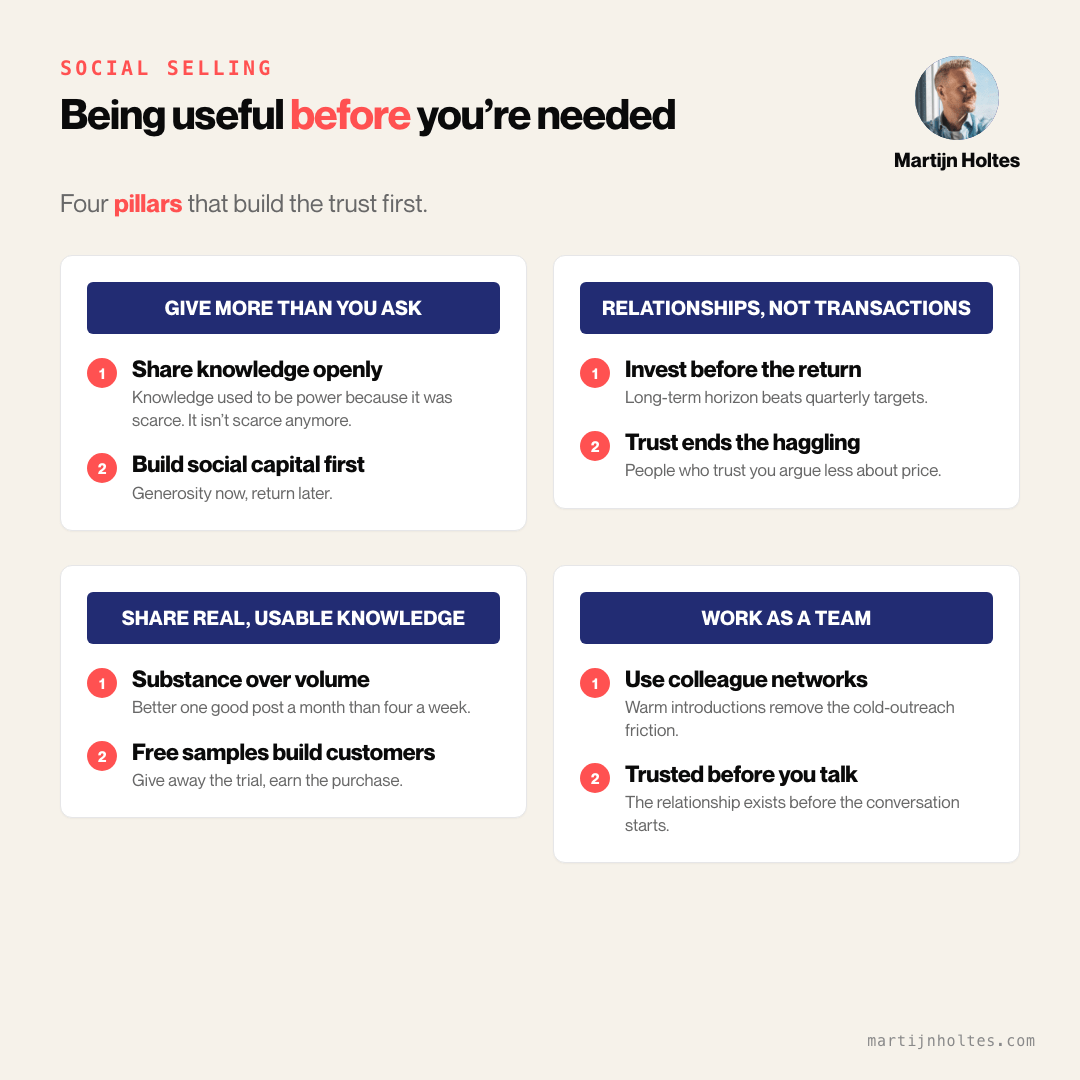
  • What is social selling? Being useful before you’re needed

    What is social selling? Being useful before you’re needed

    Most people hear “social selling” and think “how do I squeeze the most leads out of my LinkedIn network.” That’s the exact reason it doesn’t work for them.

    Building trust, specifically when it comes to social platforms like LinkedIn, pays off nothing in the short term and can pay off enormously over the years.

    Treat it like a relationship, because that’s what it is. You can sleep with someone the first night and have a fine time, but that’s not how anything lasting starts. Lasting starts with respect and the patience to get to know each other. Your prospect isn’t a lead to shove down a fucking funnel. Leads are people and most people aren’t stupid. They can smell it the second you’re only being nice because you want something.

    So asking “what’s the ROI of networking” is like asking for the ROI on a first date. So don’t and get these four things right instead.

    1. Give more than you ask for

    Top of the list, and the one most people underrate. We’re trained to justify our time by what it produced, so giving something away with no immediate return feels weird, but in a connected world that’s the whole strategy.

    A coffee with a “less interesting” lead can turn into an introduction to exactly the person you needed. Direct and indirect audiences blur together, and the more you give, the more social capital you build, until one day you launch something or need a door opened and it turns out you’re owed a hundred small favors you never asked for.

    The main thing you give away is insights and knowledge. Knowledge used to be power because it was scarce. It isn’t scarce anymore, so hoarding it buys you nothing. Share it, apply it to your specific niche so your specific audience recognises it instantly, and let people find and value you for the substance. Yes, that means you need to create better content and share your experience and thinking publicly. In a world this transparent, it’s how you stand out.

    2. Build relationships, not transactions

    “Are you the sales tiger we’re looking for?” I always wonder who the hell writes those job ads. If I had to hand part of my sales process to someone, I’d take a calm, useful human over a tiger who bites my clients’ heads off every time.

    Anyway that’s my frustration about the sales industry

    Social selling runs on long-term relationships. You invest first, and sometimes that means not closing a deal, because the buyer isn’t better off buying right now. Adding value is the only thing that counts, and if you’re not convinced you can, it’s better to wait. Because in a connected world a bad deal travels fast, and so does a good one.

    There’s a bonus in this too: when you lead with the relationship, you spend a lot less time haggling over price. People who trust you argue less about your rate.

    None of this is news, I know. The reason short-term targets still rule is that the whole economy is built on them. Shareholders want good numbers by the next meeting, the freshly promoted manager wants to show he can double revenue this quarter. It’s also, I’d bet, why family businesses tend to ride out downturns better. They think in years, so they’re steadier.

    3. Share real, usable knowledge, openly

    Plenty of companies will help you “do content.” Many of them scream for attention with ads and empty posts, and some even get results with it, but that’s not the game I’m playing.

    I only share something when it’s relevant and think it’s worth your time. Sharing knowledge is never about volume, always about substance. Better one good post a month than four a week of noise. Think of it like the free samples in a supermarket: you taste the drink, and a chunk of people put a bottle in the cart, and some of those buy it again. Drug dealers apply the same tactic but let’s not go there

    Give away a real piece of your expertise now so you can invoice the bigger piece, the training, the project, later.

    And even if your network does nothing for you yet, it’s still smart to publish. Search engines and LLM’s reward content that answers the questions people actually ask, so write it down and your audience finds you on their own. Saves you a pile of those fucking annoying cold calls nobody wants to get.

    4. Work as a team

    “Using” your colleagues sounds cold, so let’s call it what it is: strengthening each other. When you work with people you actually get on with, they’ll usually help you, especially when it costs them two minutes.

    In a networked world you can see into each other’s networks. Who knows whom, and how that helps you. LinkedIn even shows you exactly who’s in your colleagues’ network, and a warm introduction beats a cold approach every time. Remember the top of this article: don’t jump on everyone the second you spot them. Get introduced and you at least won’t look like a desperate idiot

    I trained many sales reps who do this now as a habit. Every meeting, they pull up their prospects, everyone checks their LinkedIn networks side by side, and figures out who can introduce whom. The prospect gets approached either with genuinely useful knowledge or through someone they already trust. The polished sales pitch is gone, because by the time they talk, the prospect already knows this person at least has a chance to solve their problem.

    So by the time they’re ready to buy, they already trust you.

    Everyone else is still cold-calling. And cold calls are fucking annoying…

  • The cheapest pipeline you’ll ever build

    The cheapest pipeline you’ll ever build

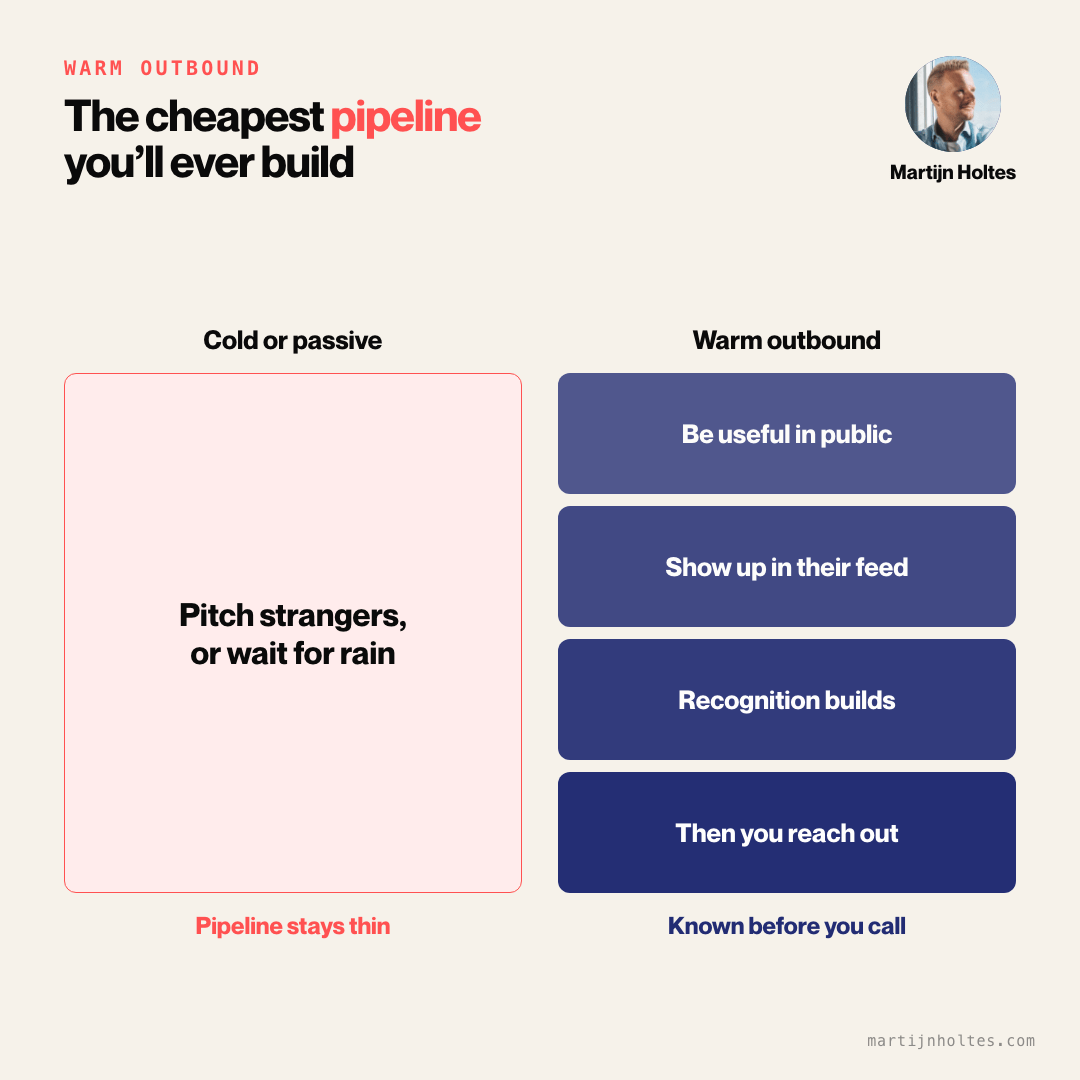
    Last year I worked with an IT company* whose sales team had split into two camps, and they defended those camps like it was religion. One half lived on cold outreach, firing connection requests at anything with a pulse and a job title. The other half had given up on that and sat back waiting for inbound, which is a strategy the way waiting for rain is in agriculture.

    The board had been arguing about it for months to determine the best strategy. Meanwhile the pipeline stayed thin for months too, which should have settled the argument, but sales teams don’t work that way.

    The cold callers were burning through lists and getting ignored, because they were reaching people who’d never heard their name. The inbound folks were waiting for a ring or message that never arrived, because nobody hands their business to a company they’ve never heard of.

    Two different ways of being a stranger.

    What we did instead

    We stopped treating it as a choice between the two. The reps started being useful in their prospects’ LinkedIn feeds first. Posting and commenting on the real problems those buyers deal with all day, weeks before anyone mentioned the product. No “great post, thanks for sharing” BS, but the kind of content that makes someone think this person gets my issues.

    For a while that was the whole job: be useful in public, in front of the exact people they’d wanted a call from.

    Then they called. Same people as they would have cold-called, except now the name on the screen wasn’t a stranger’s. Call it warm outbound: outbound timing, except the prospect already knows who you are when you call.

    Same team, same product, same list. The only thing that changed was that people knew who was knocking before they knocked.

    Why teams skip the cheapest option

    Being useful in public before there’s a deal in sight costs no budget, only patience and giving something away before you’ve earned the right to ask for anything, which is why most skip it.

    Being visible and building an online reputation gets treated as marketing’s job, something that happens somewhere else. Yes, commenting eats hours too, but an hour of being useful keeps paying out for months, and an hour of dials is gone by lunch.

    From what I’ve seen, the problem is that being useful never shows up on this quarter’s numbers, so it’s the first thing to get cut. There’s no number on the dashboard for the prospect who takes your call in three months because you were useful to them today.

    Try putting “I was useful to a stranger in March” in the CRM and see what your sales manager thinks of it.

    The grinding feels like work; that’s the trap. Even the rejection feels like effort. But when someone already knows your name and has a rough sense of how you think, the call stops being an interruption and becomes the next step in a conversation they were half in already.

    So the fight those two camps were having was the wrong fight.

    What matters is the thing underneath.

    Do the people you want to sell to know who you are before you show up? Build that, and the pipeline gets cheaper every month, because rented attention expires the day you stop paying, and a name people know keeps working for free.

    And no, you don’t need to become an influencer for this. Ten comments a week, in the feeds of the people you want to call, and the only thing a comment has to do is prove you understood the problem.

    The cheapest pipeline you’ll ever build runs on people who already know your name before you call. For everything else, you either pay for one cold dial at a time or you sit by a phone that doesn’t ring.

    *All examples are real. Names and industries changed to protect my clients’ privacy.

  • You don’t need to go viral. You need to be the obvious choice.

    You don’t need to go viral. You need to be the obvious choice.

    In 2016, I bought a personal development course for €497.

    The creator had thousands of followers, huge engagement on every post, comments full of praise. The classic “three bonuses worth €1000” were thrown in.

    I thought I was buying from an expert.

    Halfway through, I asked a question in the Q&A that went a bit beyond the course material.

    I got a vague answer that repeated what was already in the modules. I tried again with a different question. Same thing.

    The coach couldn’t answer anything that wasn’t already scripted. That’s when I realised I hadn’t bought expertise or experience. I’d bought good marketing.

    The course itself? A patchwork of ideas from other people. Nothing wrong with the content, but nothing original either.

    The creator had built a big audience. They hadn’t built deep knowledge. No experience of their own, either.

    Being seen isn’t being trusted

    I’ve thought about that course a lot lately, because it captures something I see in almost every professional I work with.

    They’re told visibility is the goal. Get more followers. Get more leads. Go viral. Be everywhere. So they chase the numbers game.

    But being famous and being an authority are not the same thing.

    Famous means being seen by many. Authority means being valued by the few who matter.

    Social platforms are designed to make you chase the first one. They’re built for dopamine, not decisions. They reward reach and impressions, not relevance and trust.

    And if you work in B2B, or you want to grow your career, that’s a problem.

    Algorithms don’t sign contracts. Humans do.

    You don’t need to be famous to the world. You only need to be the obvious choice in your network when a specific problem comes up.

    Not “sort of known.” Not “one of the options.” The first name that comes to mind, before they even start searching.

    Some people call it thought leadership. I call it being the obvious choice.

    Chasing virality is like trying to be heard in a stadium. You’re competing with everyone and reaching no one in particular.

    Being the obvious choice works differently. It’s a room, not a stadium. A room full of the right people, the ones who care about what you know and have the specific problem you’re good at solving.

    In that room, you don’t need to shout. You need to be useful.

    What this means for you

    Take a hard look at your positioning and your content. Ask yourself this:

    Does your LinkedIn profile scream “looking for a new job” or “pay attention to my hobby”? Or does it make clear: this is what I know, this is who I help, this is why it matters.

    Are you trying to appeal to everyone? Or have you made the hard choice to focus on one audience and position yourself on one, two, maybe three topics?

    • Instead of appealing to everyone, you write for the people who matter.
    • Instead of surface-level advice that sounds smart, you go deep on the problems you understand.
    • Instead of chasing trends, you develop a point of view.

    The stuff that scares away the general public is often what pulls in your people. Because it signals you know what you’re talking about. You’ve become the obvious choice.

    What’s worked for me is letting go of the endless chase for more. I stopped measuring success in impressions, though some days that’s still hard.

    I started measuring it in conversations and replies from people I respect. In opportunities that came from someone saying, “I thought of you because of…”

    So if you’re posting and nothing’s happening, if the likes don’t come and the followers don’t grow, if you’re starting to believe you’re not cut out for this, consider this:

    Maybe the problem isn’t your content. Maybe you’re optimising for the algorithm instead of the people who matter.

    The answer is to become the obvious choice for the few.

  • Your work isn’t the problem. Your audience is.

    Your work isn’t the problem. Your audience is.

    I’ve always struggled with things that seem obvious to everyone else. Simple instructions confuse me. Standard processes feel like reading a map upside down. In meetings, people explain straightforward concepts and I’m the one asking the “dumb” questions.

    For most of my life, I thought something was wrong with me. Turns out, I was playing in the wrong rooms.

    I see patterns nobody else sees. I connect ideas from completely different fields and find something new in the middle. I pick up on things that are invisible to others. And I do that because of how my brain works, not despite it.

    Two years ago I got diagnosed with ADD, and something clicked. Your value isn’t inherent. It’s defined by context.

    A violinist in a metro station

    In 2007, someone ran a social experiment with Joshua Bell, one of the finest violinists alive. He plays with the world’s best orchestras. His performances sell out concert halls where tickets cost hundreds of dollars. I’m not much into his music, but that doesn’t matter.

    For the experiment, Joshua took his $3.5 million (wtf) Stradivarius into a Washington D.C. metro station during rush hour and played for 45 minutes.

    Same piece he was going to play at a concert a few days later. Same instrument. Same skill.

    A few people paused briefly. Some dropped pocket change. Most walked right past without a second glance. Total earnings: around $32.

    Three days later, the same Joshua played the same music on the same violin in Boston. Tickets sold for over $100 each. He sold out the theatre.

    Quality doesn’t speak for itself

    I think about this experiment a lot, because it captures something I’ve experienced myself, and something I see in almost every professional I work with.

    We want to believe quality speaks for itself. That if we’re good enough, people will notice. That expertise rises to the top on its own. But it doesn’t work that way.

    Joshua’s genius didn’t change between the concert hall and the metro station. The notes were identical. But in one place people paid $100 to hear him, and in the other they threw quarters.

    The difference wasn’t him. It was everything around him.

    When I got my ADD diagnosis, I started looking at my own career through the same lens. I’d been playing my violin in a metro station.

    My ideas weren’t bad, or at least not all of them. But I was in rooms full of people rushing to get somewhere else. People who weren’t looking for what I had to offer. People who valued things I wasn’t good at and overlooked the things I was.

    The problem wasn’t my brain. The problem was the room.

    If you’re struggling in your business, or to get recognition for what you’re good at, I want you to consider something.

    Maybe your problem isn’t quality. Maybe you’re a genius playing the wrong room.

    The context

    Where are you presenting yourself? Joshua Bell, in the metro station, was surrounded by rushed commuters. The environment said: this is background noise, keep moving.

    The concert hall said something else. Elegance, comfort, a program explaining what you were about to hear. Pay attention. This matters.

    Are you trying to build authority in spaces designed for quick consumption and endless scrolling? Are you pitching to people who are mentally rushing somewhere else? The same message gets a completely different response depending on where you deliver it.

    The packaging

    How are you presenting yourself? In the metro station, Joshua’s music was free, so it read as worthless. No ticket, no program, no seat assignment. Nothing that said “this is premium.”

    The concert hall had a ticketing process and a dress code. People were probably excited for days. So by the time Joshua started playing, everyone was ready for something special.

    Are you selling your work, your services, your expertise as a commodity? Are you interchangeable with a dozen other options, or worse, with AI? Or have you thought hard about your own point of view, the thing that says: this is worth your full attention? The packaging tells people how to see you before you say a word.

    The audience

    Who are you presenting yourself to? The metro commuters were in a rushed mindset. Get to work, hurry up, don’t be late. They weren’t in the market for what Bell was offering.

    The people going to the concert had planned their evening. They’d bought tickets, dressed up, maybe booked dinner nearby. They showed up wanting to be moved.

    Are you pitching to people hunting for the fastest, cheapest option? People who want to tick a box as quickly as possible? Or are you spending time with people who want exactly what you’re best at?

    I’ll admit, coming to this realisation sucks. Sometimes we’ve spent years building relationships in rooms that will never value what we do best. Some people even feel disloyal walking away. But staying in the wrong room isn’t loyalty. It’s a slow professional death.

    Find the concert hall

    The answer isn’t to get louder. It isn’t to dumb down what you do. It isn’t to compete with people who don’t have half your skill. The answer is to change rooms.

    Looking back, I spent years trying to position myself in rooms that weren’t meant for me. Rooms where I was constantly trying to fit a brain that works differently into processes built for brains that don’t.

    Then I figured out there are other rooms. Yes, you’re right, I’m a bit slow getting this at 44.

    Rooms where the “weird” questions were valued. Where connecting unexpected dots was the whole point. Where “how does your brain even work?” became a compliment instead of a criticism.

    The internet is full of these rooms. Heck, even on LinkedIn there are tons of them.

    There are audiences waiting for exactly your perspective. Spaces where your kind of genius is precisely what people are hungry for.

    Don’t make yourself smaller. Find the concert hall. Build one if you have to.

    The people who need what you do are out there. They’re not the ones rushing through metro stations.

  • Buyers don’t pick the best. They pick who they trust.

    Buyers don’t pick the best. They pick who they trust.

    It doesn’t matter if you run your own business, sell for someone else, or you’re after a new job. The psychology of selling and persuading is changing fast.

    Ten years ago, you could get by with a Twitter account and some smart, informative tweets. Today that barely works, because AI chatbots hand people tailored answers on demand.

    But that doesn’t mean content is irrelevant.

    So instead of chasing likes, reposts, and comments, build your personal brand as someone people trust. When it’s time to make a real decision, people still want human insight, not a chatbot’s summary.

    Six reasons becoming a trusted authority is the best move you can make in 2026 if you want to sell anything.

    You put a face on the logo

    Big companies feel faceless, cold, interchangeable. Even if you work for a major, trusted brand, people still buy from people they trust.

    By building your personal brand and authority on LinkedIn, you give buyers the human face they want to connect with. You become the specific, trustworthy person inside the bigger machine. Your credibility does more than any corporate campaign can on its own. You make the company’s resources feel reachable through a person people trust.

    You warm people up automatically

    Daniel Priestley taught me that to win a new client, they usually need to spend about 7 hours with you, have 11 touchpoints, and see you in 4 different places. You can’t physically do that with every prospect.

    A trusted authority automates it by posting consistent, useful content. Your prospects are reading your ideas and meeting you digitally long before you ever get on a call. By the time you speak, they’re warmed up, familiar with your thinking, already half-sold. That shortens your sales cycle and makes the first conversation a partnership, not a pitch.

    You become vital, not optional

    An “optional” sales rep follows a script and talks about pricing. Easily replaced. A trusted authority brings something the script can’t: a point of view and a reputation of their own.

    By building your own point of view, your audience, and a recognised authority, you become someone the company can’t easily replace. You’re the source of opportunities others can’t reach. That gives you job security and a stronger hand in your career, whatever the market does.

    People come to you

    Most people spend their days chasing others who don’t know them and don’t want to be sold to. A trusted authority works the other way.

    They share their own insights, trends, and fixes for the small problems in their industry. That pulls in pre-qualified people who already value what they know and reach out first. Instead of hunting targets, you curate the questions that show up in your inbox.

    You stop looking desperate

    When you’re visibly active and respected on LinkedIn, you look confident and successful. You don’t look desperate for a single deal.

    People want to work with someone who’s clearly up to something, moving forward, with a steady stream of opportunities. It flips the power in a negotiation. Instead of you needing them, they want in.

    You own your audience

    Your employer owns the CRM, the product, and the client list. You own your reputation and your connections.

    Build yourself into a trusted authority, and your influence, your community, your authority belong to you. That’s real career safety. If you ever move to another company, or start your own thing, your influence and your audience come with you. You control where your career goes.

    Becoming a trusted authority is the clearest way out of the sales grind, and the way to build a career that holds up. You stop being a temporary resource and become a long-term partner.

    Start today. Share your insights consistently, and turn your LinkedIn profile from a résumé into a platform that builds your authority.

    P.S. Who’s a professional you follow because you trust their perspective?