Google “personal branding on LinkedIn” and you’ll drown in formulas. The 5 P’s of personal branding, the 7 pillars, the 4 C’s, a 30-day challenge with a downloadable workbook and a stock photo of someone pointing at a whiteboard.

Meanwhile, LinkedIn rebuilt the machine underneath all of it. In spring 2025 the platform moved from a relationship graph, where your connections saw your posts, to an interest graph, where the system routes content to whoever it predicts will care, follower or not.

The share of your feed coming from your own connections dropped from 72% to 31%.
Follower counts and reach stopped moving together: the Algorithm Report 2026 of Richard van der Blom found median follower counts grew 31% while impressions came in around 29% below what that growth used to predict.

Which means most personal branding advice is answering a question from 2020.
The new question isn’t “how do I grow my network.” It’s “can the system and the humans work out what I stand for.” And after 16 years of building this with 250,000+ professionals, I’ll say the part most people don’t want to hear. Most profiles fail that test before a single post gets written.

This is the long answer to what works now: the positioning that comes first, the profile that does three jobs, the content rhythm that feeds the machine without feeding the slop pile, and what all of it costs.


The short answer

Building a personal brand on LinkedIn in 2026 comes down to four moves, in this order.
Decide what you stand for, two or three topics, named in plain words.
Rebuild your profile around that positioning so it confirms, converts and classifies.
Show up on those topics through posts and, underrated, comments.
And hold the line long enough for the system and the market to trust the pattern, which takes about ninety days.

Everything below unpacks those four, with the specifics that changed this year.

How the interest graph decides who sees you

Worth two minutes of mechanics, because every practical tip below follows from them.

LinkedIn’s distribution now runs on what the engineers call topic fingerprinting. Every post gets a fingerprint from its language, topics and early engagement. Every member gets one from their behaviour. When a post’s fingerprint matches a reader’s interests, the system routes it to them, connection or not.

Underneath sit two systems in sequence: a large language model (LinkedIn calls it 360Brew) that selects candidate posts on semantic relevance, and a ranking model that reads each member’s full interaction history as a pattern.

If LinkedIn can’t file you under a topic, it can’t send you to anyone.

Two consequences follow for your brand. First, your profile fields, headline, About, skills, experience, are inputs to that classification. A vague profile, “passionate connector of people and ideas,” is unclassifiable, which hurts your distribution before you write a single post. Clear used to be a favour to the human reading you. Now the machine needs it too, or it can’t send you to anyone.

Second, the system reads patterns, not single actions, and it evaluates your topic consistency on a rolling 90-day window. Strong, consistent topic signals earn larger initial distribution and posts that keep traveling up to 40% longer. Scattered signals get you almost no reach.

Part of me dislikes this. My brain loves detours, and this machine rewards whoever’s easiest to file, which means it punishes anyone with range, like me. But it’s the machine we post in, and the workaround is simple enough: pick the lane, and bring your detours home by showing what they mean for your topic.
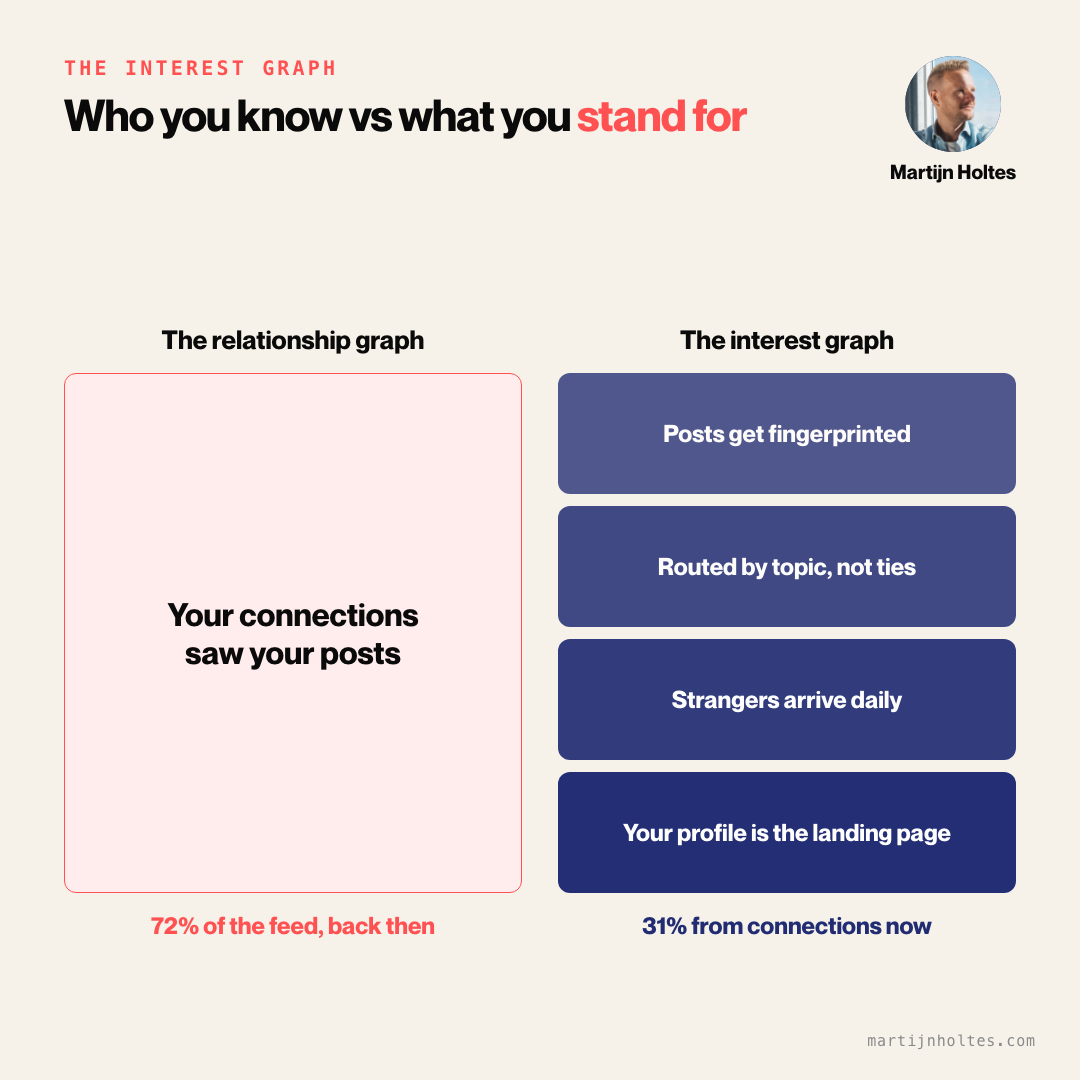
Contrast: the old relationship graph sent 72 percent of your feed from connections; the interest graph now sends 31 percent

Position before you polish

The biggest personal branding mistake happens before the profile edit: people optimise how they look before they know what they’re saying. New headline, new banner, new About section. It looks good. And it says nothing, because there’s no anchor underneath. You can’t fix “I don’t know what I’m saying” with a nicer banner.

So start with the positioning work, on one page.

Your audience, defined by problems. Not “decision-makers in tech,” but the people whose specific problem you solve. A trick I use: write down three real companies or people you’d love as clients, and find what they share. That shared trait is your audience definition, and it’s never “companies with 50 to 500 employees.”

Two or three anchor topics, named literally. The intersection of what you know and what your audience needs, in the plain words people search: “employee advocacy,” “B2B pricing strategy,” “supply-chain risk.” Not “helping organisations thrive,” which classifies you as nothing and routes you to nobody. Clever wordplay in your headline used to look smart. Now it tells the system nothing, so it sends you nowhere.

Three statements from your backstory. Your Angle: the view from your experience that your industry gets wrong. Your Authority: the specific problem you solve, not your job description. Your Voice: the message people should hear from you consistently, the conversation you want your name attached to.

If those feel abstract, mine your backstory: the moment that changed how you see your industry, the thing people keep asking you about, the one thing you wish every professional understood. The answers already exist. They’ve been building for years. You’ve never written them down.

Everything else in this article executes that one page. Without it, you’re polishing a profile that still doesn’t say anything.
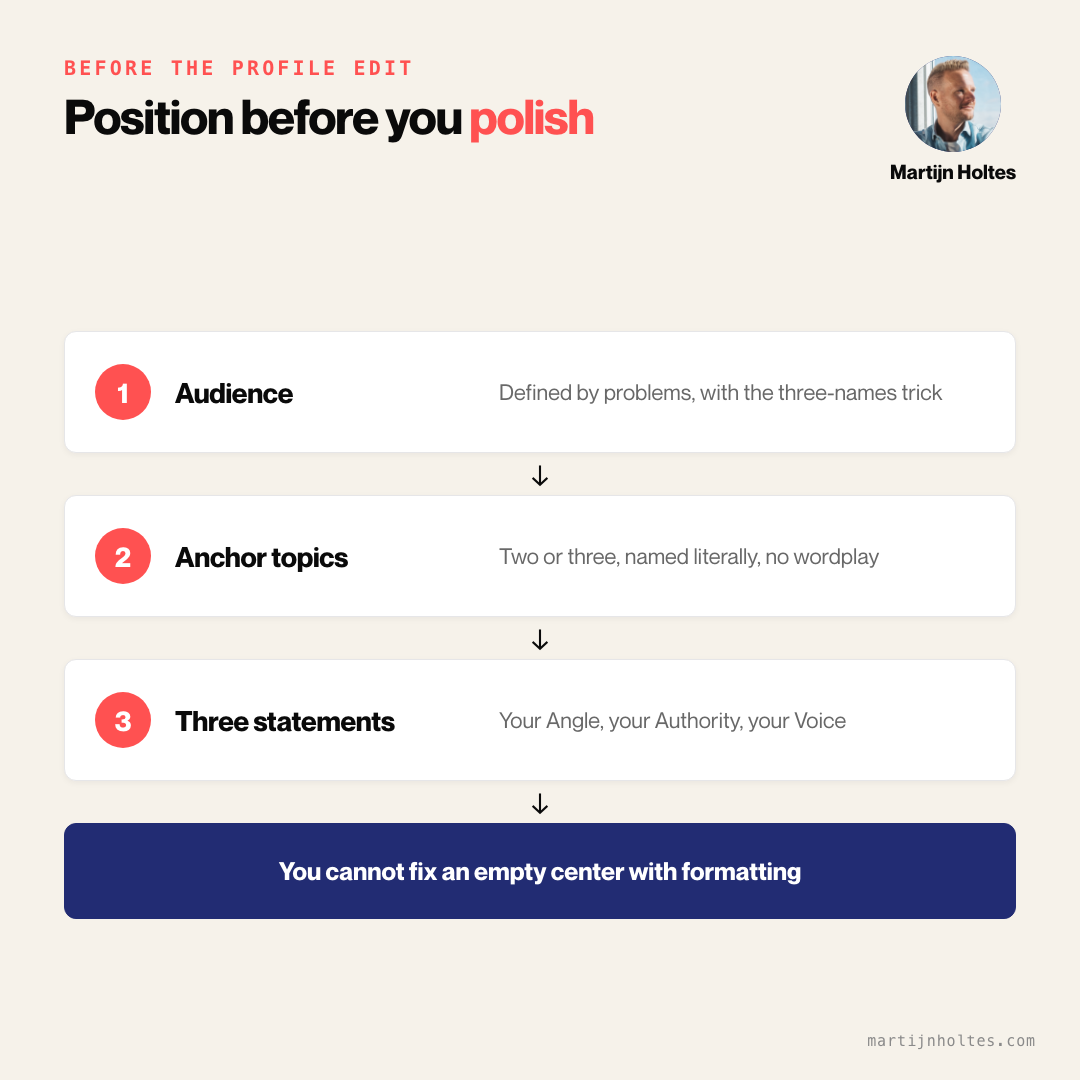
Position before you polish: define your audience by their problem, pick two or three anchor topics, and set your Angle, Authority and Voice

Your profile has three jobs now

In the interest graph era, strangers arrive at your profile because a post got routed to them. The typical path: someone sees three to five of your posts, gets curious, and visits. At that moment your profile has three jobs: confirm, convert, classify.
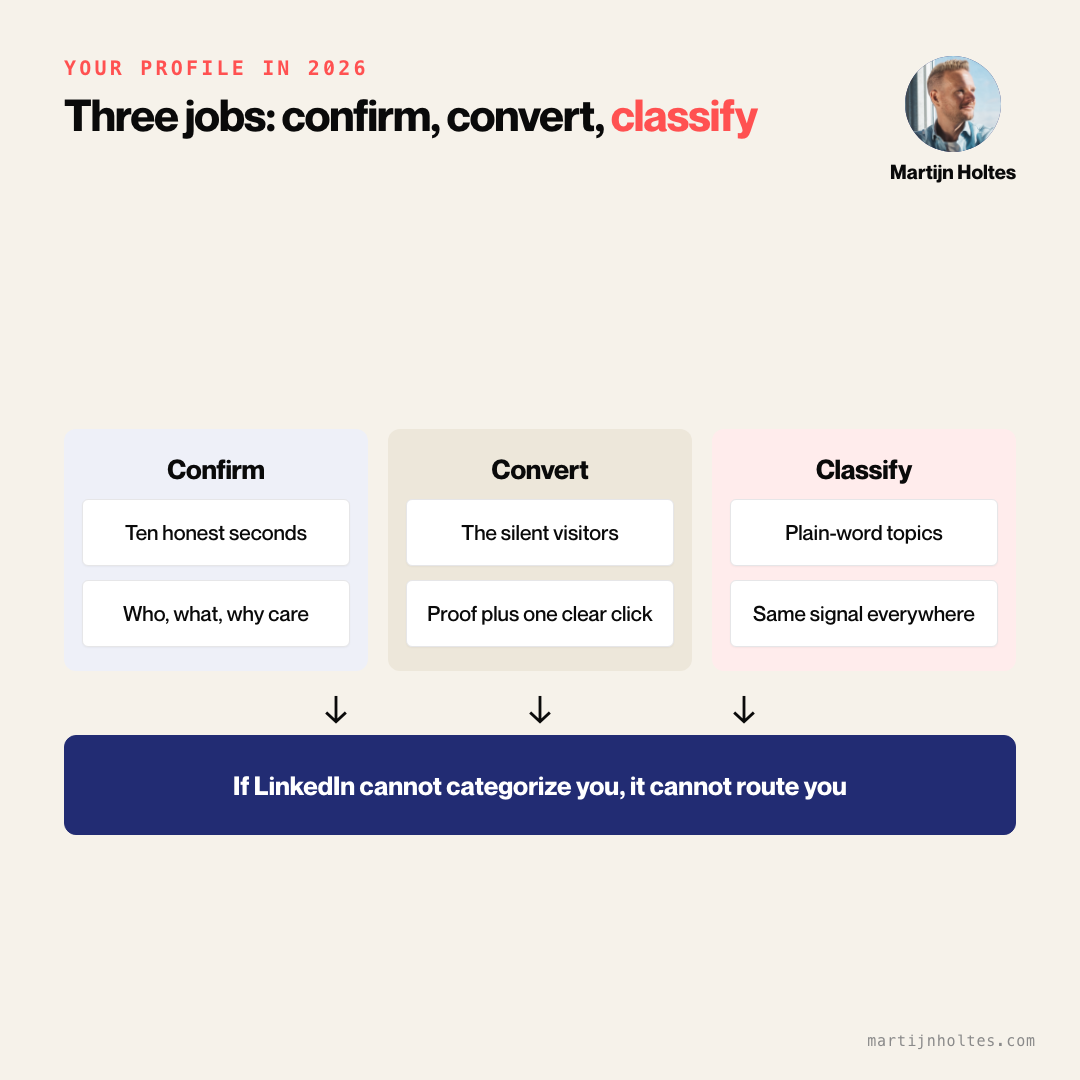
Your LinkedIn profile now has three jobs: confirm the topic, convert silent visitors, classify you for the algorithm

Confirm. The visitor came for a topic, and your profile has about ten seconds to confirm you’re the person for that topic; eye-tracking research says the first impression forms in roughly seven. Run the test in a private browser: can a stranger answer who you are, what problems you solve and why they should care, without scrolling or clicking?

Most profiles fail because they’re written as a CV for people who already know you, and a CV only works on people already looking for you. Your posts found these visitors. Your profile has to keep them.

Convert. The visitors who matter most are silent. Picture three rings around your content: a virality zone of strangers who’ll never buy, a target audience of peers who supply most of your likes, and your ideal audience, the people with budget and decisions, who barely engage at all.

They read, they visit, they decide in silence, and they reach out when they’re close to a decision. So your profile is a landing page for people who will never comment. Give them something: a headline with proof, a Featured section with one useful low-commitment resource, an About text about their problem instead of your career history.

Classify. Your profile feeds the algorithm’s understanding of you. The same two or three topics, in plain words, across headline, About, current role, skills and, ideally, recommendations, is what gives the system semantic confidence to route you.

Consistency is the multiplier: one clear signal repeated across five locations beats five clever ones. Use variants of the terms, not the same phrase five times over, but keep the signal identical.

Personal branding for B2B

A clear profile is step one. Being known takes a system.

I build that system with professionals and executives. 250,000+ professionals trained since 2011.

See how I build it

The fields that do the heavy lifting

Photo and banner. The much-quoted LinkedIn stat has profiles with a proper photo getting 14x more views and 36x more messages, and whatever the exact multiplier, the direction is obvious: this is your first trust signal. Face and shoulders, face filling most of the frame, recent, sharp, tested at thumbnail size.

The banner is a free billboard most people leave as blue wallpaper: put your value message on it in under ten words, and check it on a phone, where more than half your visitors are and where the edges crop.

The headline, your most-distributed asset. It travels with every post, every comment, every connection request, so it works harder than any other line you’ll write. You get 220 characters; the sweet spot is 150 to 200, and only the first 45 to 60 show in search results and comments, so front-load the part that matters.

Skip the “I help X achieve Y” template. Everyone uses it, so it can’t set you apart. Build it from keywords plus proof instead: the topics you want to be found for, and evidence you’re worth trusting.

Keywords get you found, proof gets you trusted; mine carries “950+ companies” for exactly that reason. Pipes between elements, no emojis, and none of the buzzwords, “passionate,” “visionary,” “guru,” that mark a profile as decoration.

The About section, read by the few who matter. Only around 15% of visitors read it, and barely anyone clicks “see more,” which sounds like a reason to neglect it until you realise who that 15% is: disproportionately your ideal audience, doing their silent homework.

Two consequences. The first three lines are a standalone deliverable, open with the question your reader can’t dismiss, the tension they recognise, or the moment they’ve lived, because that’s all most will see. And the body follows a simple arc: the problem you solve, who you are professionally and personally, the value you bring, the proof, and how to reach you.

Name your two or three topics literally in it, “I write about X, Y and Z,” first person, short paragraphs, somewhere between 1,500 and 2,000 characters. It’s a conversation starter, not a biography.

The evidence layer. Your current role description is the workhorse: write it for your audience, who you help, how, with what proof, instead of a responsibilities list, and let the job-title field carry keywords, search engines index it. Link every role to the official company page so the logo renders.

Use the Featured section as your conversion shelf: two to five items, always including one low-commitment, high-value click, a guide, a checklist, your newsletter, and rotate it every quarter. Skills feed the search: pick the three to five terms your next client would type, backed by a longer list of variants.

And recommendations are your risk-reducers, because hiring you is a risk for them, and a strong recommendation lowers it: three strong, recent, audience-relevant recommendations beat ten generic ones, and the best moment to ask is the week a project lands well. Make the whole profile proof-dense; no screen-length stretch should pass without evidence.
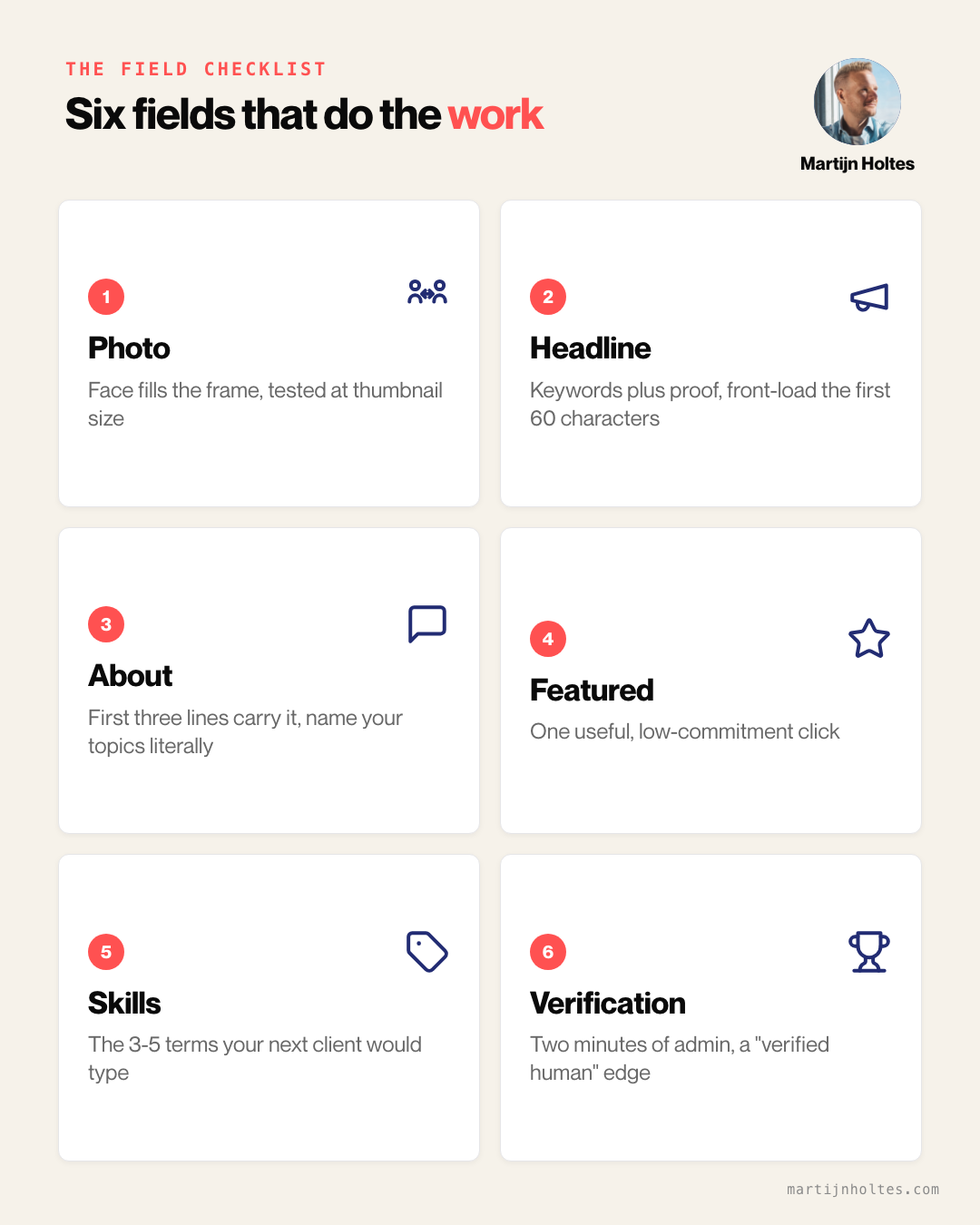
The profile fields that do the heavy lifting: photo and banner, headline, About, the evidence layer, skills and verification

The content that works in 2026

The feed rewards a recognisable point of view on a narrow lane. The algorithm doesn’t admire conviction; it finds a consistent topic pattern easy to classify and route, and readers remember the person who says one thing clearly over the person who comments on everything.

The rhythm.
Two to three posts a week is the working optimum, with daily engagement in the ten-to-twenty-minute range. More is worse: daily posting measurably cuts reach, around 45% in the current data, because the system now caps volume in favour of quality. If you can’t manage that, the working baseline is two posts a month plus twice-weekly engagement, held without fail. Two posts a week for a year beats daily for three weeks and then nothing.

The mix.
Weight your posts toward your expertise: roughly half authority content, your take on your topics, and the rest split between proof (results, cases, recommendations), personality (the human behind the expertise), and the occasional direct ask. If every post is an ask, you’re a brochure; if none is, you’re a very helpful stranger forever.

Comments, the most underrated move on the platform.
A substantive comment, a real opinion of three or more sentences, carries roughly fifteen times the weight of a like in the current engagement models, shows up in front of the author’s entire network, and takes your headline with it.

Five substantive comments a day generate more impressions than two posts a week, which means the busy professional’s excuse, no time to create content, is dead. Commenting is also how you feed your own 90-day fingerprint on the days you don’t post. Ten focused minutes. That’s the entry price.

The first hour or so.
When you do post, stay around: replying to comments in the first 30 minutes measurably extends a post’s life, because early conversation tells the system the post is worth routing further. Post-and-ghost is a real penalty now. You wouldn’t throw a party, open the door and leave.

And write your own material.
Fully AI-generated posts take a 30 to 40% reach penalty, and the audience penalty is bigger than the algorithmic one, because the feed is drowning in identical AI sludge and readers now skip anything that smells like it. Use AI to sharpen your thinking, to argue with, to compress research, but the point of view has to be yours, because your point of view is the one thing the machine can’t generate and the audience can’t get elsewhere.

And never let AI write your comments.
A bot complimenting posts under your name is the fastest way to turn your brand into background noise.
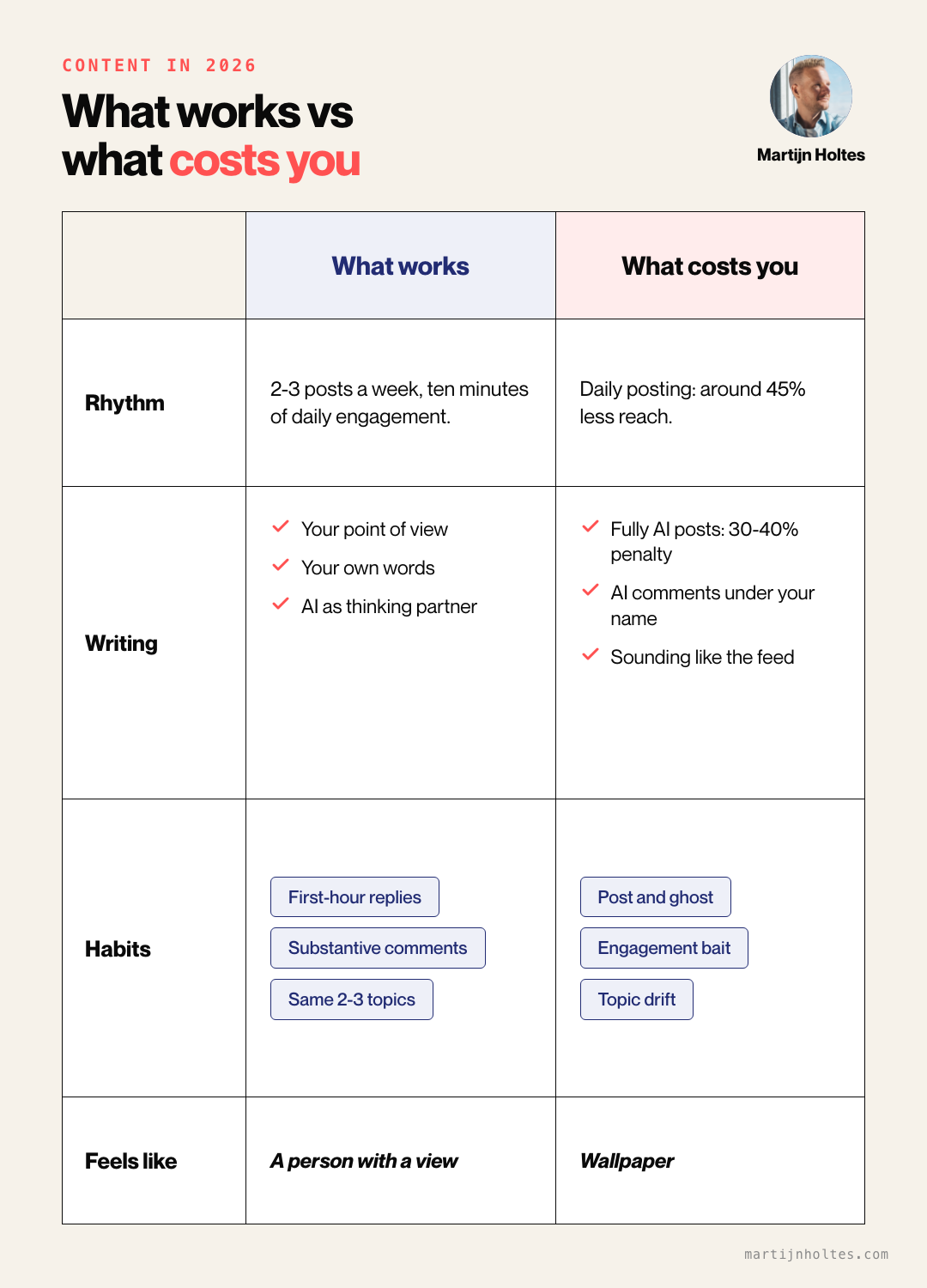
The content that works in 2026 versus what costs you reach: your point of view and substantive comments versus AI sludge and post-and-ghost

What does personal branding on LinkedIn cost?

The full breakdown, because the question deserves better than “it depends.”

In money: the platform costs nothing that matters here. Premium is optional, useful mainly for the custom profile button and search, not required to build a brand. The real spend, if you choose it, is help: a positioning and profile session, a masterclass, or coaching over a few months.

Prices vary wildly across the market, so anchor the decision to the unit this pays out in: one client, one speaking gig, one job offer. If a program can’t plausibly return one of those, skip it, and be suspicious of anyone promising you virality instead.

In time: an afternoon for the positioning page, a day for the profile rebuild, then ten minutes of daily engagement and two or three posts a week. That’s the full bill.

The expensive version of personal branding isn’t the coaching. It’s doing nothing for another two years while less skilled, more visible people keep winning opportunities you never hear about. The cost is invisible, which is exactly what makes it so easy to keep ignoring.

The system that keeps it running

Knowing all this and doing it for six months are different problems, and the second one is where personal brands die. That’s why I run a program with professionals and executives: what you share and what you skip, the objectives it has to hit, the audience and two or three topics you own, formats that fit a busy week, and the ten minutes a day that keep it alive in month six.

The framework won’t do the work for you. It makes the boring weekly part something you can keep up, and that’s the whole game.

Maintenance is light but real: review your positioning quarterly, your topics drift as your work does, and give your profile a fresh ten-second test twice a year. Expect the first measurable signals, profile visits from the right people, better acceptance rates, inbound conversations, after two to three weeks of profile fixes and two to three months of consistent activity.

Tonight, do one thing: open your profile and give yourself ten seconds. If a stranger can’t tell what you stand for, you don’t have a personal branding problem. You have a decision to make, and now you know exactly which one.

The method I use

Failed your own ten-second test?

Start with an intake call. Tell me where you’re stuck, and I’ll tell you straight if I can help, and how.

Schedule your intake call

Questions I get about personal branding on LinkedIn

How do I build a personal brand on LinkedIn?

In order: define your Angle, Authority and Voice and pick two or three anchor topics in plain words. Rebuild your profile so it confirms your topic in ten seconds, converts silent visitors and classifies cleanly for the algorithm. Then show up: two to three posts a week, daily substantive comments, same topics, for at least ninety days.

What content works best for personal branding in 2026?

Your own point of view on your two or three anchor topics: lessons from real work, opinions you can defend, experience the reader can use. Substantive comments count double for the effort: around fifteen times the weight of a like, visible to the author’s whole network, with your headline attached. Fully AI-generated content costs you reach and, worse, reader trust.

Is there a formula for personal branding, like the 5 P’s or 7 pillars?

There’s no magic formula, and everyone selling one is selling packaging. What holds is a sequence: positioning before polish, profile before content, consistency before results. I run it as a program with clients, a system for keeping it going, not a secret.

What does personal branding on LinkedIn cost?

The platform: nothing that matters. The work: an afternoon of positioning, a day of profile rebuilding, then ten minutes a day plus two or three posts a week. Paid help, from masterclasses to coaching, buys speed and sharper positioning; measure it against the value of one client or one opportunity. The most expensive option is staying invisible.

How long before a personal brand shows results?

Profile fixes show in two to three weeks: more visits from the right people, better acceptance rates. Content compounds on the 90-day window the algorithm itself uses, which is also about how long human trust takes to form. Expect inbound conversations around month three, and don’t quit in the silent first month; that’s where everyone quits.

Do I need thousands of followers for this to work?

No, and 2026 made that official: distribution now follows topics, not follower counts, and reach has decoupled from audience size. A clear profile with a consistent point of view can outperform a big unfocused account, because the interest graph routes clarity, and buyers trust it.

Does using AI for LinkedIn content hurt my personal brand?

Fully AI-written posts lose roughly 30 to 40% reach, and readers discount them further, the feed is full of them and they all sound the same. Use AI as a thinking partner and editor, keep the point of view and the words recognisably yours, and never let it write comments in your name.

What matters most on my profile?

In visitor order: photo and headline (the first impression forms in seconds), then your activity, then the About section that only your most serious visitors read. Fix them in that order, keep the same two or three topics across all of them, and make every section carry proof. One page of positioning beforehand makes every field ten times easier to write.
Category: Thought Leadership

  • Personal branding on LinkedIn – what works in 2026

    Personal branding on LinkedIn – what works in 2026

    Google “personal branding on LinkedIn” and you’ll drown in formulas. The 5 P’s of personal branding, the 7 pillars, the 4 C’s, a 30-day challenge with a downloadable workbook and a stock photo of someone pointing at a whiteboard.

    Meanwhile, LinkedIn rebuilt the machine underneath all of it. In spring 2025 the platform moved from a relationship graph, where your connections saw your posts, to an interest graph, where the system routes content to whoever it predicts will care, follower or not.

    The share of your feed coming from your own connections dropped from 72% to 31%.
    Follower counts and reach stopped moving together: the Algorithm Report 2026 of Richard van der Blom found median follower counts grew 31% while impressions came in around 29% below what that growth used to predict.

    Which means most personal branding advice is answering a question from 2020.
    The new question isn’t “how do I grow my network.” It’s “can the system and the humans work out what I stand for.” And after 16 years of building this with 250,000+ professionals, I’ll say the part most people don’t want to hear. Most profiles fail that test before a single post gets written.

    This is the long answer to what works now: the positioning that comes first, the profile that does three jobs, the content rhythm that feeds the machine without feeding the slop pile, and what all of it costs.


    The short answer

    Building a personal brand on LinkedIn in 2026 comes down to four moves, in this order.
    Decide what you stand for, two or three topics, named in plain words.
    Rebuild your profile around that positioning so it confirms, converts and classifies.
    Show up on those topics through posts and, underrated, comments.
    And hold the line long enough for the system and the market to trust the pattern, which takes about ninety days.

    Everything below unpacks those four, with the specifics that changed this year.

    How the interest graph decides who sees you

    Worth two minutes of mechanics, because every practical tip below follows from them.

    LinkedIn’s distribution now runs on what the engineers call topic fingerprinting. Every post gets a fingerprint from its language, topics and early engagement. Every member gets one from their behaviour. When a post’s fingerprint matches a reader’s interests, the system routes it to them, connection or not.

    Underneath sit two systems in sequence: a large language model (LinkedIn calls it 360Brew) that selects candidate posts on semantic relevance, and a ranking model that reads each member’s full interaction history as a pattern.

    If LinkedIn can’t file you under a topic, it can’t send you to anyone.

    Two consequences follow for your brand. First, your profile fields, headline, About, skills, experience, are inputs to that classification. A vague profile, “passionate connector of people and ideas,” is unclassifiable, which hurts your distribution before you write a single post. Clear used to be a favour to the human reading you. Now the machine needs it too, or it can’t send you to anyone.

    Second, the system reads patterns, not single actions, and it evaluates your topic consistency on a rolling 90-day window. Strong, consistent topic signals earn larger initial distribution and posts that keep traveling up to 40% longer. Scattered signals get you almost no reach.

    Part of me dislikes this. My brain loves detours, and this machine rewards whoever’s easiest to file, which means it punishes anyone with range, like me. But it’s the machine we post in, and the workaround is simple enough: pick the lane, and bring your detours home by showing what they mean for your topic.

    Contrast: the old relationship graph sent 72 percent of your feed from connections; the interest graph now sends 31 percent

    Position before you polish

    The biggest personal branding mistake happens before the profile edit: people optimise how they look before they know what they’re saying. New headline, new banner, new About section. It looks good. And it says nothing, because there’s no anchor underneath. You can’t fix “I don’t know what I’m saying” with a nicer banner.

    So start with the positioning work, on one page.

    Your audience, defined by problems. Not “decision-makers in tech,” but the people whose specific problem you solve. A trick I use: write down three real companies or people you’d love as clients, and find what they share. That shared trait is your audience definition, and it’s never “companies with 50 to 500 employees.”

    Two or three anchor topics, named literally. The intersection of what you know and what your audience needs, in the plain words people search: “employee advocacy,” “B2B pricing strategy,” “supply-chain risk.” Not “helping organisations thrive,” which classifies you as nothing and routes you to nobody. Clever wordplay in your headline used to look smart. Now it tells the system nothing, so it sends you nowhere.

    Three statements from your backstory. Your Angle: the view from your experience that your industry gets wrong. Your Authority: the specific problem you solve, not your job description. Your Voice: the message people should hear from you consistently, the conversation you want your name attached to.

    If those feel abstract, mine your backstory: the moment that changed how you see your industry, the thing people keep asking you about, the one thing you wish every professional understood. The answers already exist. They’ve been building for years. You’ve never written them down.

    Everything else in this article executes that one page. Without it, you’re polishing a profile that still doesn’t say anything.

    Position before you polish: define your audience by their problem, pick two or three anchor topics, and set your Angle, Authority and Voice

    Your profile has three jobs now

    In the interest graph era, strangers arrive at your profile because a post got routed to them. The typical path: someone sees three to five of your posts, gets curious, and visits. At that moment your profile has three jobs: confirm, convert, classify.

    Your LinkedIn profile now has three jobs: confirm the topic, convert silent visitors, classify you for the algorithm

    Confirm. The visitor came for a topic, and your profile has about ten seconds to confirm you’re the person for that topic; eye-tracking research says the first impression forms in roughly seven. Run the test in a private browser: can a stranger answer who you are, what problems you solve and why they should care, without scrolling or clicking?

    Most profiles fail because they’re written as a CV for people who already know you, and a CV only works on people already looking for you. Your posts found these visitors. Your profile has to keep them.

    Convert. The visitors who matter most are silent. Picture three rings around your content: a virality zone of strangers who’ll never buy, a target audience of peers who supply most of your likes, and your ideal audience, the people with budget and decisions, who barely engage at all.

    They read, they visit, they decide in silence, and they reach out when they’re close to a decision. So your profile is a landing page for people who will never comment. Give them something: a headline with proof, a Featured section with one useful low-commitment resource, an About text about their problem instead of your career history.

    Classify. Your profile feeds the algorithm’s understanding of you. The same two or three topics, in plain words, across headline, About, current role, skills and, ideally, recommendations, is what gives the system semantic confidence to route you.

    Consistency is the multiplier: one clear signal repeated across five locations beats five clever ones. Use variants of the terms, not the same phrase five times over, but keep the signal identical.

    Personal branding for B2B

    A clear profile is step one. Being known takes a system.

    I build that system with professionals and executives. 250,000+ professionals trained since 2011.

    See how I build it

    The fields that do the heavy lifting

    Photo and banner. The much-quoted LinkedIn stat has profiles with a proper photo getting 14x more views and 36x more messages, and whatever the exact multiplier, the direction is obvious: this is your first trust signal. Face and shoulders, face filling most of the frame, recent, sharp, tested at thumbnail size.

    The banner is a free billboard most people leave as blue wallpaper: put your value message on it in under ten words, and check it on a phone, where more than half your visitors are and where the edges crop.

    The headline, your most-distributed asset. It travels with every post, every comment, every connection request, so it works harder than any other line you’ll write. You get 220 characters; the sweet spot is 150 to 200, and only the first 45 to 60 show in search results and comments, so front-load the part that matters.

    Skip the “I help X achieve Y” template. Everyone uses it, so it can’t set you apart. Build it from keywords plus proof instead: the topics you want to be found for, and evidence you’re worth trusting.

    Keywords get you found, proof gets you trusted; mine carries “950+ companies” for exactly that reason. Pipes between elements, no emojis, and none of the buzzwords, “passionate,” “visionary,” “guru,” that mark a profile as decoration.

    The About section, read by the few who matter. Only around 15% of visitors read it, and barely anyone clicks “see more,” which sounds like a reason to neglect it until you realise who that 15% is: disproportionately your ideal audience, doing their silent homework.

    Two consequences. The first three lines are a standalone deliverable, open with the question your reader can’t dismiss, the tension they recognise, or the moment they’ve lived, because that’s all most will see. And the body follows a simple arc: the problem you solve, who you are professionally and personally, the value you bring, the proof, and how to reach you.

    Name your two or three topics literally in it, “I write about X, Y and Z,” first person, short paragraphs, somewhere between 1,500 and 2,000 characters. It’s a conversation starter, not a biography.

    The evidence layer. Your current role description is the workhorse: write it for your audience, who you help, how, with what proof, instead of a responsibilities list, and let the job-title field carry keywords, search engines index it. Link every role to the official company page so the logo renders.

    Use the Featured section as your conversion shelf: two to five items, always including one low-commitment, high-value click, a guide, a checklist, your newsletter, and rotate it every quarter. Skills feed the search: pick the three to five terms your next client would type, backed by a longer list of variants.

    And recommendations are your risk-reducers, because hiring you is a risk for them, and a strong recommendation lowers it: three strong, recent, audience-relevant recommendations beat ten generic ones, and the best moment to ask is the week a project lands well. Make the whole profile proof-dense; no screen-length stretch should pass without evidence.

    The profile fields that do the heavy lifting: photo and banner, headline, About, the evidence layer, skills and verification

    The content that works in 2026

    The feed rewards a recognisable point of view on a narrow lane. The algorithm doesn’t admire conviction; it finds a consistent topic pattern easy to classify and route, and readers remember the person who says one thing clearly over the person who comments on everything.

    The rhythm.
    Two to three posts a week is the working optimum, with daily engagement in the ten-to-twenty-minute range. More is worse: daily posting measurably cuts reach, around 45% in the current data, because the system now caps volume in favour of quality. If you can’t manage that, the working baseline is two posts a month plus twice-weekly engagement, held without fail. Two posts a week for a year beats daily for three weeks and then nothing.

    The mix.
    Weight your posts toward your expertise: roughly half authority content, your take on your topics, and the rest split between proof (results, cases, recommendations), personality (the human behind the expertise), and the occasional direct ask. If every post is an ask, you’re a brochure; if none is, you’re a very helpful stranger forever.

    Comments, the most underrated move on the platform.
    A substantive comment, a real opinion of three or more sentences, carries roughly fifteen times the weight of a like in the current engagement models, shows up in front of the author’s entire network, and takes your headline with it.

    Five substantive comments a day generate more impressions than two posts a week, which means the busy professional’s excuse, no time to create content, is dead. Commenting is also how you feed your own 90-day fingerprint on the days you don’t post. Ten focused minutes. That’s the entry price.

    The first hour or so.
    When you do post, stay around: replying to comments in the first 30 minutes measurably extends a post’s life, because early conversation tells the system the post is worth routing further. Post-and-ghost is a real penalty now. You wouldn’t throw a party, open the door and leave.

    And write your own material.
    Fully AI-generated posts take a 30 to 40% reach penalty, and the audience penalty is bigger than the algorithmic one, because the feed is drowning in identical AI sludge and readers now skip anything that smells like it. Use AI to sharpen your thinking, to argue with, to compress research, but the point of view has to be yours, because your point of view is the one thing the machine can’t generate and the audience can’t get elsewhere.

    And never let AI write your comments.
    A bot complimenting posts under your name is the fastest way to turn your brand into background noise.

    The content that works in 2026 versus what costs you reach: your point of view and substantive comments versus AI sludge and post-and-ghost

    What does personal branding on LinkedIn cost?

    The full breakdown, because the question deserves better than “it depends.”

    In money: the platform costs nothing that matters here. Premium is optional, useful mainly for the custom profile button and search, not required to build a brand. The real spend, if you choose it, is help: a positioning and profile session, a masterclass, or coaching over a few months.

    Prices vary wildly across the market, so anchor the decision to the unit this pays out in: one client, one speaking gig, one job offer. If a program can’t plausibly return one of those, skip it, and be suspicious of anyone promising you virality instead.

    In time: an afternoon for the positioning page, a day for the profile rebuild, then ten minutes of daily engagement and two or three posts a week. That’s the full bill.

    The expensive version of personal branding isn’t the coaching. It’s doing nothing for another two years while less skilled, more visible people keep winning opportunities you never hear about. The cost is invisible, which is exactly what makes it so easy to keep ignoring.

    The system that keeps it running

    Knowing all this and doing it for six months are different problems, and the second one is where personal brands die. That’s why I run a program with professionals and executives: what you share and what you skip, the objectives it has to hit, the audience and two or three topics you own, formats that fit a busy week, and the ten minutes a day that keep it alive in month six.

    The framework won’t do the work for you. It makes the boring weekly part something you can keep up, and that’s the whole game.

    Maintenance is light but real: review your positioning quarterly, your topics drift as your work does, and give your profile a fresh ten-second test twice a year. Expect the first measurable signals, profile visits from the right people, better acceptance rates, inbound conversations, after two to three weeks of profile fixes and two to three months of consistent activity.

    Tonight, do one thing: open your profile and give yourself ten seconds. If a stranger can’t tell what you stand for, you don’t have a personal branding problem. You have a decision to make, and now you know exactly which one.

    The method I use

    Failed your own ten-second test?

    Start with an intake call. Tell me where you’re stuck, and I’ll tell you straight if I can help, and how.

    Schedule your intake call

    Questions I get about personal branding on LinkedIn

    How do I build a personal brand on LinkedIn?

    In order: define your Angle, Authority and Voice and pick two or three anchor topics in plain words. Rebuild your profile so it confirms your topic in ten seconds, converts silent visitors and classifies cleanly for the algorithm. Then show up: two to three posts a week, daily substantive comments, same topics, for at least ninety days.

    What content works best for personal branding in 2026?

    Your own point of view on your two or three anchor topics: lessons from real work, opinions you can defend, experience the reader can use. Substantive comments count double for the effort: around fifteen times the weight of a like, visible to the author’s whole network, with your headline attached. Fully AI-generated content costs you reach and, worse, reader trust.

    Is there a formula for personal branding, like the 5 P’s or 7 pillars?

    There’s no magic formula, and everyone selling one is selling packaging. What holds is a sequence: positioning before polish, profile before content, consistency before results. I run it as a program with clients, a system for keeping it going, not a secret.

    What does personal branding on LinkedIn cost?

    The platform: nothing that matters. The work: an afternoon of positioning, a day of profile rebuilding, then ten minutes a day plus two or three posts a week. Paid help, from masterclasses to coaching, buys speed and sharper positioning; measure it against the value of one client or one opportunity. The most expensive option is staying invisible.

    How long before a personal brand shows results?

    Profile fixes show in two to three weeks: more visits from the right people, better acceptance rates. Content compounds on the 90-day window the algorithm itself uses, which is also about how long human trust takes to form. Expect inbound conversations around month three, and don’t quit in the silent first month; that’s where everyone quits.

    Do I need thousands of followers for this to work?

    No, and 2026 made that official: distribution now follows topics, not follower counts, and reach has decoupled from audience size. A clear profile with a consistent point of view can outperform a big unfocused account, because the interest graph routes clarity, and buyers trust it.

    Does using AI for LinkedIn content hurt my personal brand?

    Fully AI-written posts lose roughly 30 to 40% reach, and readers discount them further, the feed is full of them and they all sound the same. Use AI as a thinking partner and editor, keep the point of view and the words recognisably yours, and never let it write comments in your name.

    What matters most on my profile?

    In visitor order: photo and headline (the first impression forms in seconds), then your activity, then the About section that only your most serious visitors read. Fix them in that order, keep the same two or three topics across all of them, and make every section carry proof. One page of positioning beforehand makes every field ten times easier to write.
  • What is thought leadership? (And what it’s not)

    What is thought leadership? (And what it’s not)

    What is thought leadership, or what is a thought leader?
    I get introduced as one, usually right after the “16 years, 250,000 professionals helped” part.
    Most of us, including me, have or had no idea what the concept really means.
    Is it an ego trip or is there something substantial about it? To me, it is defined by something really simple.

    The people we call thought leaders usually aren’t smarter than everyone around them. They just said what they thought out loud, with their name on it, while everyone else kept quiet.
    That’s the whole trick. It’s got nothing to do with intelligence and everything to do with your experience, in-depth knowledge of the topic and the nerve to share a point of view even if people disagree with it.

    That nerve is also why most people never do it, and I get why.
    Put an opinion out with your name attached and someone can push back, quote you, and push a screenshot in your face, when you’ve changed your mind.

    Staying quiet feels safer, and for a long time, it was.
    Not anymore.

    We’ve got machines now that hand anyone a competent, reasonable answer to almost any question in about four seconds. If your value was knowing the standard answer, I have bad news for you.

    The scarce thing now is a person who’s done the work, innovates, reads and holds a point of view you can’t get from a prompt.
    What AI doesn’t have is your experience, the mistakes you paid for, and the opinion you formed at 2am after a project blew up. And the more AI floods the world with average answers, the more a point of view makes you antifragile.

    So let me answer the question properly, because the term deserves a better definition than the people who ruined it.


    What is thought leadership, in simple words

    Thought leadership is getting known for a clear point of view by the people who decide where the opportunities go.

    That’s the whole thing.

    You know something from experience. You say it in public, in your own words, consistently.
    And after a while the right people connect your name to that topic, so when a project, a speaking gig or a lead needs what you have, your name comes up first.

    Notice what’s not in that definition.
    No follower counts, viral posts or daily video of you walking through an airport.
    You don’t need to be louder than everyone else, you need to be clearer, to the few who matter.

    In practice it is almost boring.
    It is a tax lawyer known for one sharp view on holding structures.
    An IT manager whose posts get forwarded inside client companies.
    A consultant whose name comes up in meetings she’s not part of, because the people who make the decision have been reading her content for a year.

    That’s what leading thought means: when your topic comes up, you’re already in the conversation, even when you’re not there.

    Definition diagram: thought leadership is being known for a clear point of view by the people who decide, not follower counts or viral posts


    How the term got ruined

    Somewhere along the way, thought leadership got hijacked by people posting daily selfies with a lesson attached. “I just had my lunch, this is what it taught me about B2B sales.”
    Add the gurus promising that if you post at 7:00 sharp every morning, with a million-dollar template, your pipeline will explode and everything will be amazeballs, and you can see why serious professionals want nothing to do with the label.

    Those people made the term sound like a self-promotion scheme.
    And because the loudest examples are the worst ones, plenty of skilled people concluded the whole category is fake. Which suits the fakers fine, because it keeps the people with real expertise out of the arena.

    When someone reshapes their opinions weekly to match whatever trends, that’s content.
    When a ghostwriter produces safe platitudes under an executive’s name, that’s PR.

    When someone who’s done the work for years shares what they’ve learned, takes a position and defends it, that’s thought leadership, and we as readers can tell the difference faster than you’d think.


    Is thought leadership just marketing?

    Yes, in the sense that it makes you easier to find, easier to trust and easier to buy from.
    If that offends you, you’ll need to explain to me why being findable by people with the exact problem you can solve is a bad thing.

    But no, in the sense that it can’t be faked the way marketing can.
    A campaign can claim anything.
    A point of view has to survive contact with an audience that knows the subject, week after week, in public.
    If you wanna figure this out, ask this question: would this person hold the same opinion if nobody was watching?
    If yes, you’re reading thought leadership.
    If the opinion changes with the algorithm, you’re reading an ad with a face on it.

    There’s also an ethical line, because the question “is thought leadership ethical” gets me asked more than you’d expect.
    Claiming expertise you don’t have, buying engagement, and fabricating results is just a lie packed in a content calendar. People eventually find out, and the industry is full of people finding out right now.


    Why does this matter more than five years ago

    Being good at what you do no longer sets you apart. Not because skill lost value, but because it became the baseline. AI hands everyone the same competent answer, and every competitor claims the same quality in the same words. Information went from scarce to free, which means knowledge alone doesn’t make you valuable anymore.

    What no tool can copy is the way you see a problem, shaped by everything you’ve done that nobody else has.
    Your point of view is the one asset that doesn’t devalue when the machines get better.

    But a point of view only counts if the right people know it’s there.

    And the buying side has already moved.
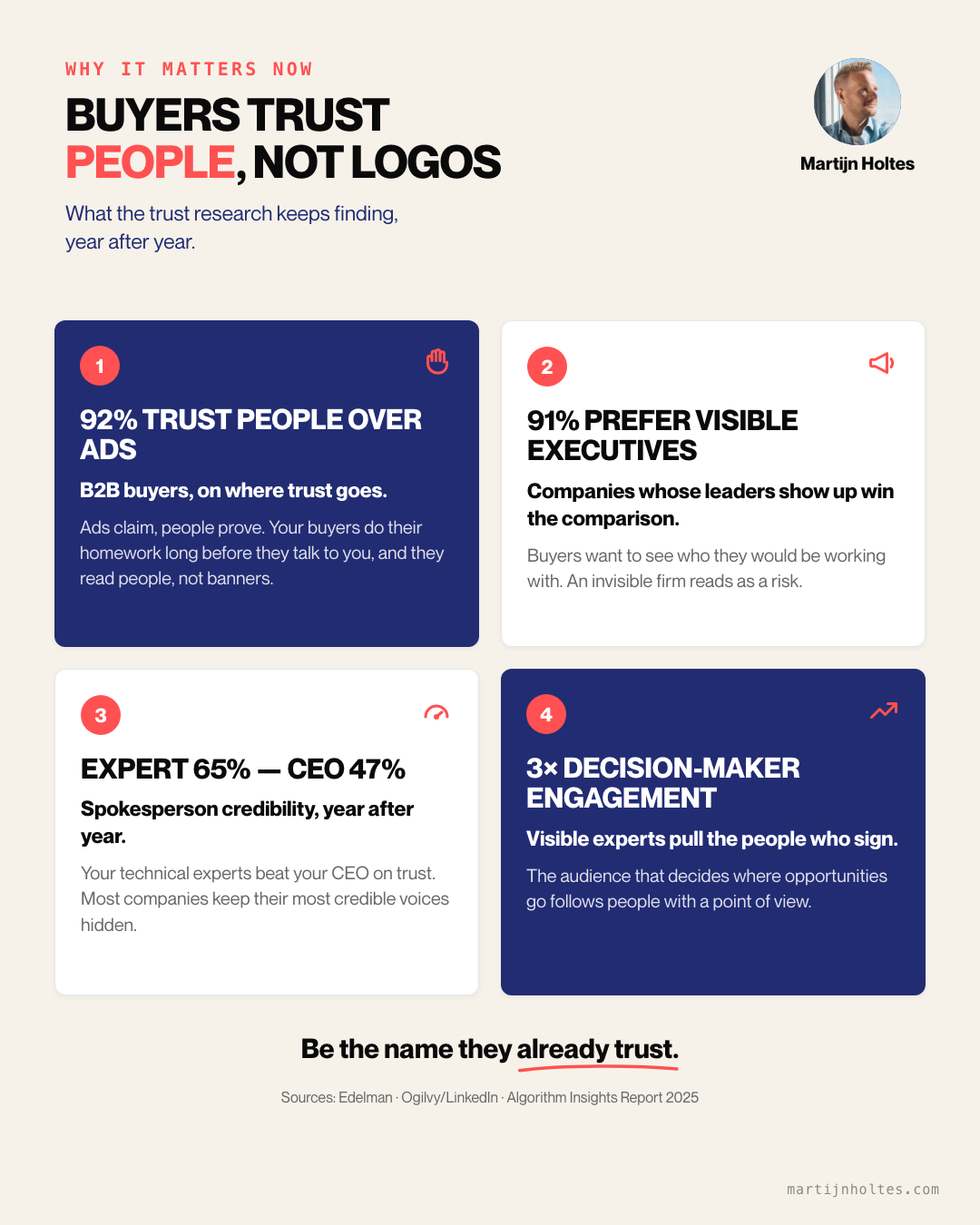
    The Edelman and Ogilvy/LinkedIn research came to the same conclusion year after year:
    ✅ 92% of B2B buyers trust people over ads,
    ✅ 91% prefer companies with visible executives,
    ✅ A technical expert scores 65% on credibility, where a CEO gets 47%.
    Read that last one again: your experts beat your CEO.

    Buyers do most of their homework before they ever talk to a salesperson, reading, comparing, and building a mental shortlist.
    If they can’t find a person with a point of view at your firm, they find one at your competitor.

    Statistic cards: 92 percent of B2B buyers trust people over ads, 91 percent prefer companies with visible executives, technical experts score 65 percent credibility versus 47 for a CEO


    Why the most skilled people stay invisible

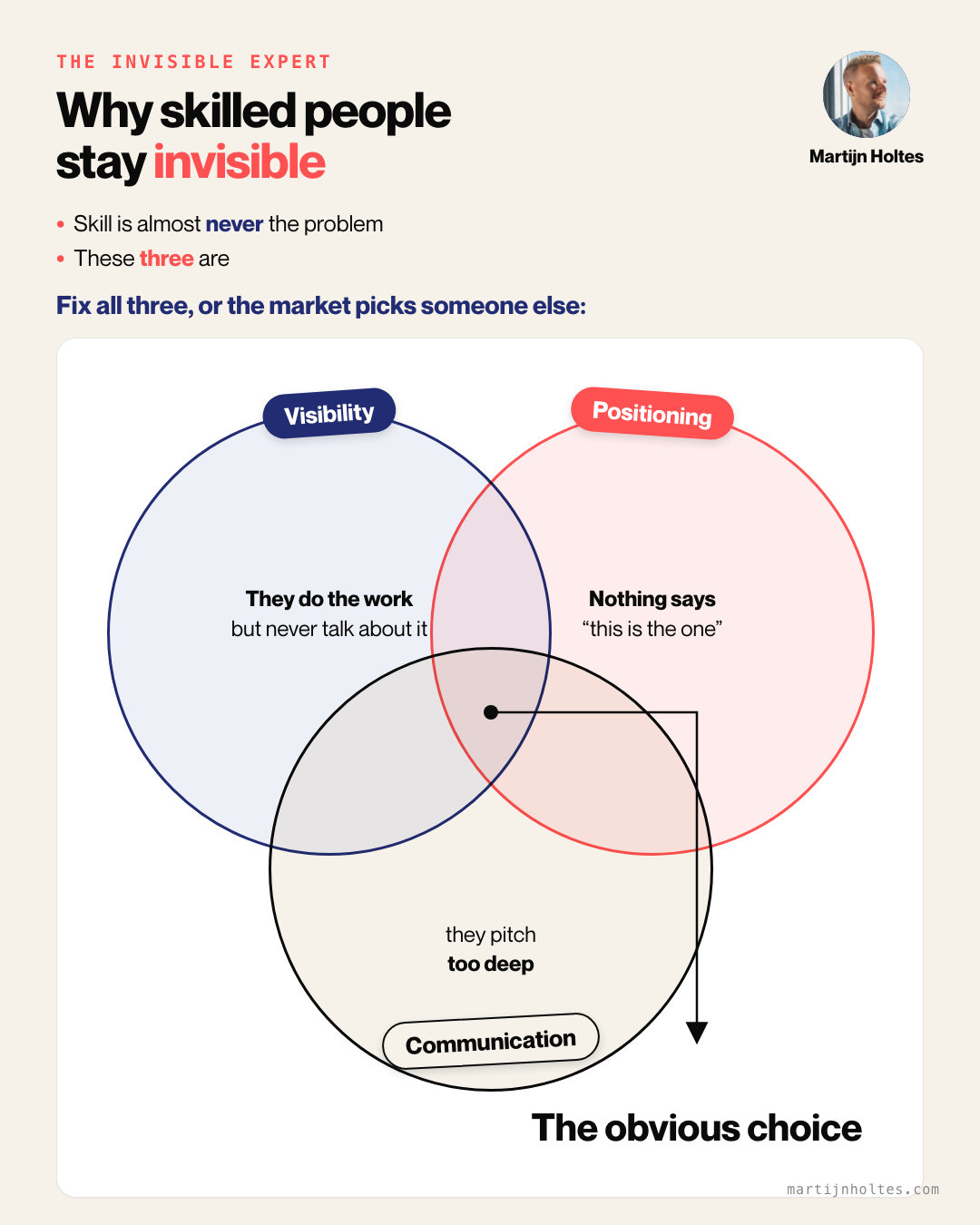
    Three things keep skilled people stuck, and most invisible experts are stuck on at least two.

    Visibility.
    They do the work but never talk about it, so the people who need them don’t know they exist.
    I know cause I am one of them 🫣

    They were told the work speaks for itself, but it doesn’t anymore.
    Quality is the baseline, not the differentiator, and your competitors who are half as good but twice as visible will win the deals. Not because they’re better, but because the buyer found them first and never looked further

    Positioning.
    Even when they’re visible, nothing marks them as the obvious choice.
    Same titles, same claims, same “passionate about helping businesses grow.”
    If I could swap your profile text onto your competitor’s page and nobody would notice, you don’t have a positioning problem, you have a positioning problem.

    Communication.
    They pitch at the wrong level, too deep inside their own expertise.
    When you get that good, you forget what it was like not to know, and your audience still needs you to close that gap. The expert who can’t be understood loses to the expert who can, every time, regardless of who knows more.

    Notice that none of these are fixed by posting more.
    That’s why “be more active on LinkedIn” is such useless advice: it treats a positioning problem as a volume problem.

    Three overlapping circles showing why skilled professionals stay invisible: visibility, positioning and communication

    Thought leadership vs personal branding

    People treat these as rivals, but they’re the same work from two sides.
    Personal branding is how you’re known. Thought leadership is what you’re known for.

    You can have a personal brand without thought leadership.
    A recognizable face, a polished profile, and nothing to say.
    You can’t have thought leadership without a personal brand, because a point of view nobody can find isn’t leading anything.
    In practice you build them together, and the point of view does the heavy lifting, because a strong opinion clearly argued is memorable in a way a nice headshot will never be.

    Thought leadership for B2B

    Good at the job, invisible to the people who need you?

    That’s fixable, and it doesn’t take a personality transplant. I’ve done this with 250,000+ professionals at 950+ companies.

    See how I build it

    Thought leadership vs influencer

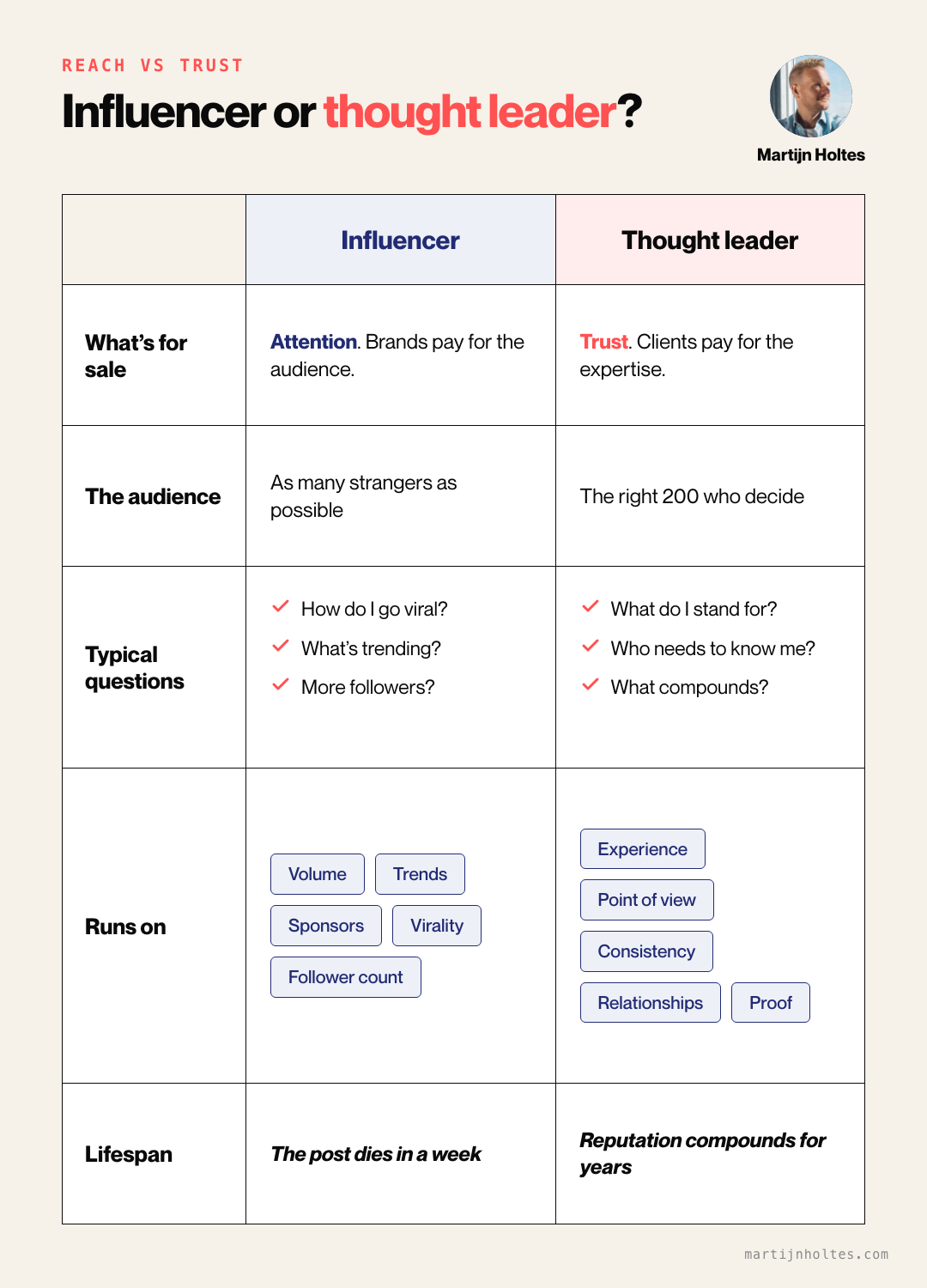
    An influencer’s audience is the product.
    They get paid because many people watch, and the topic can be sneakers today and software tomorrow.

    A thought leader’s product is trust.
    They get hired because the right two hundred people believe they understand the problem.
    Which is why follower count tells you almost nothing here.
    I know consultants with 3,000 followers who win seven-figure projects from their posts, and creators with 80,000 who can’t sell an e-book.
    Reach is about being seen by strangers.
    Thought Leadership is about being trusted by the people who sign.
    Different game, different scoreboard, and the biggest mistake in this whole subject is playing the first game while needing the results of the second.

    Comparison table of influencer versus thought leader: audience as the product versus trust as the product

    The mistakes that keep professionals unknown

    After working on this for many companies and with many participants on this for years, these are the top mistakes I noticed.

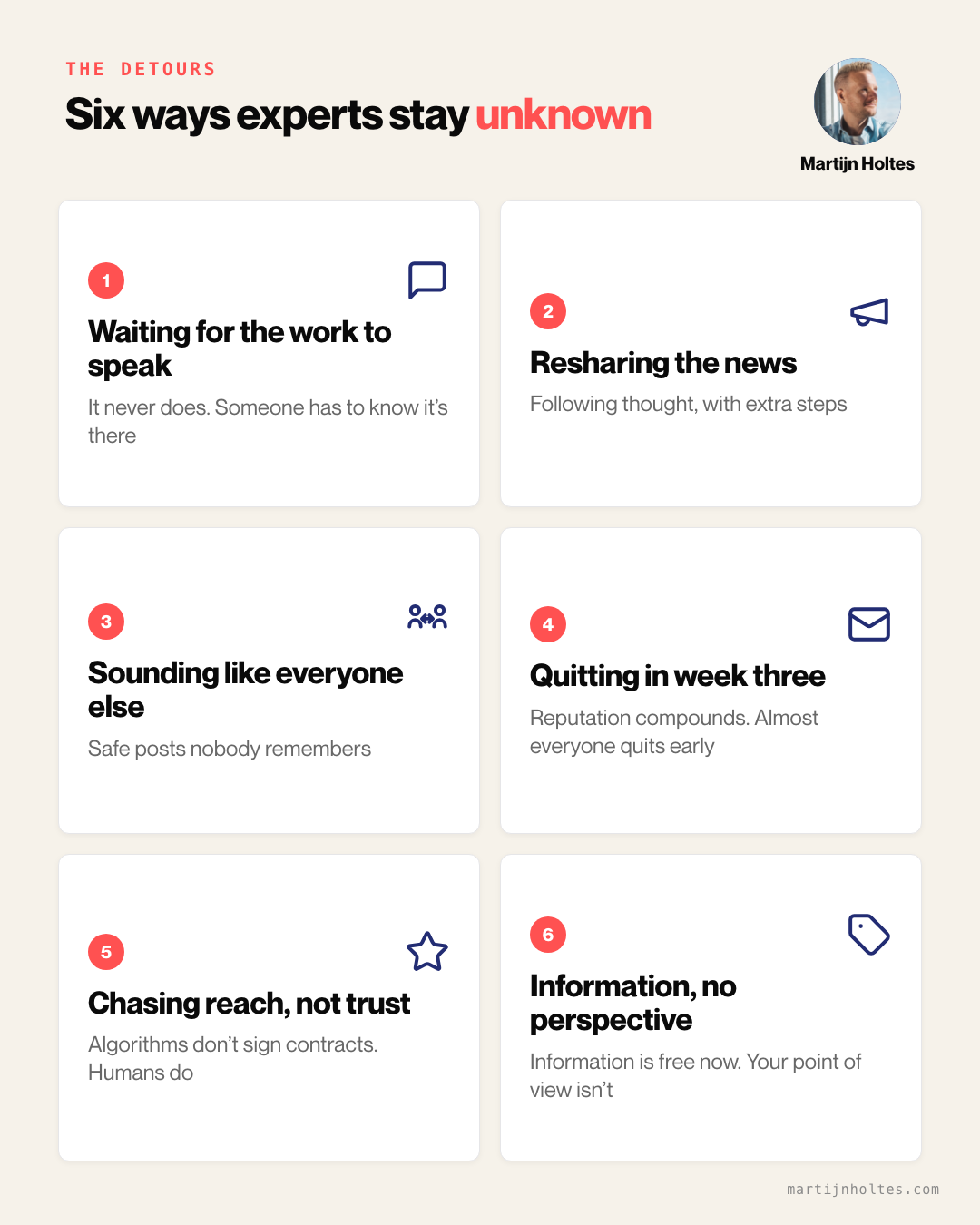
    Grid of six mistakes that keep skilled professionals unknown, from waiting for the work to speak for itself to sharing information instead of perspective

    Waiting for the work to speak for itself.
    It never does. Someone has to know it’s there. Your work can’t speak if nobody knows it exists, and the buyer’s shortlist gets built from what they can see, not from what’s true.

    Resharing industry news and calling it a day.
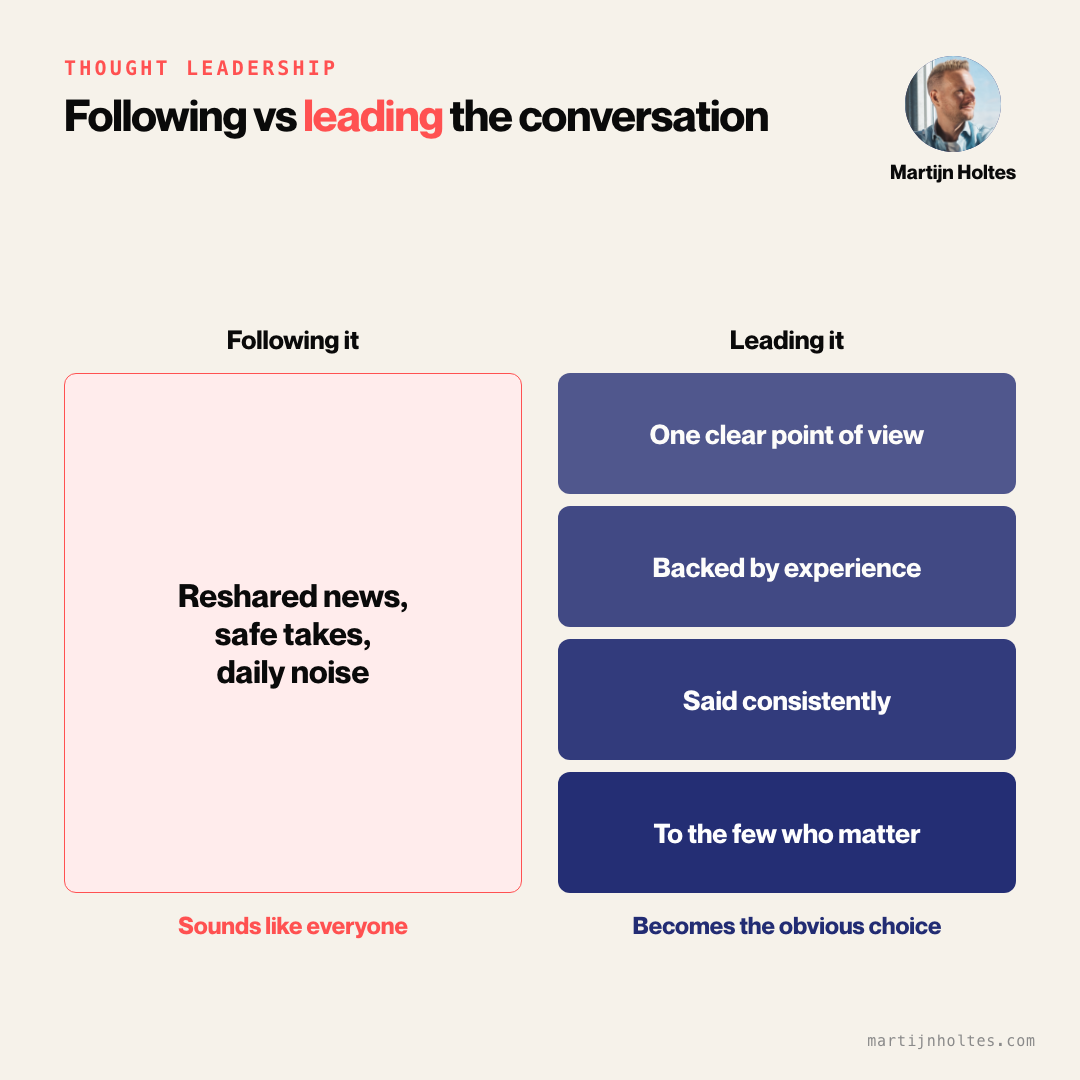
    Reposting someone else’s article with “interesting read!” isn’t leading thought. It’s following it, with extra steps.
    The value was never the news, it’s what you think the news means for your corner of the market. No take, no thought, no leadership.

    Sounding like everyone else.
    Safe, agreeable posts that nobody could disagree with, because nobody could remember them either.
    The profile that says “passionate about innovation,” the post that congratulates the industry on another insightful event. Most people hide their real opinion behind professional wallpaper, and then wonder why nothing comes back.

    Quitting after three weeks.
    You post four times, nothing comes back, and you conclude it doesn’t work.
    Reputation compounds slowly and then all at once, and almost everyone quits during the slow part. The silence at the start isn’t failure, it’s the buyers watching before they trust. They’re there. They’re reading. They’re not ready to wave yet.

    Sharing information instead of perspective.
    The how-to listicle that any competitor, or any chatbot, could have written. Useful, forgettable, and interchangeable. Information is free now. Your point of view isn’t, and it’s the only part worth publishing under your own name.

    Chasing reach instead of trust.
    A hundred thousand views from people who will never hire anyone do less for your business than one buyer who reads you for a month and then brings your name into a meeting. Algorithms don’t sign contracts. Humans do.

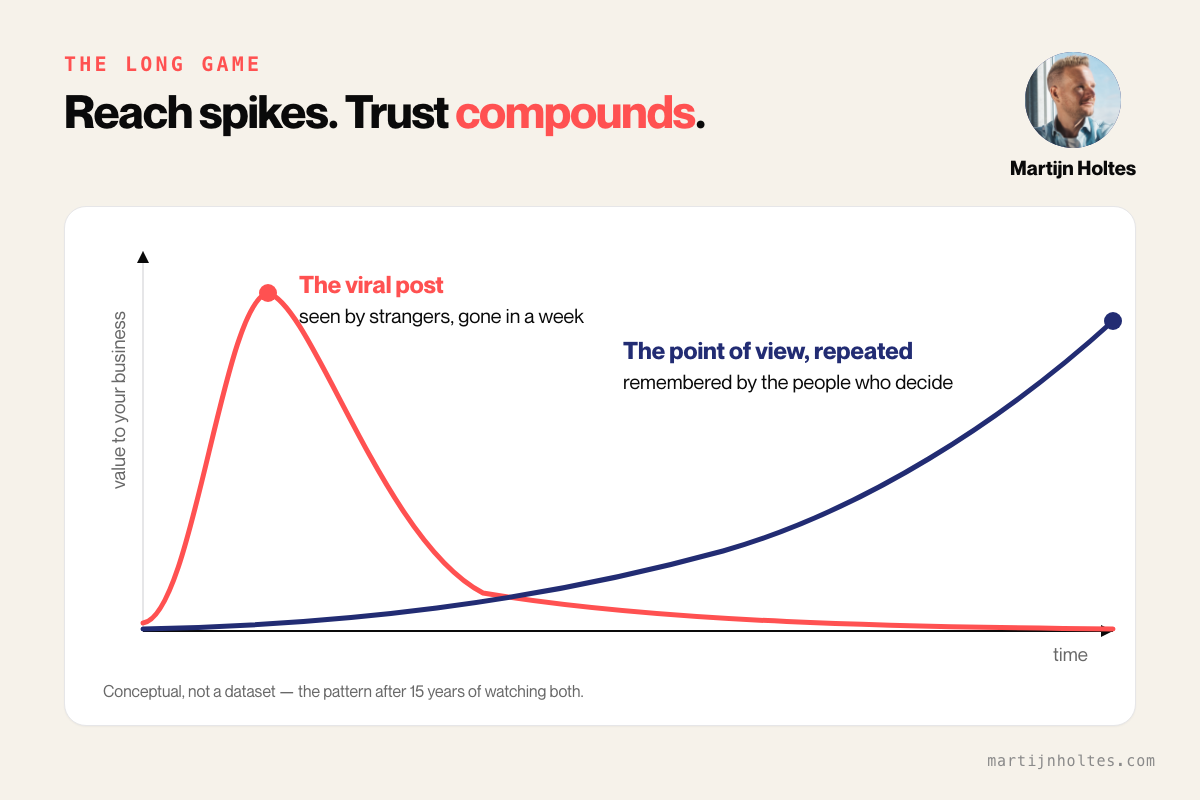
    Line chart: a viral post spikes and fades within a week while a repeated point of view compounds into trust over time

    What about a point of view feels risky (and what’s true)

    The most common pushback I hear specifically with larger companies or the ones in legal is :
    “I work with confidential things, I can’t share opinions online.”
    And there’s a milder version underneath it: “who am I to have a take?”

    Nobody is asking you to share client information or start fights online.
    A point of view is a clear answer to the questions your audience keeps asking.
    You already have those answers, you give them across the table every week.
    The only change is the size of the audience.

    I sat on my own point of view for years because I’d decided I wasn’t smart enough to have one.
    The questions I was embarrassed to ask turned out to be the questions half the room was too proud to ask, and answering them in public is now my job.
    The bar for a valuable opinion is lower than your imposter syndrome says, because most of your competitors aren’t saying anything at all.

    A model for Thought Leadership

    Most thought leadership advice tells you to post more.
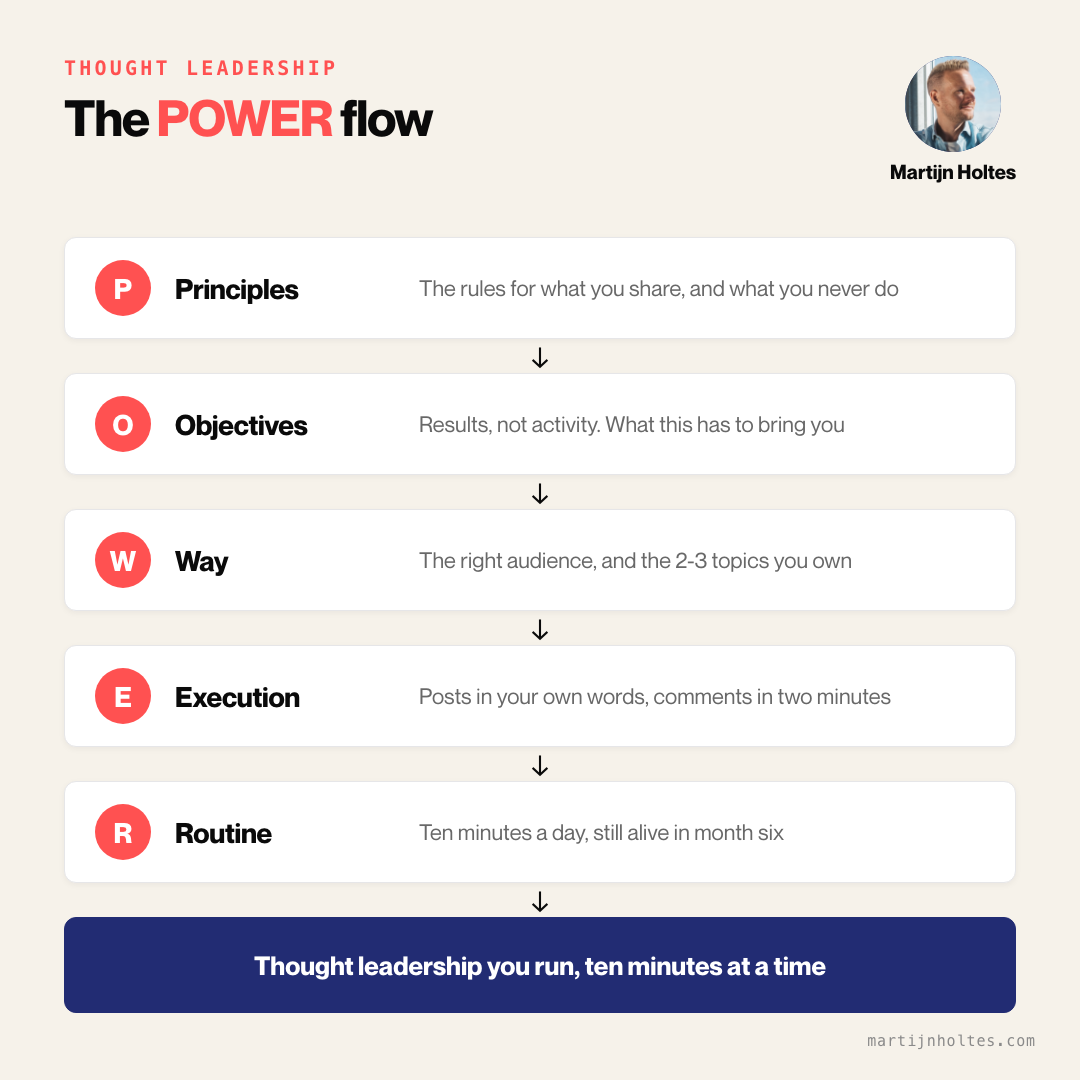
    That’s not how reputation works, so I created a five-step method I run with executives and independent professionals. In this order, because each step sets up the next.

    The POWER method flow: Principles, Objectives, Way, Execution, Routine

    Principles.
    The few rules for what you share, what you skip, what you never do, so you decide faster and stay consistent instead of debating every post. Without principles, every post is a fresh negotiation with yourself, and that negotiation is where most people quit.

    Objectives.
    What this has to bring you is a speaking gig, meetings with the right people, and a stronger reputation around your topic. Results, not activity, because if you can’t tell whether it was worth your time, you’ll stop.
    Likes are not an objective. Nobody ever paid a salary or invoice with a like.

    Way.
    Who you want to reach and the two or three topics you want to own. Narrow feels scary, but it’s exactly what makes people connect your name to something specific.
    Nobody refers to “someone who knows about business.”

    Execution.
    Simple formats that fit a busy week so you can actually do this in the long run.
    Posts in your own words, and comments that show your expertise in two minutes instead of two hours.
    A substantive comment under the right post, seen by the right people, does more than 5 superficial posts do.

    Routine.
    Ten minutes a day or more, whatever you can keep up, because this only works if you’re still doing it in month six. Intensity is what beginners bring. Consistency is what winners bring.

    Building Thought leadership is a system you run.
    Not a personality type you’re born with, and not a full-time job on top of your job.

    Where to start, before any framework

    You don’t need a strategy document to begin.
    You need a clear answer to the questions your audience keep asking.

    Write down the three questions colleagues, partners or clients ask you again and again, and what you tell them .
    That answer, the one you’ve given fifty times, is a point of view.
    You’ve been leading thought in private for years; you’ve only kept the audience to one person per meeting.
    Then say one of those answers in public this week, in the same words.

    Nobody’s grading your first posts, and the silence you’re afraid of is where everyone starts.
    The market wasn’t waiting for me to feel ready, and it isn’t waiting for you.
    It’s choosing from the people it can see, every single week.

    The POWER method

    Want this applied to your situation?

    Start with an intake call. No form, no gatekeeper. Tell me where you’re stuck, and I’ll tell you straight if I can help, and how.

    Schedule your intake call

    Questions I get about thought leadership

    What is thought leadership in simple words?

    Getting known for a clear point of view by the specific people who decide where opportunities go. You share what your experience taught you, consistently and in public, until the right people connect your name to your topic and come to you.

    What’s the difference between thought leadership and personal branding?

    The same work from two sides. Personal branding is how you’re known, thought leadership is what you’re known for. A brand without a point of view is a face without a message; a point of view nobody can find isn’t leading anything.

    Is thought leadership just marketing?

    It makes you easier to find and trust, so in that sense it works like marketing. The difference: it can’t be faked long. A point of view has to survive a knowledgeable audience week after week. The test: would this person say the same thing if nobody was watching?

    What’s the difference between a thought leader and an influencer?

    An influencer monetizes attention from a large audience, and the topic is interchangeable. A thought leader earns trust from a small, specific audience on one topic, and gets hired because of it. Reach versus trust, in short, and only one of them shows up in your pipeline.

    What does thought leadership look like in practice?

    A tax lawyer known for one sharp view on holding structures. A supply-chain director whose posts get forwarded inside client companies. A consultant whose name comes up in meetings she’s not in, because the decision-makers have been reading her for a year, in silence. Day to day it’s ten focused minutes: one clear take, a few substantive comments, repeated for months.

    What are the most common thought leadership mistakes?

    Waiting for the work to speak for itself, resharing news instead of taking a position, sounding like every competitor, chasing reach instead of trust, publishing information instead of perspective, and quitting in week three because reputation compounds slower than a dashboard refreshes.

    Do you have to post every day to be a thought leader?

    No. Saying more won’t get you known; saying one thing clearly will. A couple of posts a week plus real engagement beats daily volume, and the opinion you keep holding back is worth more than your next ten safe posts combined.

    How long does it take to build thought leadership?

    Months, not weeks. The first signals, profile visits from the right people, inbound questions, your name mentioned in rooms you’re not in, tend to show after two to three months of consistency, and it compounds from there. Reputation is the asset that keeps working after you stop paying for it, which is exactly why it takes longer than an ad.

  • Your follower count says nothing. That’s the whole problem.

    Your follower count says nothing. That’s the whole problem.

    At a networking event last month someone told me his follower count before he told me what he does for a living. Twelve thousand, he said, like it settled something. I asked him how many client conversations he had started this year and he changed the subject.

    I get why the number is tempting. Online, you can measure everything: clicks, views, reactions, and followers. Numbers feel like proof, and a big one feels like success. Nothing wrong with measuring. But the market has gone completely bananas on this one specific number.

    Let me just be real to you: no one gives a Fuck about your reach except you and your marketing department

    Anyone can fake the number

    Ten followers is worse than a thousand, sure. But a thousand followers tells you nothing, because a thousand followers is something you can buy for the price of lunch. Bots, engagement pods, a “like and win an iPad” campaign, take your pick. Ten minutes and a few euros and your number goes up.

    And those followers will never read a thing you write, never reply, never buy. Which was the entire point of showing up on these platforms in the first place. You wanted people who’d eventually work with you. You bought a number that guarantees the opposite.

    The “but a big following makes me look credible” argument doesn’t hold either. When did you last check the follower count of someone whose work you actually rate? Yes, that is correct, never! You trusted them for what they said, not for how many people were listening.

    The algorithm agrees with me

    A big, dead audience doesn’t just sit there doing nothing. It now even works against you.

    Every feed, LinkedIn included, decides who sees your post based on their interests, and on how the first slice of your audience responds. Post something and a fraction of your followers see it, and if they engage, the platform reads that as “this is worth showing to more people” and widens the reach. If they don’t engage, it stops showing you to anyone.

    So if you’ve padded your account with bought or bribed followers who feel nothing when you post, you’ve trained the algorithm to think your content is worthless. The number under your name went up, and the number of people who actually see your work went down. You paid to become less visible.

    Congratulations.

    What the number should be

    A follower count is only worth anything when you earned it, one real person at a time, because you said something useful and they wanted more. Those are the people who actually open what you write and reply, and some of them, when the timing’s right, book the call.

    And it’s usually smaller than you’d think. You operate in a narrow slice of the market, which means a “small” audience of the right few hundred people can put you in front of most of the buyers who matter. One person who runs the kind of firm you want to work with, reading your post and thinking “finally, someone who gets it,” beats ten thousand people you’ll never hear from again.

    This was true in 2022 and it’s truer now than it’s ever been. AI means anyone can flood the feed with infinite content and buy all the reach they want, so the numbers mean even less than they did. The one thing that can’t be faked, bought, or generated is a real person deciding they trust you. That’s the only metric that ends in a contract.

    So the next time you catch yourself checking the follower count, yours or anyone else’s, ask the better question: how many of them would take your call?

    Chase that number instead.

  • Why smart professionals stay invisible

    Why smart professionals stay invisible

    You read something, nod along, think “I should use that”, and then close the tab. By Friday it’s gone, buried under the next forty things you read.

    Most of us are knowledge workers and get paid for what we know. But what you know is trapped in your head and scattered across a hundred half-read articles, presentations and emails.

    The fix isn’t reading faster, or saving more. It’s what you do with the good stuff once you find it.

    For years I tried to find a system that would surface the right thing at the right moment. Bookmarks, saved articles, even writing it down in a journal, none of it did shit. Turns out reading something does nothing. You have to put it in your own words before your brain actually keeps it. The moment you rewrite an insight instead of just saving it, it clicks.

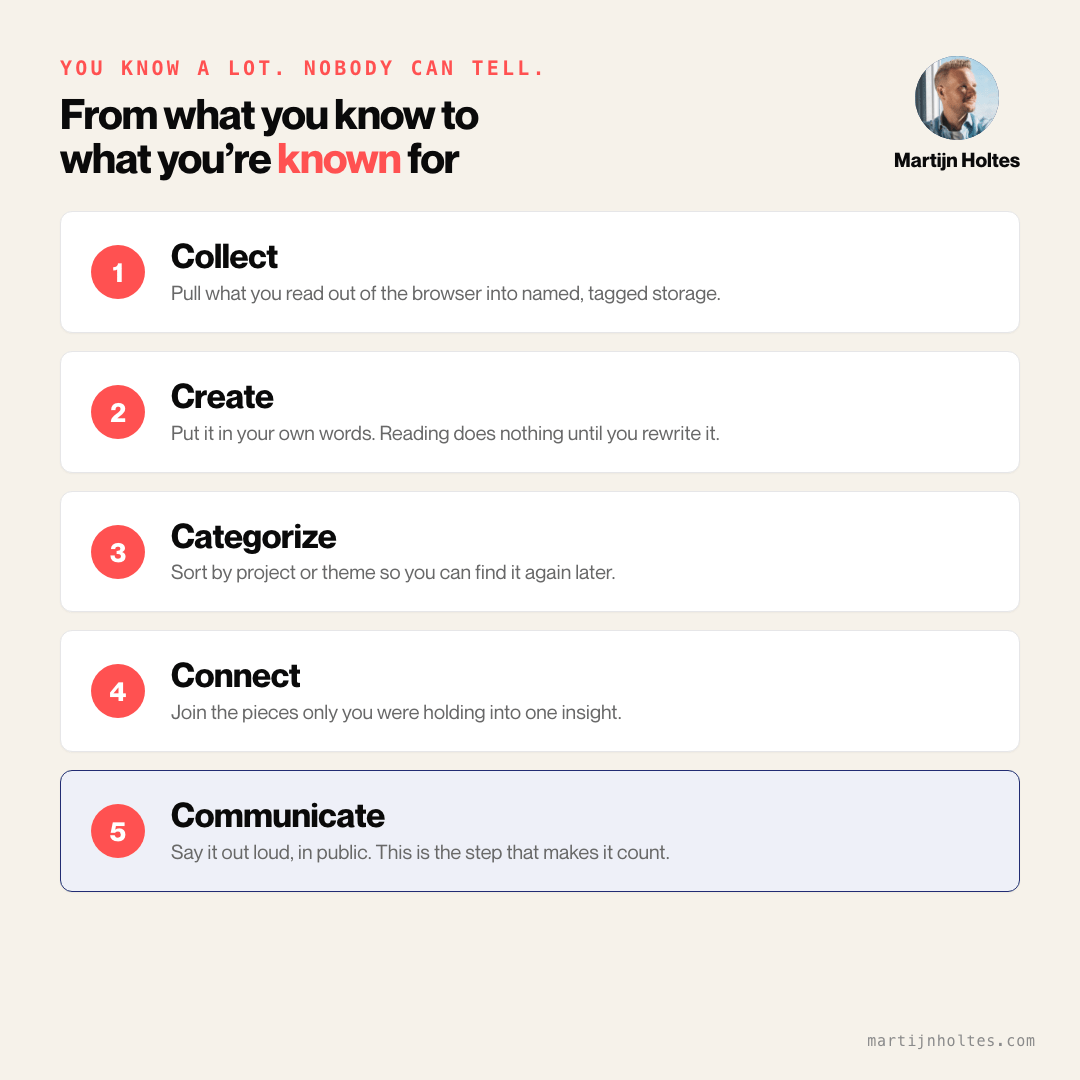
    This is what worked for me. Five moves, and they all happen to start with C.

    The 5 C’s

    Collect. Reading it doesn’t count. Collecting means getting it out of the browser and into a place with a name, so you’ll find it again. Bookmark, note app, whatever works. Read a sharp piece on client retention? Save it, tag it “client relationships,” done. If it lives in an open tab, it’s already lost.

    Create. This is where most people stop, and it’s the one that pays. Don’t just clip the article, react to it. Write down the key point AND how you’d use it on the thing you’re working on right now. A note is a conversation with your future self, so ask it a question, argue with it, connect it to your actual work. A quote you saved just sits there. A quote with your own take stapled to it is something you can use next week.

    Categorize. Information you can’t find again does nothing for you. Give every project and theme its own folder or tag so future-you pulls the right thing in ten seconds instead of ten minutes. It’s boring admin, and it’s the difference between finding the thing and never seeing it again.

    Connect. This is where it gets good. Take two things that were never near each other, a point from an article on consumer behavior and a number from your own last report, and put them side by side. New idea, one only you could have, because only you were holding those two particular pieces. This is the move AI can’t do for you, by the way. It can connect the average of everything ever written. It can’t connect the two things only you happen to be holding.

    Communicate. Knowledge grows when you give it away. Turn what you learned into a post, a talk, a memo to your team. Not only does it help other people, it forces you to actually understand the thing, and it does something else: it makes you the person known for this. The person who gets known isn’t the one who knows the most. It’s the one people actually hear from.

    The whole point is the last one

    You can nail Collect, Create, Categorize and Connect and still be invisible. A beautifully organized brain that never says anything out loud is a tidy way to stay unknown.

    The reputation, the referrals, the “we should get him in for this,” all of it comes from Communicate. That’s the step that turns private knowledge into a public position. And it’s the one people skip, because it’s the one that feels risky, and because the first four feel like progress while committing to nothing.

    So build the system, yes. Collect, create, categorize, connect. But if it all dies in your notes app, you’ve just built a sophisticated place to hide. Say the thing out loud. That’s where the knowledge finally starts paying you back.

  • Information is free now. Your point of view isn’t.

    Information is free now. Your point of view isn’t.

    For years I collected information like it was going to save me. I saved articles I never reopened. Built an extensive and way too complicated Notion database in a weekend and abandoned by Tuesday. I had 40 browser tabs I kept alive for weeks because closing them felt like admitting I’d never read them. I told myself I was “staying sharp.” The truth is I was like a fucking hoarder, piling up newspapers in his living room. And the worst thing is that under all that saved brilliance, my decisions got worse, not better.

    I thought that more information was more edge. Turns out that’s exactly backwards, and the last two years made it painfully obvious.

    Those brilliant insights you were saving are now infinite

    Information used to be scarce. That’s why we treated it like currency. If you knew the thing the other one didn’t, you had an advantage.

    That world is gone. AI will hand you a decent answer to almost any question in four seconds, then write you a thousand words on it, then make you a slide deck about it before you’ve finished your coffee. Content isn’t scarce anymore. It’s the cheapest thing on earth.

    And when something is everywhere and free, it stops being worth anything. Even the most valuable information you have is worthless within 24 hours, killed by a new study, a better take, or a world that moved while you were reading. Knowing things is no longer the job.

    Your brain didn’t get the memo

    Your brain is built to grab every scrap of information in sight, because for most of our human history missing a signal could get you eaten. That instinct doesn’t switch off because you work in an office now. So you feel the pull constantly, to check one more thing, read one more take, open one more tab. Those executive fuckers at social media platforms know this, so don’t blame yourself too hard for scrolling two hours

    You can feel it right now, probably. Some part of you is already halfway to a different screen.

    The result is that we treat information like an all-you-can-eat buffet and then wonder why we feel sick. There’s junk information and there’s healthy information, exactly like food, and most people are on a diet of crumbled up Doritos over a donut . Notifications, doomscroll, the rate of burnout and stress in knowledge work isn’t a mystery. We’re drowning a brain that was never built to swim in this.

    Piling up more won’t fix a problem caused by too much going in. You can’t out-read the firehose.

    The scarce thing now is a point of view

    So the edge isn’t information anymore. It’s your personal point of view.

    A lived through, structured way of looking at the world, so you can put information in context instead of just swallowing it. A clear signal on what matters and what doesn’t. Paul Saffo put it better, years ago: “In a world of hyper-abundant content, point of view will become the scarcest of resources.” He wrote that before AI could generate infinite content on demand.

    Think about what AI actually does. It takes everything ever written and averages it into a competent, completely generic answer. It’s the best information-processor ever built, and it has no point of view at all. Yes you can go crazy with skills, tone of voice docs, etc. etc., but since I have done all of this stuff, I can tell you for sure it still asks me for lived experience as an example when I write articles like this.

    The one thing AI structurally cannot do is the one thing that’s worth everything now. Have an experience-based point of view. The way you, specifically, see this problem after doing the work. The thing nobody can copy isn’t what you know, everyone can get that now. It’s how you see it.

    Perspective first, apps later

    Most people go wrong at exactly this point, and I went wrong here for years too. They decide they need a “system.” They open Notion, OneNote, or whatever tool got hyped that week, and they spend a month building an empty cathedral of folders they’ll never fill. The tool becomes the hobby. The thinking never happens. (Believe me I’ve been there and done that)

    Personal knowledge management (PKM) is real and it’s worth building. It’s the set of habits and tools that turn information into actual outcomes instead of a bigger pile. But it starts with your perspective, not with software.

    Before you touch an app, answer two questions on paper:

    • What projects are you actually working on right now? Everything. The new website, the spare room you’re renovating, the bike trip you need to plan. Write them all down.
    • What else in your life needs attention? Your health, your relationships, the interests you keep saying you’ll get to.

    Only once that’s on the page do you build structure around it. PARA (Projects, Areas, Resources, Archives) is a clean way to do that and worked for a while for me. But no matter what fancy system you use the order matters Reality first, the filing system second.

    Once you have the lens, the firehose changes. Instead of weighing every piece of information for importance, which is impossible, you filter everything through one question:

    Does this serve what I’m actually working on?

    Most of it doesn’t, and now you can let it go without guilt. The rest you keep, not because it’s interesting, but because it’s useful to you, now.

    Development isn’t a straight line

    One more thing, because it’s the part people skip. Having a point of view doesn’t mean deciding once and defending it forever. That’s not perspective, that’s ego.

    A point of view gets tested against reality. You put it into the world, watch what comes back, and adjust. You don’t find your angle in a seminar or a nice course, you find it by executing and seeing what survives. Growth doesn’t move in a straight line, it runs in loops, and the only way to run the loop is to actually do something with what you think.

    Which, ironically enough, is the opposite of hoarding. Hoarding is safe cause it feels like progress and commits to nothing. Putting your point of view out there, where it can be wrong, is scary. But it’s the whole game.

    Anyway. Go close some tabs.

  • How I use AI for content (and where it fails)

    How I use AI for content (and where it fails)

    A few weeks ago, someone sent me a LinkedIn post they’d written with AI and asked for feedback.
    It was clean, well-structured and had zero grammatical errors.
    And I had no damn clue what this person believed.

    The post could have come from anyone in their industry.
    Right keywords, popular hook format, call-to-action at the end.
    Checked every box.

    This is what happens when you give AI a topic but not a perspective.
    You get content that looks professional, but it’s contributing to AI slop.

    The problem isn’t the tool

    I use AI a lot.
    Even this article that you’re reading right now, Claude has helped me put it together.
    I know many experts say you shouldn’t use AI for content creation.
    But that’s sort of the same as saying you can’t use a car to go from A to B, because a horse would be more authentic.

    If you get poor results, you aren’t using the wrong tools.
    You are probably skipping the thinking that makes AI useful in the first place.

    For example:
    Level one: you ask AI to write a post about thought leadership.
    Level two: you type “thought leadership is not about being smart or knowing everything. It’s about having the courage to share your professional point of view. Please give me five angles on how I can approach this message.”

    Same tool, same topic, completely different output.
    The difference is the instruction.
    And the best instructions aren’t a prompt template from someone’s viral newsletter, they’re a clear picture of who you are, what you stand for, and who you’re talking to.

    p.s. please make sure you are at least at level two this week

    Where AI helps

    There is a ton of information and instructions out there on how you can use AI in your day-to-day workflow and operations.
    Below you’ll find some simple examples if you’re getting started.

    1. Research and inspiration
    I use AI to scan what’s happening in my industry. What questions are people asking? What topics are getting traction? What’s been said to death?

    I used to use Google Alerts for this, but now it’s a combination of Perplexity, Google Gemini, and Claude Code. It saves me hours of reading and surfaces things I would have missed on my own.

    2. First draft acceleration
    Once I know what I want to talk about, I use AI to build a first draft.
    I feed it my positioning statements, tone of voice guidelines and the summary of one of the topics from my research.
    The draft is never published, but it gives me something to react to instead of a blank page.
    I rewrite, rearrange, add my own examples and cut anything that feels like it could have come from anyone.

    3. Editing and formatting
    AI is good at tightening sentences, catching repetition and cleaning up flow.
    I use it as a second pair of eyes after I’ve written my version.
    One catch.
    Instruct your AI to only highlight the things that are wrong.
    Don’t let it rewrite your text, to make sure your writing stays your own.

    This is where AI adds the most value with the least risk.
    The thinking is done, the POV is mine, and AI helps clean it up.

    Where AI sucks

    1. Your backstory
    AI doesn’t have your experience.
    It doesn’t know the client who changed your mind, the failure that taught you more than success ever did, or the contrarian view you built over the years.

    Ask AI to generate your positioning, and you’ll get something that sounds reasonable.
    And means nothing.
    Your POV has to come from you.
    No shortcut.

    2. Your angle on a topic
    AI can give you both sides of an argument.
    What it can’t do is pick a side based on what you’ve lived through.

    Your take, the specific perspective that comes from years of doing this work, is the part that makes content worth reading.

    Hand that to AI and you’ve handed over the only thing that makes you different.

    3. Your engagement
    Comments, replies, DMs, real conversations.
    It is where trust gets built and there is no way to automate that.
    It’s the part where people are most tempted to use AI because it saves time.

    Don’t.

    The human part is the whole point.
    Someone leaves a thoughtful comment on your post and gets a robot reply?
    You’ve lost more trust than the post created.

    So where do you start?

    I wrote about this before, the Backstory framework.
    Six questions that help you find your Angle, Authority, and Voice.
    Those three statements are the foundation AI needs from you.

    Without them, you’re asking AI to guess who you are.
    And it will. It’ll guess wrong.

    The order that works

    1. Build your backstory (your positioning statements)
    2. Pick your angle on a specific topic
    3. Use AI to help you draft, research, and edit
    4. Keep your engagement human

    Most people start at step 3.
    Then we wonder why the output is so bad.

    That post someone sent me? It had everything except a point of view.
    That’s the one thing worth protecting.

  • Your backstory beats any AI prompt template

    Your backstory beats any AI prompt template

    Last month I was running one of my Thought Leadership training sessions. Fifteen executives, all with fifteen-plus years of experience.

    One of them asked:

    “Ok Martijn, I get it. Positioning myself and posting is important, but what should I post about and how? I don’t have time to dedicate one or two hours a week to writing, and I want to stay far away from those terrible AI-written posts.”

    So I asked why she was so interested in the industry, and what shaped how she sees it?

    Simple question, hard to answer.

    She had plenty of expertise and experience to build a point of view from. Nobody had ever asked her that question before.

    We start too quickly

    Everyone is rushing to use AI for personal branding. AI has all the answers, it’s easy to use, and let’s all agree we’re all a bit lazy. The problem is that optimising headlines and rewriting About sections for your profile won’t get you anywhere if you skip the hardest step.

    We go straight to “how do I look?” before answering “what do I want to be known for?”

    Skip that step and it’s like decorating your house before pouring the foundation. It looks nice until everything comes crumbling down.

    Your profile, your content, your conversations, they all need an anchor. Without it, you’re optimising without a solid foundation.

    That anchor is your backstory.

    What makes you different

    Your backstory isn’t your CV. It’s the collection of experiences that made you see your industry the way you do.

    • The client who changed your mind.
    • The failure that taught you more than any success.
    • The moment you realised everyone was approaching something the wrong way.

    That’s the stuff AI will never know about. And from what I’ve seen, it’s exactly what your audience is looking for.

    It’s difficult to get that backstory straight. Believe me, I’ve been struggling with it for the last three years. Last week I updated my personal website and finally had a breakthrough.

    The six questions I asked myself

    1. Turning Point
    “The moment that changed my perspective on my industry was when {blank}”
    Be specific. When did it happen? What shifted?

    2. Expertise
    “People often seek me out for guidance on {blank}”
    Not your job description but your expertise. What do people keep asking you about?

    3. Contrarian View
    “My experience taught me that most people get {blank} wrong because {blank}”
    What has your experience shown you that goes against common wisdom?

    4. Driving Mission
    “The industry challenge that energizes me to solve is {blank}”
    Not what you sell. What you care about fixing.

    5. Signature Insight
    “The one thing I want every professional in my field to understand is {blank}”
    If you had one message, what would it be?

    6. Leadership Topic
    “Based on answers 1 to 5, the industry conversation I should lead is {blank}”
    The conversation you want people to associate with your name.

    You don’t need to get this perfect on the first try. Write your answers, let them sit for a day, and then come back and sharpen them.

    From six answers to three statements

    Alright, that was the hard part, now the fun begins.
    Once you’ve answered the six questions, combine them into three positioning statements:

    Your Angle (Answers 1 + 3)
    Your turning point plus your contrarian view. This becomes the content that challenges your industry’s thinking.

    Your Authority (Answers 2 + 4)
    Your expertise plus your mission. This becomes your positioning, what you help people do and why.

    Your Voice (Answers 5 + 6)
    Your signature insight plus your leadership topic. This becomes the consistent message people hear from you everywhere.

    How this works in practice

    My example in social selling:

    My Angle:
    Early in my career, I realised selling should be about helping, not quota-chasing. Most people treat sales as a competition rather than a collaboration. My content challenges that assumption.

    My Authority:
    I help professionals build trust through social selling that prioritises human connection over automation.

    My Voice:
    As AI handles more of our processes, the professionals who win are those who create real human connections. That’s the conversation I want to lead.

    Three statements that guide my LinkedIn profile, my content, and who I connect with. When I’m stuck on what to write, who to connect with, or what to do, I go back to these.

    Do this before you touch AI

    AI is a tool. A good one, but it still needs guidance and direction. And the best direction isn’t a prompt template from someone’s viral post. It’s your positioning statements.

    From now on, use your Angle, your Authority, and your Voice in every chat. It will help you draft content that sounds like you. Definitely not perfect, but way better than a general “copy-pasted prompt” you found somewhere on the web.

    Your backstory is the angle AI needs. Without it, you’re outsourcing your thinking to a machine that doesn’t know you, your audience and your business.

    And outsourcing your thinking to AI? That is a stupid idea.

    The ones who stand out aren’t the ones with the best-optimised profiles, or the most polished message. They’re the ones who know what they stand for, and let everything else flow from that.

    Your backstory already exists. You’ve been building it for years. You haven’t written it down yet.

  • Your work isn’t the problem. Your audience is.

    Your work isn’t the problem. Your audience is.

    I’ve always struggled with things that seem obvious to everyone else. Simple instructions confuse me. Standard processes feel like reading a map upside down. In meetings, people explain straightforward concepts and I’m the one asking the “dumb” questions.

    For most of my life, I thought something was wrong with me. Turns out, I was playing in the wrong rooms.

    I see patterns nobody else sees. I connect ideas from completely different fields and find something new in the middle. I pick up on things that are invisible to others. And I do that because of how my brain works, not despite it.

    Two years ago I got diagnosed with ADD, and something clicked. Your value isn’t inherent. It’s defined by context.

    A violinist in a metro station

    In 2007, someone ran a social experiment with Joshua Bell, one of the finest violinists alive. He plays with the world’s best orchestras. His performances sell out concert halls where tickets cost hundreds of dollars. I’m not much into his music, but that doesn’t matter.

    For the experiment, Joshua took his $3.5 million (wtf) Stradivarius into a Washington D.C. metro station during rush hour and played for 45 minutes.

    Same piece he was going to play at a concert a few days later. Same instrument. Same skill.

    A few people paused briefly. Some dropped pocket change. Most walked right past without a second glance. Total earnings: around $32.

    Three days later, the same Joshua played the same music on the same violin in Boston. Tickets sold for over $100 each. He sold out the theatre.

    Quality doesn’t speak for itself

    I think about this experiment a lot, because it captures something I’ve experienced myself, and something I see in almost every professional I work with.

    We want to believe quality speaks for itself. That if we’re good enough, people will notice. That expertise rises to the top on its own. But it doesn’t work that way.

    Joshua’s genius didn’t change between the concert hall and the metro station. The notes were identical. But in one place people paid $100 to hear him, and in the other they threw quarters.

    The difference wasn’t him. It was everything around him.

    When I got my ADD diagnosis, I started looking at my own career through the same lens. I’d been playing my violin in a metro station.

    My ideas weren’t bad, or at least not all of them. But I was in rooms full of people rushing to get somewhere else. People who weren’t looking for what I had to offer. People who valued things I wasn’t good at and overlooked the things I was.

    The problem wasn’t my brain. The problem was the room.

    If you’re struggling in your business, or to get recognition for what you’re good at, I want you to consider something.

    Maybe your problem isn’t quality. Maybe you’re a genius playing the wrong room.

    The context

    Where are you presenting yourself? Joshua Bell, in the metro station, was surrounded by rushed commuters. The environment said: this is background noise, keep moving.

    The concert hall said something else. Elegance, comfort, a program explaining what you were about to hear. Pay attention. This matters.

    Are you trying to build authority in spaces designed for quick consumption and endless scrolling? Are you pitching to people who are mentally rushing somewhere else? The same message gets a completely different response depending on where you deliver it.

    The packaging

    How are you presenting yourself? In the metro station, Joshua’s music was free, so it read as worthless. No ticket, no program, no seat assignment. Nothing that said “this is premium.”

    The concert hall had a ticketing process and a dress code. People were probably excited for days. So by the time Joshua started playing, everyone was ready for something special.

    Are you selling your work, your services, your expertise as a commodity? Are you interchangeable with a dozen other options, or worse, with AI? Or have you thought hard about your own point of view, the thing that says: this is worth your full attention? The packaging tells people how to see you before you say a word.

    The audience

    Who are you presenting yourself to? The metro commuters were in a rushed mindset. Get to work, hurry up, don’t be late. They weren’t in the market for what Bell was offering.

    The people going to the concert had planned their evening. They’d bought tickets, dressed up, maybe booked dinner nearby. They showed up wanting to be moved.

    Are you pitching to people hunting for the fastest, cheapest option? People who want to tick a box as quickly as possible? Or are you spending time with people who want exactly what you’re best at?

    I’ll admit, coming to this realisation sucks. Sometimes we’ve spent years building relationships in rooms that will never value what we do best. Some people even feel disloyal walking away. But staying in the wrong room isn’t loyalty. It’s a slow professional death.

    Find the concert hall

    The answer isn’t to get louder. It isn’t to dumb down what you do. It isn’t to compete with people who don’t have half your skill. The answer is to change rooms.

    Looking back, I spent years trying to position myself in rooms that weren’t meant for me. Rooms where I was constantly trying to fit a brain that works differently into processes built for brains that don’t.

    Then I figured out there are other rooms. Yes, you’re right, I’m a bit slow getting this at 44.

    Rooms where the “weird” questions were valued. Where connecting unexpected dots was the whole point. Where “how does your brain even work?” became a compliment instead of a criticism.

    The internet is full of these rooms. Heck, even on LinkedIn there are tons of them.

    There are audiences waiting for exactly your perspective. Spaces where your kind of genius is precisely what people are hungry for.

    Don’t make yourself smaller. Find the concert hall. Build one if you have to.

    The people who need what you do are out there. They’re not the ones rushing through metro stations.