In masterclasses or training I give, at some point someone inevitably brings this up.
The rules and ratios of a content strategy.
We’ve talked strategy, positioning, content, building trust, and then a hand goes up: “But what’s the ratio? How many posts per week? Is there a formula?”
I understand where this is coming from because a formula feels safe.
If positioning and posting is math, you can’t fail at it; you can only miscount.
And the influencers and creators aiming solely at reach know we all love these kinds of over-simplified concepts.
Which is why the internet is full of rules with numbers in them: the 5-3-2 rule, the 4-1-1 rule, the 3-3-3 rule, the 80/20 rule, the rule of 7, the 95-5 rule.
People search for these, hoping one of them is the answer.
When I ran an SEO research round on this, the numbered rules were the single strongest pattern in what people ask. One of them even showed up in six of my fourteen searches.
I’ve spent 16 years testing this stuff in practice, so let me save you the detour.
Most of these rules are BS, wearing a lab coat.
But, and this is the interesting part, almost every one of them is wrapped around a concept that’s correct. The numbers are made up, but the ideas underneath mostly aren’t.
So let me help you with which ones make sense and which ones you can skip.
In this article
- The rule of 7: folklore, correct direction
- The 5-3-2 rule and the 4-1-1 rule: training wheels from the curation era
- The 80/20 rule: true, and true of everything
- The 3-3-3 rule: nobody knows what it is
- “Best time to post”: the little cousin of the rules
- The 95-5 rule: the one that survives
- What the numbered rules are selling
- What to use instead of a formula
- The rules, answered plainly
The rule of 7
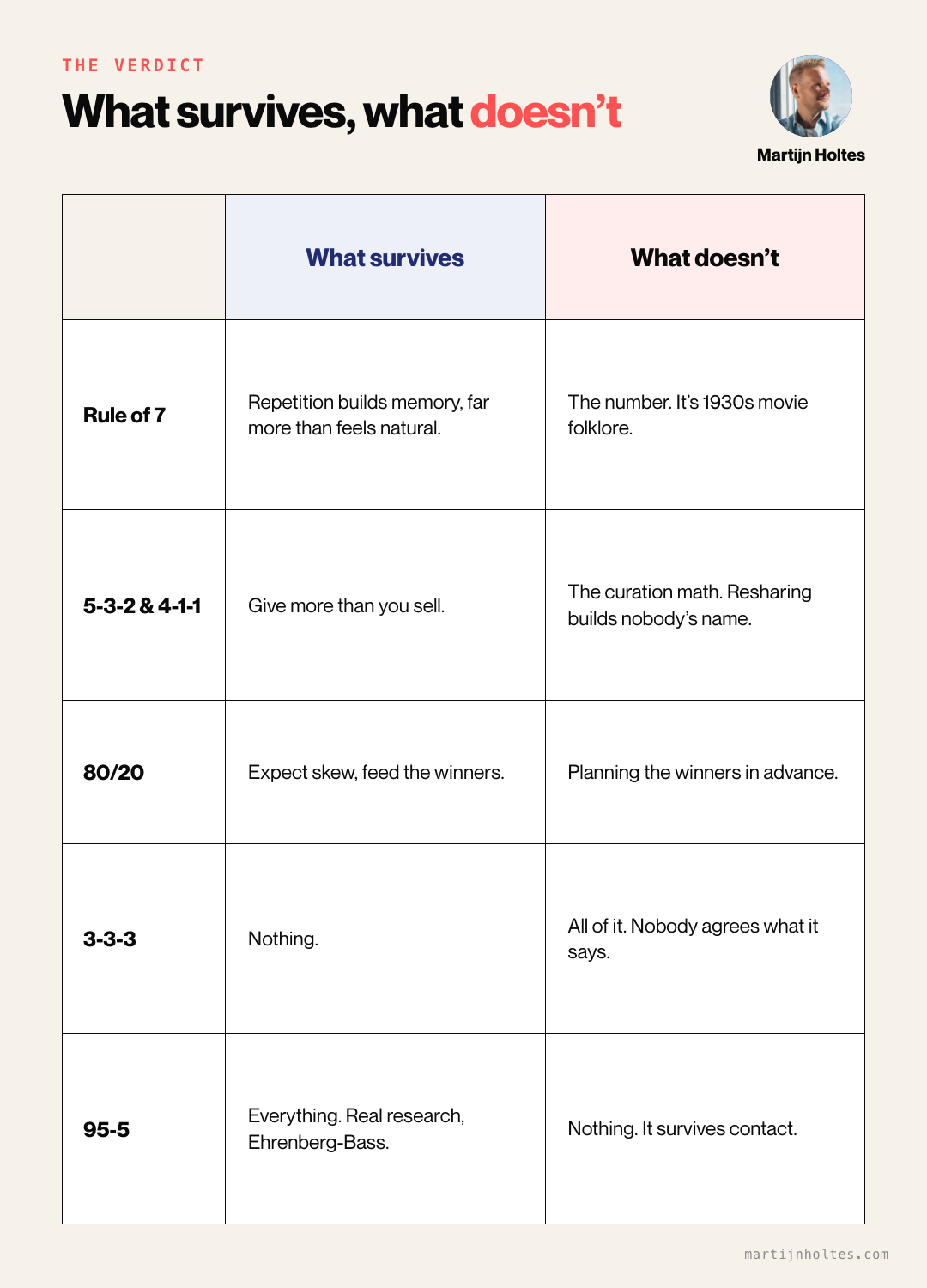
The claim: a buyer needs seven touches with your message before they act.
The origin is older than LinkedIn, older than your CRM, older than television: 1930s movie studios worked out that people needed repeated exposure to a film before they’d buy a ticket. Marketers adopted it, and the seven stuck because seven sounds precise.
Nobody has ever shown that the number is seven. It might be three for a familiar name and thirty for a stranger selling something expensive, and in a feed where your buyer scrolls past four hundred posts a day, “touch” itself is a stretchy unit.
But the direction is correct, and it’s the direction most of us ignore.
One post, one email or one meeting does nothing.
Familiarity is built by repetition over time, and the market rewards the name it has seen before.
In every group I trained, the person who posts once, gets silence, and concludes “LinkedIn doesn’t work for me” is the same person who’d never expect one call to close a deal.
The rule survives if you read it as “far more touches than feels reasonable.”
It doesn’t the moment you build a spreadsheet to track your results with a column that says 7.
The 5-3-2 rule and the 4-1-1 rule.
Both are content-mix recipes.
– The 5-3-2 rule says that out of every ten posts, five should be curated from others, three your own content, two personal.
– The 4-1-1 rule, born on Twitter in the content marketing world, says for every one post about yourself, share one relevant repost and four pieces from others.
The idea underneath is good, and it’s the idea that separates accounts people follow from accounts people mute.
Talk about yourself rarely, be useful often.
Nobody follows a walking brochure, and the account that’s 80% “we’re proud to announce” is the reason the mute button exists.
But the recipes themselves date from the curation era, when resharing other people’s articles counted as a content strategy.
That era is over.
Feeds are drowning in reshared BS, and reposting industry news with “interesting read!” builds nobody’s reputation, because the reader learns nothing about you from it.
What people need from you now is your take, your experience, your point of view, the one thing that can’t be curated from elsewhere.
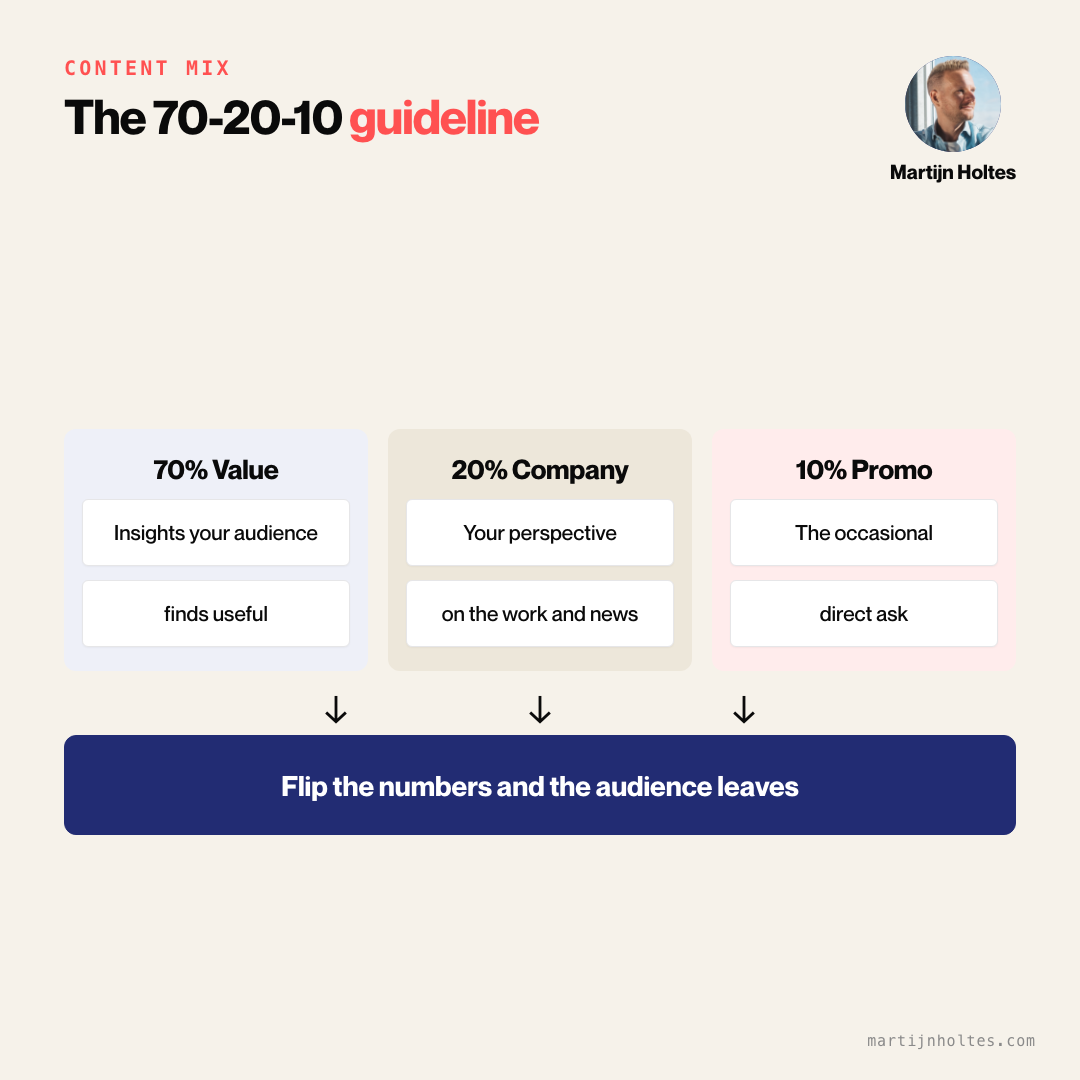
In my programs, I hand my clients a ratio.
✅ 70% insights your audience finds useful
✅ 20% company perspective
✅ 10% promotional.
The 80/20 rule
Pareto’s principle gets applied often to a content strategy.
80% value and 20% promotion. It’s the same as the 70/20/10 rule as above, still fine as a starting guardrail.
✅ A handful of your posts will produce most of your reactions.
✅ Of your five main topics, one will drive most of your engagement.
✅ A small slice of your network will generate almost all your opportunities.
My experience is that many people get obsessed by this 80/20 principle.
we search for winners when the research input is rarely enough to make those kinds of predictions.
The trick is to publish consistently enough that the winners have room to happen, then double down when you find them. The rule survives as a mindset. It fails as a plan, because you only learn which 20% mattered afterwards.
The 3-3-3 rule
This one is my favourite, for the wrong reasons.
The 3-3-3 rule was the single most-searched rule in my research round.
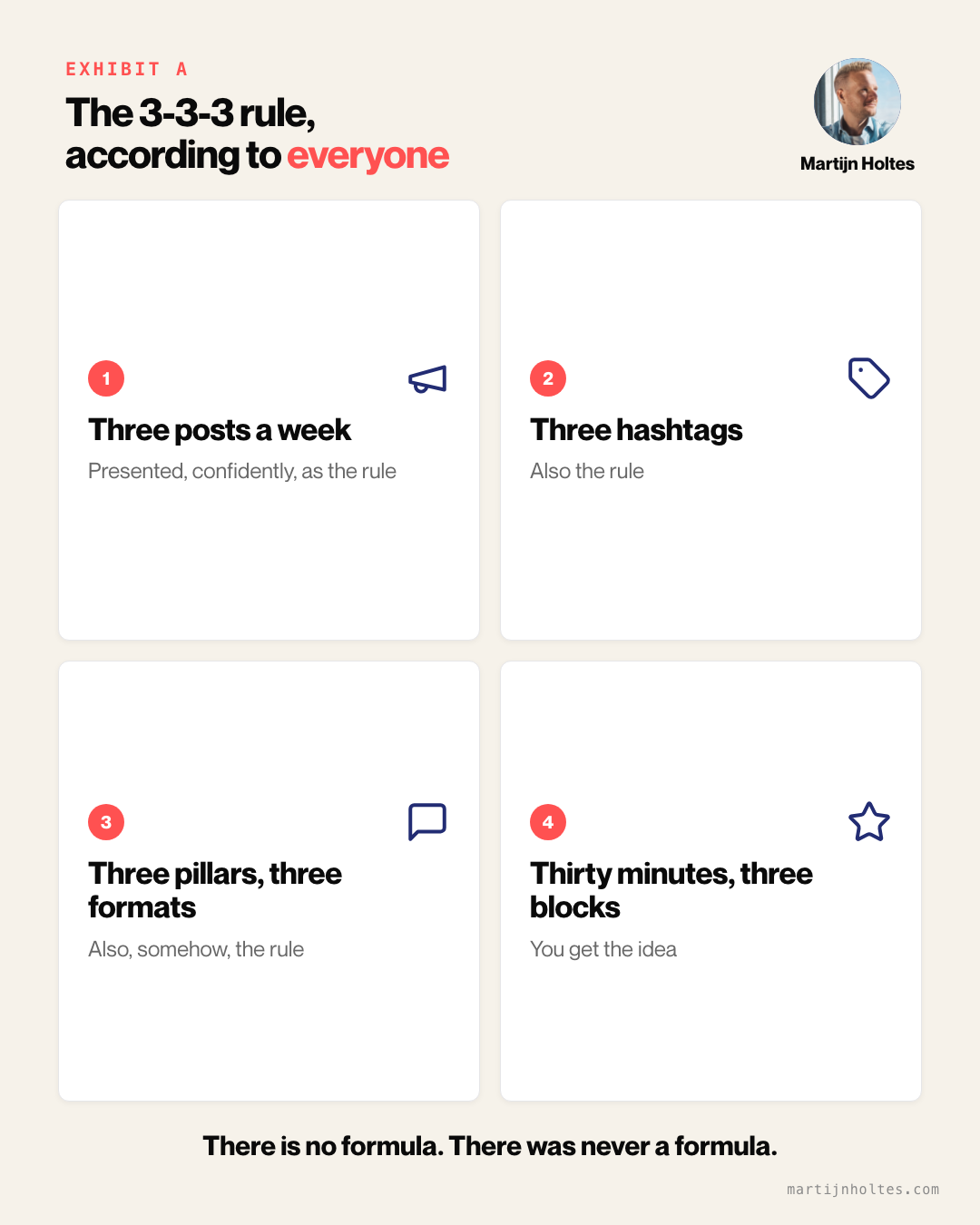
Ask five marketers what it says, and you get five answers.
Three posts a week, or three hashtags, or three content pillars in three formats, or thirty minutes split three ways.
I’ve seen every one of these presented, confidently, as The 3-3-3 Rule.
A rule that is popular with that little agreement on its content tells me something.
The demand was never for the rule.
It’s for certainty.
People aren’t searching “3-3-3 rule” because they saw it work.
They’re searching because someone mentioned it, and the idea that a secret formula exists, one everyone else already knows, is unbearable.
There is no formula. There was never a formula.
The people you admire, the companies that succeed are not counting to three.
“Best time to post”
Not a numbered rule, but it lives in the same drawer, and it’s the question I get asked a lot!
I spent my early years posting at the “optimal” times, and I can report the result made little difference.
My problem was never the clock.
My problem was that I sounded like everyone else who’d read the same free guide.
Timing has a small effect, but engagement does!
Post when your audience is awake and online, and be around in the first few hours to answer comments, because conversation helps a post travel.
The 95-5 rule
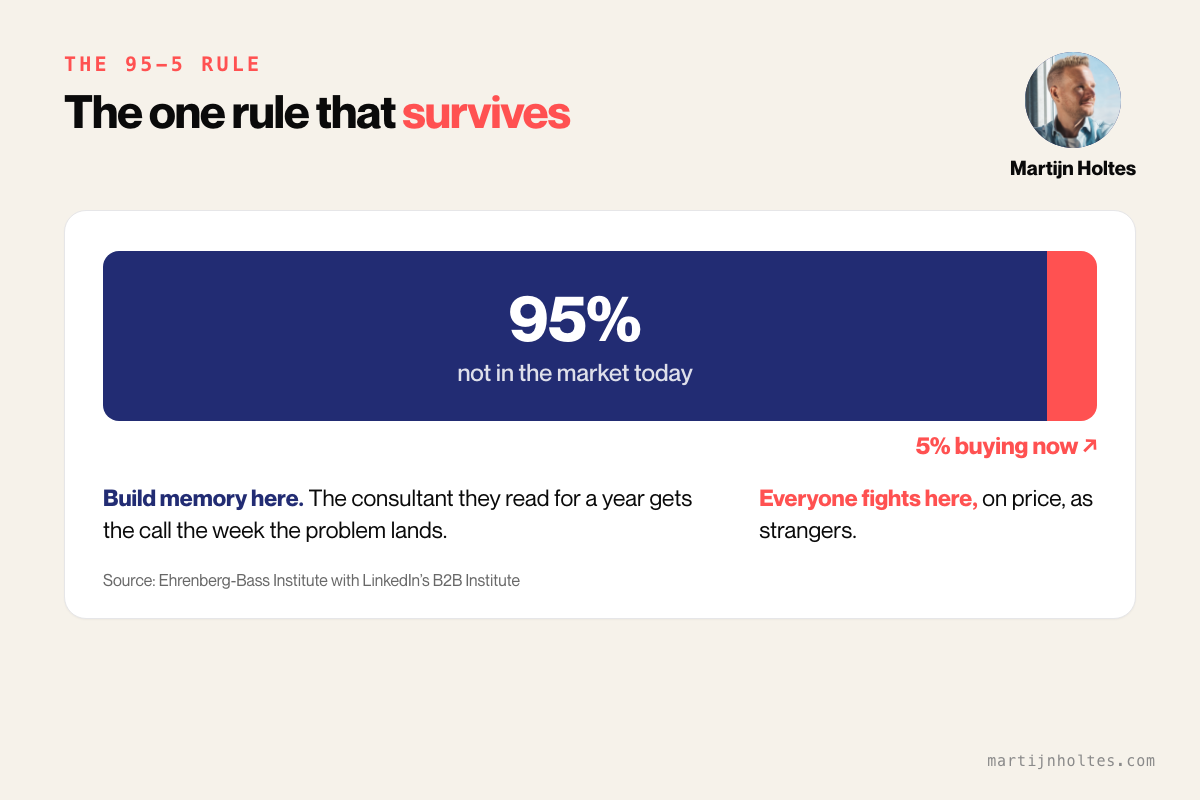
The claim is that at any moment, about 95% of your potential buyers are not in the market for what you sell.
Only around 5% are buying now.
It comes from the Ehrenberg-Bass Institute, working with LinkedIn and the underlying point holds up.
The overwhelming majority of people seeing your content today have no budget, no project and no intention of buying this quarter.
Most sales reps and business development professionals or entrepreneurs read that as bad news and post less.
It’s the best news on this list. And if you’re not into selling something, it’s also the case for attracting new talent.
It means the game was never converting this week’s audience, but rather being remembered by the 95% until they’re ready.
The consultant they’ve followed over the last year gets the call the moment an issue arrives.
The one who only showed up to sell to the 5% gets compared on price with four strangers.
It also explains why so many people quit LinkedIn “because it doesn’t generate leads.”
They measured a twelve-month game with a two-week ruler.
If 95% of your audience can’t or won’t buy right now, silence after a good post isn’t rejection.
It’s building a reputation of being someone that can be trusted.
The 95-5 rule survives because it never pretended to be a posting recipe.
It’s a description of how markets work, and everything I teach about trust and reputation stands on the same ground. You build the relationship before you need it, because when someone finally moves, they move toward the ones they already trust.
What the numbered rules are selling
Every one of these rules has a reasonable idea in it.
Repeat yourself more than feels natural, be useful more often than you sell, expect smaller results on the short term, accept that most of your audience isn’t converting today.
Every one of them dresses the idea up as a number, because “be patient and generous” doesn’t sound like good advice, but “the 4-1-1 rule” sounds like something a professional would know.
The number is the packaging, not the product.
The danger isn’t following the rules; it’s what following them does to your attention.
Marketing and sales teams will debate their content ratio for an hour, while nobody could name the three questions their buyers keep asking.
They were doing the accounting instead of the work, and the accounting felt like progress.
That’s the cost of formula-hunting.
It hands you something to optimise that isn’t the thing.
The rules were never the strategy.
I help companies align marketing, sales and employees around goals you can name.
See how that works
What to use instead of a formula
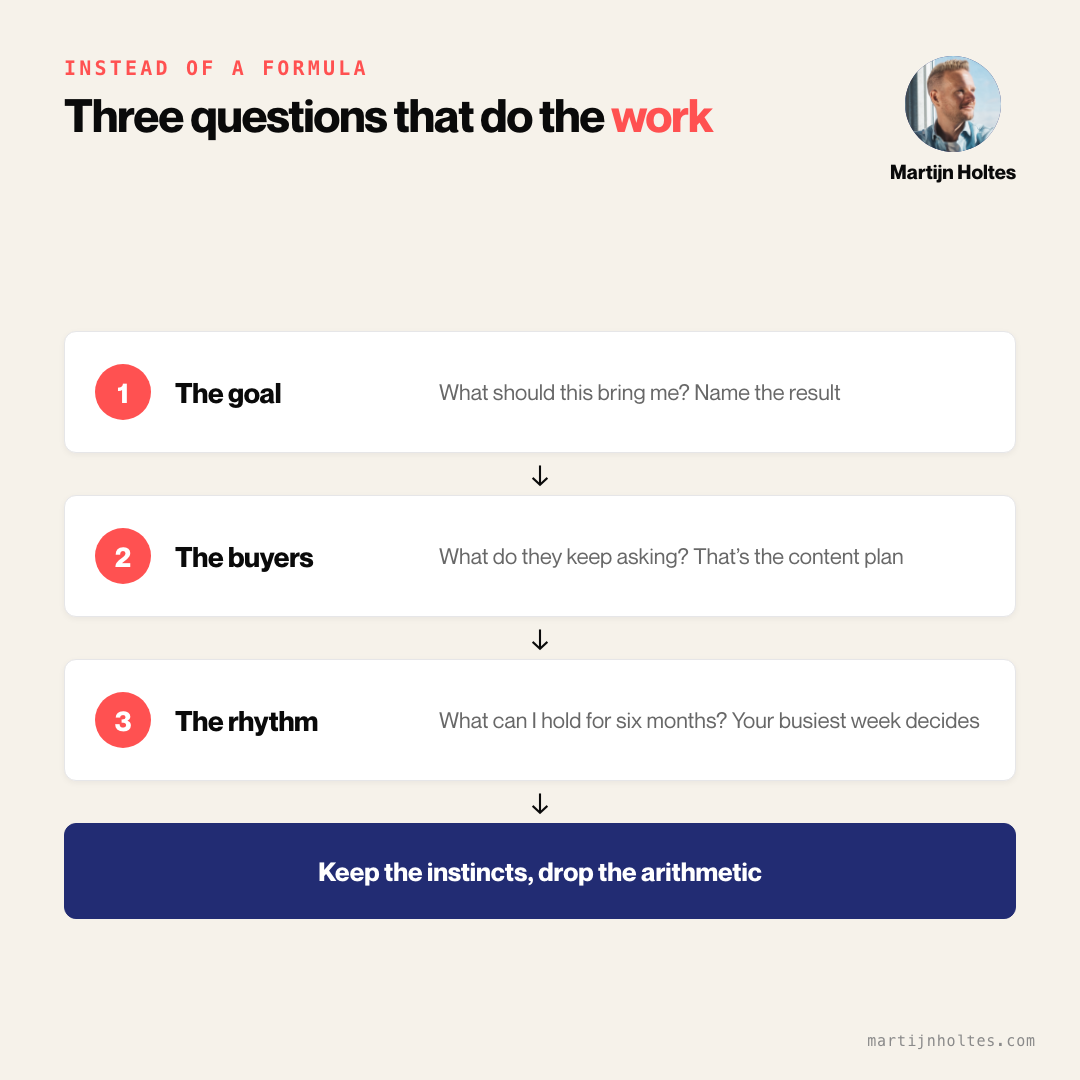
Three questions, and they do everything the rules promise.
What should this bring me?
Name the result. Inbound conversations, speaking gigs, candidates, being top of mind with twenty specific buyers.
A goal you can name beats a ratio you can count, because now you can tell whether any of this is working.
What do my buyers keep asking?
Their recurring questions are your content plan. Answer them in public, in your own words, with your own examples. Do that and your “content mix” sorts itself out, because useful is the default and selling becomes the natural result of it.
What rhythm can I hold for six months?
Not the rhythm of your most motivated week, the rhythm of your busiest one.
One post a week you can keep, beats five you can’t, because the 95% out there aren’t judging your frequency.
They’re noticing whether you’re still around when their moment comes.
Show up consistently, say something you believe in your own words, be useful to the 95% who aren’t buying yet, and sell rarely enough that people don’t flinch when you do.
Anyway.
If someone tells you they’ve cracked LinkedIn with a formula, ask them why they’re selling the formula instead of using it.
Want judgment instead of arithmetic?
I’ll bring 16 years of what held up.
Schedule your intake callThe rules, answered plainly
What is the 5-3-2 rule on LinkedIn?
A content-mix recipe: of every ten posts, five curated from others, three of your own professional content, two personal. The useful part is the proportion of giving to selling. The curation-heavy split is outdated; your own point of view now matters far more than resharing.
What is the 4-1-1 rule?
For every post about yourself, share one relevant repost and four pieces of content from others. Same family as 5-3-2: a guardrail against self-promotion overload, built for the curation era. Keep the generosity principle, skip the bookkeeping.
What is the 3-3-3 rule on LinkedIn?
There’s no agreed definition. Depending on who you ask it’s three posts a week, three hashtags, three pillars in three formats, or thirty minutes in three blocks. It’s the clearest proof that people search for certainty, not for a specific rule.
What is the 80/20 rule in LinkedIn marketing?
As a content mix: 80% useful, 20% promotional, a fine starting guardrail. As a description of outcomes: a few posts, topics and relationships will drive most of your results, and the skew is usually stronger than 80/20. Expect it, and feed what works.
What is the 95-5 rule?
Research from the Ehrenberg-Bass Institute with LinkedIn’s B2B Institute: roughly 95% of your potential buyers are not in-market at any given moment, only about 5% are buying now. The consequence: build trust and memory with the 95% so you’re the first call when they enter the market.
What is the rule of 7 in marketing?
The old claim that buyers need seven exposures to your message before acting, dating back to 1930s movie marketing. The specific number is folklore, but the direction is right: familiarity takes far more repetition than most professionals are comfortable with.
Does the best time to post on LinkedIn matter?
Marginally. Post when your audience is awake and be available in the first hour for the conversation. Beyond that, timing differences are noise, and no posting schedule fixes content that sounds like everyone else’s.
Do LinkedIn posting formulas work?
The directions inside them work: consistency, usefulness, patience, restrained selling. The precise numbers don’t, and nobody serious is counting. If a formula gets you started, use it as training wheels, then replace it with three questions: what should this bring me, what do my buyers keep asking, and what rhythm can I hold for six months?